O Mere Shah-e Khuban Lyrics and Translation: Let’s Learn Urdu-Hindi

Clad in a tight kimono, Asha Parekh prances about Japan in Love in Tokyo (1966)

Next we will explore the lyrics and translation of the hit song “O Mere Shah-e Khuban” from Love in Tokyo. Shot on location in Japan shortly after the 1964 Olympics, Love in Tokyo (1966) is nothing short of an “exotic” tourist fantasy. The film is one of a trilogy of films I put in this category from the same era with Night in London (1967) and An Evening in Paris (1967). These are movies that dazzled Indian audiences with a glimpse into a lifestyle and culture outside the familiar homeland, and on occasion were almost laughably politically incorrect. Love in Tokyo stars Asha Parekh (playing an Indian woman raised Japanese) and Joy Mukherji who finds himself in Tokyo for reasons almost too complicated to discuss here (or probably anywhere outside a psychiatric ward).

But say what you want about the worth of the film’s plot, Love in Tokyo’s soundtrack is wonderful (the cheesy title song grows on you in spite of its lyrics). The real gem of the album is the love ballad “O Mere Shah-e Khuban”, with music by Shankar-Jaikishen. Lata Mangeshkar and Mohammed Rafi each sing a version at different points in the film. I naturally prefer Rafi’s because of that deep sublime silky voice, but it’s open for argument. The lyrics have some rare Urdu vocabulary and is an example of probably the only time you will ever hear the “h” in “shaah” actually pronounced because of the “-e-” conjunct that follows! This Hasrat Jaipuri ghazal harkens to a famous couplet of Mughal era poet Momin Khan Momin: “Tum mere paas hote ho goyaa/Jab koi doosraa nahii.N hotaa.” The lines can be interpreted on several levels, literal and spiritual, and are a beautiful example of classical Urdu poetry’s rich legacy in contemporary music.

I loved the intro music to this song so much, I actually featured it in my Harvard thesis film. Enjoy our English translation of “O Mere Shah-e Khuban” below!

O Mere Shah-e Khuban Lyrics and Translation:

O mere shaah-e khubaa.N, o meri jaan-e janaana
Oh my beautiful ruler, the love of my life
Tum mere paas hote ho
You are beside me
Koi doosra nahi.N hota
Let no one else take your place

O mere shaah-e khubaa.N…

Kab khayaalo.N ki dhoop dhalti hai
When the sunlight fades from my thoughts
Har qadam par shamaa si jalti hai
Then with every step there is a light as if from a candle
Mera saayaa jidhar bhi jaataa hai
For wherever my shadow goes
Teri tasveer saath chalti hai
It goes with your image

O mere shaah-e khubaa.N…

Tum ho saharaa mei.N, tum gulistaan mei.N
You are in the desert, you are in the rose gardens
Tum ho zarron mei.N tum biyaabaan mei.N
You are in every particle, you are in the wilderness
Mai.N ne tumko kahaa.N kahaa.N dekha
I have seen you everywhere
Chhupke rehte ho tum rag-e-jaan mei.N
You are hidden within my very veins

O mere shaah-e khubaa.N…

Meri aankho.N ki justaju tum ho
You are that for which my eyes are searching
Iltijaa tum ho, aarzoo tum ho
You are my prayer, and you are my desire
Main kisi aur ko to kya jaanuu.N?
What could I know about anyone else
Meri ulfat ki aabroo tum ho
The honor of my love lies with you

O mere shaah-e khubaa.N…

Glossary:

Shaah: ruler; khubaa.N: radiant, beautiful; janaanaa: beloved; doosra: second, other; dhoop: sunlight; shamaa: light, candle; saayaa: shadow; tasveer: photograph, image; saharaa: desert; gulistaan: rose garden; zar: particle; biyaabaan: wilderness, desert; rag: vein, vessel; justaju: quest, search; iltijaa: request, prayer; aarzoo: desire; ulfat: love; aabroo: honor

As a bizarre bit of trivia, in the film Asha Parekh often does her hair in cutsy ponytails with a beaded elastic. The hairdo became known as “The Love in Tokyo” and was enjoyed a brief period of popularity among the masses. But men, don’t think you’re above this sort of fad–that classy plaid fedora from Jewel Thief? Sold-out in Indian stores across the nation after the film’s release. So let’s just try be grateful for what dignity we have.

Sweet ‘do, Asha. You totally blend in now!

-Mrs. 55
Two or Three Things I Know about Mira Nair: Thoughts from a Former Intern

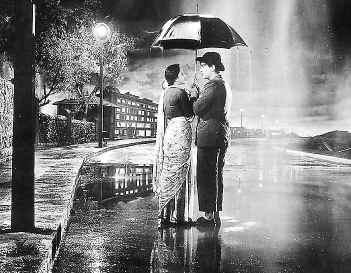
Nargis and Raj Kapoor in one of the most iconic shots of classic Indian cinema from Shree 420 (1955)

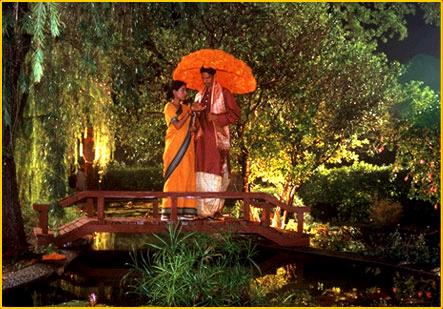
A scene from Mira Nair’s Monsoon Wedding (2001) inspired by Raj Kapoor’s classic

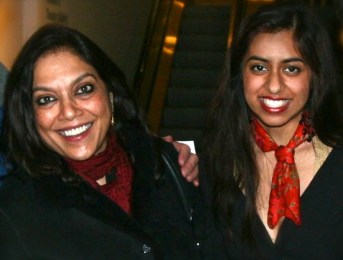
After the summer of my sophomore year, I was fortunate enough to intern with my favorite contemporary director Mira Nair. Both of us had studied film production at Harvard University and incidentally under the same professor! I first met Mira at his film screening at the Museum of Modern Art in New York City when I spotted her in the audience. My heart was beating so fast, I could hardly sit still through the screening. After the show, I gave her my impromptu elevator speech and joined the crew at Mirabai Films that summer!

Intern Mira Nair

Mira Nair and I at the MoMA my sophomore year. Note the glazed look in my eyes. Best day ever!

I was twelve years old when I saw Monsoon Wedding (2001) and have yet to find a movie from my generation that I love more. Mira’s other films include Vanity Fair, Salaam Bombay, The Namesake, Kama Sutra, and Amelia, but what does any of this have to do with old Hindi cinema? I want to talk about a side to her movies that you may not have been familiar with—that is, the impact of classic Bollywood on her work.

Perhaps you can recall that scene from Monsoon Wedding in which the wedding planner marries the housemaid beneath an umbrella. Look familiar? It should! Mira was directly inspired by Raj Kapoor’s famous song “Pyaar Hua Iqrar Hua” in directing this scene. Like Nargis and Raj Kapoor walking together on a rainy night, huddled together beneath an umbrella, Mira’s characters strike the same pose to celebrate their romance at the height of the Indian monsoons.

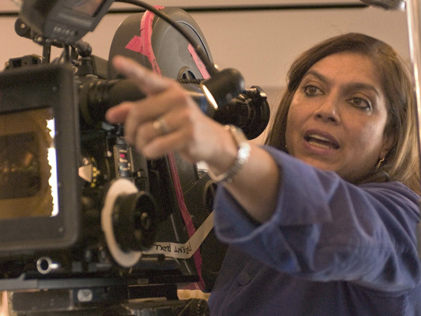
On-set and behind-the-camera with Hollywood director, Mira Nair.

In the front lobby of Mirabai Films hangs an original hand-painted movie poster of Aurat (1940), Mehboob Khan’s little-known precursor to the later smash-hit Mother India (1959). Its relative obscurity (and the eagerness to explain) brings a pride that can only be known to a fellow old Bollywood fanatic. By her desk is a beautiful and fascinating work of photography taken of the interior of R.K. Studios. Mira once explained how the studio in her photograph seems so unassuming and bland, but there, in an inconspicuous back wall besides an empty soda bottle hangs a small, telling picture of the greatest showman of India—Raj Kapoor himself. Despite his wealth and glamour, he and his colleagues maintained an inspiring sense of humility throughout his career that inspired hers.

If you’re looking for more celebrity interest, there is a great scene in her film, Vanity Fair (2004), in which the heroine (played fearlessly by Reese Witherspoon) makes an ill-received attempt to blend in among a high-class dinner party. Guess what? The scene was inspired by none other that the classic song Jaane Woh Kaise from Guru Dutt’s classic Pyaasa! In fact, Mira love it so much and wanted to make sure she captured Dutt’s spirit so precisely, that she got the whole cast together and watched Pyaasa for a movie night before the shoot. You heard me, people. If you have yet to watch Pyaasa yourself and are still looking for reasons to make the commitment, try this: Reese Witherspoon has seen it and you haven’t. Enough said.

Guru Dutt makes the room incredibly uncomfortable in Pyaasa (1957), an inspiration for Reese Witherspoon’s future character in Vanity Fair (2004).

And did you know Mira was very close friends with bold auteur Satyajit Ray? Mira’s favorite of his films include The Apu Trilogy and Days and Night in the Forest (1970), the latter of which was actually screened at the Harvard Film Archive last year with Sharmila Tagore in person! (I obviously had front row seats, almost underwent cardiac arrest upon seeing Sharmila in person, and begged for an autograph that is now framed on my desk. But that’s neither here nor there.) In fact, after growing up on these films, Mira came to respect Sharmila so much as an actress, and eagerly cast her in one of her first indie films called Mississippi Masala (1991)!

There are a million other ways old Bollywood films have influenced her work, and I have highlighted only a few that I know from working with her personally. Watch her films and let us know which others you can spot! Until then, put Pyaasa on your early Christmas list.

-Mrs. 55

Lata Goes Cabaret!

A true fan of old Bollywood movies is all too familiar with the wonderfully awkward genre of songs known as cabaret numbers. Don’t even pretend like you don’t know what I’m talking about. Here at Mr. and Mrs. 55, we don’t judge our readers based on their taste – even if this includes a love for uncomfortably suggestive lyrics, flamboyant dance moves, and scantily clad B-grade actresses. Despite my initial aversion to these types of songs, I have learned to appreciate cabaret numbers for their showiness and sheer entertainment value.

Helen sizzles in her portrayal of "aa-jaan-e-jaa.n" on screen in Inteqaam (1969)

In terms of vocals, the queen of cabaret numbers in those days was the ever-versatile Asha Bhonsle. Asha’s voice was perfect for this type of song; she had the right combination of seduction, silkiness, and charm to execute cabaret songs with finesse.  In fact, Asha’s skill in performing cabaret numbers (think piiyaa tuu ab to aajaa from Caravaan and yeh meraa dil from Don) is one way in which she carved a niche for herself in the industry to emerge from the shadows of elder sister Lata Mangeshkar. However, although Asha was the dominating force when it came to the cabaret genre, you may be surprised to know that Lata also sung her fair share of vamp songs in films. Generally known for her conservative and purist reputation, Lata’s take on this genre is markedly different from her sister’s style: she avoids Asha’s over-the-top histrionics in favor of a more quiet (yet effective) seductive appeal. Let’s take a look at the following examples to see how Lata fares when she goes cabaret:

  1. aa jaan-e-jaa.n, aa meraa yeh husn jawaa.n.  This song from Inteqaam (1969) is perhaps the most well-known example of Lata singing cabaret, and she really nails the execution here by slowly and subtly seducing the listener with her enchanting vocals. Although Lata had an understanding with most music directors that she would not agree to sing cabarets, Laxmikant-Pyarelaal assured her that this song would not be problematic because it was composed with her style and artistic vision in mind. We’re grateful that Lata compromised here because, in my book, this song is one of the finest examples of cabaret singing in Hindi cinema.
  2. mehfil soyii, aisaa koii hogaa kahaa.n. Although this is the second lesser-known cabaret number by Lata in Inteqaam, it’s almost as good as the first. Like aa jaan-e-jaa.n, Lata’s silky vocals and understated seduction make this a cabaret to remember. The little stacatto “oh” that Lata adds to each antara is absolutely precious.
  3. is duniyaa me.n jiinaa ho, to sun lo merii baat. This song from Gumnaam (discussed earlier by Mrs. 55 here) might not qualify as a cabaret using a strict definition, but it’s certainly worth mentioning because it is one of Lata’s best songs picturized on Helen. In an otherwise grim and suspenseful thriller, this song composed by Shankar-Jaikishan provides some interesting contrast with its light-hearted, frothy spirit. The second line of this song’s mukhda has always confused me: “gham chhoD ke manaao rang-relii, man lo jo kahe kitty kelly.” Helen’s character is probably referring to herself in the third-person, but where the heck did this “Kitty Kelly” nickname come from?
  4.  jiinevaale jhuum ke mastaanaa ho ke jii. Penned by Sahir Ludhianvi and composed by Chitragupta, this rare number sung by Lata in Vaasna (1968) has a different feel to it from the typical cabarets we know and love. While its lyrics and music aren’t quite as sultry as the other cabarets here, this song is worth a listen as a strong example of music directors from this time period experimenting with Western fusion. I especially enjoyed the lilting interludes composed by Chitragupta, who was a music director from the Golden Age known for his stylish orchestration.
  5. mera naam rita christina. Though Helen was the undisputed diva of the vamp genre, there are the occasional instances where cabarets were picturized on other actresses. Saira Banu, looking stunning as ever in a red dress, seduces Biswajeet (watch him pretend like he doesn’t love it) with this fun number from April Fool (1964). I won’t say that this is one of Lata’s best renditions, but this song composed by Shankar-Jaikishan was immensely popular when it was released — so much so that it was banned by the Vividh Bharati radio station for being “culturally inappropriate.”

    Saira Banu in "mera naam rita christina" from April Fool (1964)

  6. aur mera naam hai jamiilaa. Before Laxmikant-Pyarelaal had composed the songs in Inteqaam that shot Lata to cabaret super-stardom, they wrote this song for her a couple years earlier in Night in London (1967). Supposedly, Laxmikant-Pyarelaal had traveled to London to become inspired by the locale while writing the music for this film. I’d say they did an excellent job of capturing the right spirit: Lata shines here with a cabaret that is tailored to suit her style. Even if you hate the song, be sure to watch the video for this one because I know you don’t want to miss out on Helen dancing scandalously while she’s surrounded by a gaggle of shirtless men.

After taking a listen to these examples, do you think Lata had what it took to pull off the cabaret genre? We want to hear your thoughts in the comments! Also, don’t forget to follow us on Twitter @themrandmrs55.

–Mr. 55

Waqt Ne Kiya Lyrics and Translation: Let’s Learn Urdu-Hindi

For our next song, we discuss the lyrics and English translation of Waqt Ne Kiya, an evergreen song by Geeta Dutt from Kaaghaz Ke Phool (1957). Although nearly everyone has grown up watching movies, few people have an understanding of what the production of a film entails. I don’t mean just the technical aspects of constructing a shot—I refer to that way of life, to the tinsel-lined world of glamour and infamy, of triumph and ruin, and of the battle for self-respect that challenges a director. Guru Dutt’s final film, Kaaghaz Ke Phool (1957), is an intimate and haunting tragedy that shows the audience just that—a glimpse into the vanished studio era of 1950s Bollywood.

Waheeda Rehman pays a price for her fame in Kaaghaz Ke Phool (1957)

Following in the mesmerizing footsteps of Sunset Boulevard (1950) and The Blue Angel (Der blaue Engel, 1930), Kaaghaz Ke Phool reveals another side to the world of show business through the rise and spiraling downfall of a great director.  It examines the price of the soul of an artist, and is a harsh critique of contemporary values (even including the social condemnation of divorce!). In an ironic twist, the film was a flop at the box office when first released, leading to events in Guru Dutt’s personal life that mirrored the story of his own film. Eerily autobiographical, the film has now achieved a cult status in the history of Indian cinema.

The famous song “Waqt Ne Kiya” comes at a time in the film when the hero and the love of his life both come to an unspoken understanding that they must let each other go. As for the picturization, it is a cinematographer’s dream. Look at the lighting in these shots—at the rich blacks of the shadows, and how the dust from the overhead spotlights is captured floating ethereally in the air. The camera dollies in slowly to each character as they stare at one another and at their unfulfilled dreams enacting before them in the spotlight. There is actually very little movement by the actors—the real player is the camera itself, gracefully gliding through the empty set like a spectre of their own shattered hopes.

Enjoy the lyrics and full English translation of the masterpiece “Waqt Ne Kiya” below:

Waqt Ne Kiya Lyrics and Translation:

Waqt ne kiya kya hasee.N sitam
What a beautiful tragedy time has wrought
Tum rahe na tum
You are no longer you
Hum rahe na ham
I am no longer me
 
Beqaraar dil is tarha mile
Our restless hearts met in such a way
Jis tarha kabhi hum judaa na the
As though we were never apart
Tum bhi kho gaye
You became lost
Hum bhi kho gaye
I was lost too
Ek raah par chalke do qadam
As we walked a few footsteps on the same path
Waqt ne kiya…
 
Jaaye.Nge kahaa.N sujhta nahii.N
We cannot see where we are going
Chal paDe magar raastaa nahii.N
We set forward despite there being no path
Kya talaash hai
For what do we search?
Kuch pataa nahii.N
I do not know
Bun rahe hai.N dil khaab dam ba-dam
With every breath, my heart grows another dream
Waqt ne kiya…

Glossary:

Waqt= time, sitam= tragedy, torture; beqaraar= restless; tarha=manner judaa= apart; qadam= footsteps, talaash= search; dam ba-dam= with every breath

For anyone interested in gossip, the song is sung by Geeta Dutt—wife of none other than director and actor Guru Dutt himself. A major star on her own right, Geeta shot to fame at the age of sixteen when she wowed audiences with her uniquely rich and emotional voice (becoming S.D. Burman’s favorite!) But she too later suffered a personal tragedy from the well-known affair between her husband and his favorite actress, Waheeda Rehman—who actually lip-syncs “Waqt Ne Kiya” and plays the role of “the other woman” in the film! As I said, talk about life mimicking art. For more on Guru Dutt’s films, check out our earlier post on Pyaasa!

-Mrs. 55

Jurm-E-Ulfat Pe Lyrics and Translation: Let’s Learn Urdu-Hindi

This gem penned by Sahir Ludhianvi in Taj Mahal (1963) is probably one of our favorite picks for an old film song that makes the makes the best use of Urdu lyrics. This classic movie narrates the love story between Shah Jahan and Mumtaz Mahal. Ludhianvi’s heart-wrenching lyrics combined with Roshan’s beautiful music (a nuanced use of Raga Gaud Malhar!), Lata’s magical voice, and Bina Rai’s graceful portrayal of Mumtaz Mahal on screen make this song a truly memorable masterpiece.

All the couplets in this song are beautifully constructed, but one of the lines in this song is particularly intriguing. In the fourth couplet, Ludhianvi writes: “takht kyaa chiiz hai aur laal-o-javaahar kya hai?” As a whole, this couplet expresses the sentiment that love is so powerful that it transcends wealth, royalty, and even divinity. However, Ludhianvi’s use of the specific word laal-o-javaahar (red jewels, rubies) to symbolize wealth is interesting because it appears to be a reference to Javaahar Laal Nehru, who happened to be Prime Minister of India at the time that this song was written. Nehru was certainly seated on the “takht” of India in 1963, but what is Ludhianvi’s purpose in referencing him in this line of the song?

Although we can’t know for sure, here’s what we think. Because Ludhianvi is known to use his lyrics as a medium for criticism and political satire, it is likely that he is criticizing Nehru for his role in starting the Sino-Indian War of 1962. Nehru’s stubbornness and refusal to negotiate escalated tensions between India and China, ultimately leading to a war that cost thousands of human lives on both sides. (As a side note, the patriotic classic “aye mere vatan ke logo.n” was written to commemorate the soldiers who lost their lives in this war). Here, I would venture to say that Ludhianvi is using the reference to suggest that lovers are prepared to suffer losses greater than those incurred by Nehru in the war.

If you haven’t heard this song yet, you’re totally missing out–take a listen and pay close attention to the glossary below to learn some new and difficult Urdu vocabulary!

–Mr. 55

Lyrics:
jurm-e-ulfat
pe hame.n log sazaa dete hai.n

kaise naadaan hai.n, sholo.n ko havaa dete hai.n

hamse diivaane kahii.n tark-e-vafaa karte hai.n
jaan jaaye ki rahe, baat nibhaa dete hai.n

aap daulat ke taraazuu me.n dilo.n ko tole.n
ham muhabbat se muhabbat ka silaa dete hai.n

takht kya chiiz hai aur laal-o-javaahar kya hai?
ishqvaale to khudaayii bhii luuTaa dete hai.n

hamne dil de bhii diyaa, aur ahad-e-vafaa le bhii liyaa.
aap ab shauq se de le.n jo sazaa dete hai.n

jurm-e-ulfat pe hame.n log sazaa dete hai.n

Glossary
jurm-e-ulfat: offenses in love; sazaa: punishment; naadaan: naive; sholaa: flame; tark-e-vafaa: end of love; jaan: life; nibhaa dena: to fulfill; daulat: wealth; taraazuu: scales; silaah denaa: to respond; takht: throne; laal-o-javaahar: red jewels, rubies; ishqvaale: lovers; khudaayii: godliness, divinity; luuTaa denaa: to sacrifice; ahad-e-vafaa: vow of loyalty; shauq se: with pleasure

Rough Translation
People punish me for the offenses I have committed in love
How naive they must be, for they are only adding air to a burning flame.

Elsewhere, people crazier than I put an end to their love.
Whether I live or die, I will remain faithful to my word.

You may weigh hearts on scales of wealth,
But I respond to love with love.

What is the value of thrones and rubies?
Lovers can sacrifice even divinity.

I have already given my heart and taken a vow of loyalty.
Now, with pleasure, you may deliver my punishment.

People punish me for the offenses I have committed in love.