Lata Goes Cabaret!

A true fan of old Bollywood movies is all too familiar with the wonderfully awkward genre of songs known as cabaret numbers. Don’t even pretend like you don’t know what I’m talking about. Here at Mr. and Mrs. 55, we don’t judge our readers based on their taste – even if this includes a love for uncomfortably suggestive lyrics, flamboyant dance moves, and scantily clad B-grade actresses. Despite my initial aversion to these types of songs, I have learned to appreciate cabaret numbers for their showiness and sheer entertainment value.

Helen sizzles in her portrayal of "aa-jaan-e-jaa.n" on screen in Inteqaam (1969)

In terms of vocals, the queen of cabaret numbers in those days was the ever-versatile Asha Bhonsle. Asha’s voice was perfect for this type of song; she had the right combination of seduction, silkiness, and charm to execute cabaret songs with finesse.  In fact, Asha’s skill in performing cabaret numbers (think piiyaa tuu ab to aajaa from Caravaan and yeh meraa dil from Don) is one way in which she carved a niche for herself in the industry to emerge from the shadows of elder sister Lata Mangeshkar. However, although Asha was the dominating force when it came to the cabaret genre, you may be surprised to know that Lata also sung her fair share of vamp songs in films. Generally known for her conservative and purist reputation, Lata’s take on this genre is markedly different from her sister’s style: she avoids Asha’s over-the-top histrionics in favor of a more quiet (yet effective) seductive appeal. Let’s take a look at the following examples to see how Lata fares when she goes cabaret:

  1. aa jaan-e-jaa.n, aa meraa yeh husn jawaa.n.  This song from Inteqaam (1969) is perhaps the most well-known example of Lata singing cabaret, and she really nails the execution here by slowly and subtly seducing the listener with her enchanting vocals. Although Lata had an understanding with most music directors that she would not agree to sing cabarets, Laxmikant-Pyarelaal assured her that this song would not be problematic because it was composed with her style and artistic vision in mind. We’re grateful that Lata compromised here because, in my book, this song is one of the finest examples of cabaret singing in Hindi cinema.
  2. mehfil soyii, aisaa koii hogaa kahaa.n. Although this is the second lesser-known cabaret number by Lata in Inteqaam, it’s almost as good as the first. Like aa jaan-e-jaa.n, Lata’s silky vocals and understated seduction make this a cabaret to remember. The little stacatto “oh” that Lata adds to each antara is absolutely precious.
  3. is duniyaa me.n jiinaa ho, to sun lo merii baat. This song from Gumnaam (discussed earlier by Mrs. 55 here) might not qualify as a cabaret using a strict definition, but it’s certainly worth mentioning because it is one of Lata’s best songs picturized on Helen. In an otherwise grim and suspenseful thriller, this song composed by Shankar-Jaikishan provides some interesting contrast with its light-hearted, frothy spirit. The second line of this song’s mukhda has always confused me: “gham chhoD ke manaao rang-relii, man lo jo kahe kitty kelly.” Helen’s character is probably referring to herself in the third-person, but where the heck did this “Kitty Kelly” nickname come from?
  4.  jiinevaale jhuum ke mastaanaa ho ke jii. Penned by Sahir Ludhianvi and composed by Chitragupta, this rare number sung by Lata in Vaasna (1968) has a different feel to it from the typical cabarets we know and love. While its lyrics and music aren’t quite as sultry as the other cabarets here, this song is worth a listen as a strong example of music directors from this time period experimenting with Western fusion. I especially enjoyed the lilting interludes composed by Chitragupta, who was a music director from the Golden Age known for his stylish orchestration.
  5. mera naam rita christina. Though Helen was the undisputed diva of the vamp genre, there are the occasional instances where cabarets were picturized on other actresses. Saira Banu, looking stunning as ever in a red dress, seduces Biswajeet (watch him pretend like he doesn’t love it) with this fun number from April Fool (1964). I won’t say that this is one of Lata’s best renditions, but this song composed by Shankar-Jaikishan was immensely popular when it was released — so much so that it was banned by the Vividh Bharati radio station for being “culturally inappropriate.”

    Saira Banu in "mera naam rita christina" from April Fool (1964)

  6. aur mera naam hai jamiilaa. Before Laxmikant-Pyarelaal had composed the songs in Inteqaam that shot Lata to cabaret super-stardom, they wrote this song for her a couple years earlier in Night in London (1967). Supposedly, Laxmikant-Pyarelaal had traveled to London to become inspired by the locale while writing the music for this film. I’d say they did an excellent job of capturing the right spirit: Lata shines here with a cabaret that is tailored to suit her style. Even if you hate the song, be sure to watch the video for this one because I know you don’t want to miss out on Helen dancing scandalously while she’s surrounded by a gaggle of shirtless men.

After taking a listen to these examples, do you think Lata had what it took to pull off the cabaret genre? We want to hear your thoughts in the comments! Also, don’t forget to follow us on Twitter @themrandmrs55.

–Mr. 55
The Bollywood Horse and Buggy Song

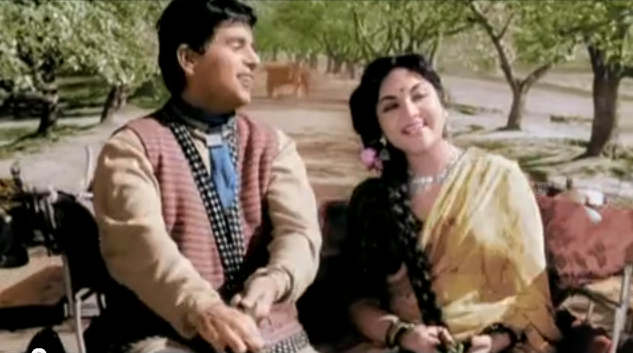
Dilip Kumar and Vijayantimala take a cue from their horse in Naya Daur (1957)

You know what I’m talking about. Guy and girl are falling in love. The setting: indistinct country road. A trotting horse (hay load optional) comes into view. Guy holds the reigns, a gentle clip-clop sets the beat like a metronome, and at last someone can’t resist and bursts into love song. Yes, nothing evokes the pastoral innocence of Bollywood’s rural ideal like a good horse and buggy sequence.

I’ve come up with a list of my top 5 horse and buggy songs. No matter how terrible you’re your day was, these’ll always put you in the mood. Sure, the economy is a mess, and yes, studying/work/dieting is rough. But isn’t it comforting to know that at least there will always be an appropriate forum to burst into song freely with a built-in beat? Just find a horse, grab a partner, and say hello to some fresh village air.

1. Mang Ke Saath Tumhaara (Naya Daur, 1957)

-The epitome of the horse and buggy genre. If this song doesn’t just make you want to join your nearest agrarian values movement, then you are made of steel. Dilip Kumar and Vijayantimala’s dynamic is so cute in this song, you overcome your gag reflex and find yourself basking in the bliss of better, bygone days. This film was recently recoloured following the latest trend, and the whole soundtrack is magic.

2. Haule Haule Chalo More Sajna (Saawan Ki Ghata, 1966)

-I absolutely love this song. It gets my spirits up every time. I think part of it is my love of Sharmila Tagore’s teasing persistence, while Manoj Kumar only pretends he isn’t loving it. This is also a beautiful example of one of the few melodious Asha Bhonsle songs that I honestly think no one else could have sung better (as in, Lata). Her voice is just a joy to listen to as she completely hits the mood of this playful winner.

3. Yun To Hamne Laakh Haseen Dekhe Hain (Tumsa Nahin Dekha, 1957)

-Oh Mohammed Rafi, can you do no wrong? The lyrics are adorable and this time, it’s the heroine playing hard to get. But don’t lie to yourself, girl–these are the days before Shammi Kapoor discovered jalebi, and he’s looking pretty fly with that Elvis ‘do. Asha comes back around later in the film for a brief female version of this song, but it’s a classic case of the ladies getting the shaft and having to sing too high because of the standard set by the male version (more on this issue to come). Until then, enjoy a slim Shammi treat to soothe all your pains.

4. Piya Piya Piya Mora Jiya Pukare (Baap Re Baap, 1955)

-Another incredibly cute duet/cheese-fest—this time brought to you by Chand Usmani and Kishore Kumar (who also acts!) The film itself is completely forgettable, but this Asha-Kishore duet is a fun benchmark for the genre. Please don’t miss their fellow travelers on car, who clearly all wish this had been a chorus song.

5. Aye Neele Gagan Ke Tale (Humraaz, 1967)

-Ok, I admit, this song doesn’t fit the classic definition of horse and buggy song. But hey, watching Raajkumar ride up on a horse like the prince of anyone’s dreams (and the subsequent quasi-dream sequence in the Darjeeling countryside) certainly deserves mention somewhere. And that rich voice of Mahendra Kapoor that gives a perfect song a little something-something? Yes, please.

An extremely honorable mention goes to “Aye Nargis-e Mastana” from Arzoo (1965) starring Sadhana and Rajendra Kumar. She’s definitely riding a horse the entire song, but Rajendra Kumar’s awkwardness brings the cute factor back down to Earth.

-Mrs. 55

The Lost Art of the Raga-Mala

For musically-inclined fans of Hindi cinema, the Lata-Rafi duet “Kuhu Kuhu Bole Koyelia” from the film Suvarna Sundari (1957) stands out as one of the finest examples of how Hindustani classical music has been incorporated into the genre of Bollywood music. This song has always been a personal favorite of mine, and it happens to be one of the first pieces of Indian music I adapted for performance on the piano. This song takes on the structure of a ragamala (literally, a garland of ragas), a form derived from Hindustani classical music in which different musical modes are intertwined within a single composition. In “Kuhu Kuhu Bole Koyelia,” four ragas are used beautifully in combination: Sohini, Bahaar, Jaunpuri, and Yaman.

A.N.R and Anjali Devi star in Suvarna Sundari (1957)

Whenever I listen to a song like this, I feel compelled to draw comparisons between the music created during the Golden Age of Hindi cinema and the music produced by the Bollywood industry today. Aside from the occasional gem, the songs found in Hindi movies today fail to impress on all counts. The music produced today simply lacks the magic found in the songs from the yesteryears of Hindi cinema, which reflect the efforts of a host of talented music directors, lyricists, and vocalists.

Take, for example, the skillful manner in which Lata Mangeshkar and Mohammed Rafi render this composition. Their voices navigate through the intricacies of each raga with a level of musical precision and maturity that is sadly missing in the singers who rule the Bollywood industry today. In addition to nailing the technical sargam and harkats, they sing with a graceful ease and poise that allows this complex composition to appeal to a broad audience, regardless of musical background. Will we ever get to hear such a beautifully intricate raag-mala sung in a Bollywood film produced today? Based on current trends, I am skeptical about the prospects of such an opportunity – the industry needs to stop celebrating Sheila’s jawani and return to its roots in order to preserve the rich musical heritage of our culture.

–Mr. 55

P.S. Some of you may be interested to know that a Telegu version of this composition also exists, which was sung by Jikki and Ghantasala.