O Mere Shah-e Khuban Lyrics and Translation: Let’s Learn Urdu-Hindi

Clad in a tight kimono, Asha Parekh prances about Japan in Love in Tokyo (1966)

Next we will explore the lyrics and translation of the hit song “O Mere Shah-e Khuban” from Love in Tokyo. Shot on location in Japan shortly after the 1964 Olympics, Love in Tokyo (1966) is nothing short of an “exotic” tourist fantasy. The film is one of a trilogy of films I put in this category from the same era with Night in London (1967) and An Evening in Paris (1967). These are movies that dazzled Indian audiences with a glimpse into a lifestyle and culture outside the familiar homeland, and on occasion were almost laughably politically incorrect. Love in Tokyo stars Asha Parekh (playing an Indian woman raised Japanese) and Joy Mukherji who finds himself in Tokyo for reasons almost too complicated to discuss here (or probably anywhere outside a psychiatric ward).

But say what you want about the worth of the film’s plot, Love in Tokyo’s soundtrack is wonderful (the cheesy title song grows on you in spite of its lyrics). The real gem of the album is the love ballad “O Mere Shah-e Khuban”, with music by Shankar-Jaikishen. Lata Mangeshkar and Mohammed Rafi each sing a version at different points in the film. I naturally prefer Rafi’s because of that deep sublime silky voice, but it’s open for argument. The lyrics have some rare Urdu vocabulary and is an example of probably the only time you will ever hear the “h” in “shaah” actually pronounced because of the “-e-” conjunct that follows! This Hasrat Jaipuri ghazal harkens to a famous couplet of Mughal era poet Momin Khan Momin: “Tum mere paas hote ho goyaa/Jab koi doosraa nahii.N hotaa.” The lines can be interpreted on several levels, literal and spiritual, and are a beautiful example of classical Urdu poetry’s rich legacy in contemporary music.

I loved the intro music to this song so much, I actually featured it in my Harvard thesis film. Enjoy our English translation of “O Mere Shah-e Khuban” below!

O Mere Shah-e Khuban Lyrics and Translation:

O mere shaah-e khubaa.N, o meri jaan-e janaana
Oh my beautiful ruler, the love of my life
Tum mere paas hote ho
You are beside me
Koi doosra nahi.N hota
Let no one else take your place

O mere shaah-e khubaa.N…

Kab khayaalo.N ki dhoop dhalti hai
When the sunlight fades from my thoughts
Har qadam par shamaa si jalti hai
Then with every step there is a light as if from a candle
Mera saayaa jidhar bhi jaataa hai
For wherever my shadow goes
Teri tasveer saath chalti hai
It goes with your image

O mere shaah-e khubaa.N…

Tum ho saharaa mei.N, tum gulistaan mei.N
You are in the desert, you are in the rose gardens
Tum ho zarron mei.N tum biyaabaan mei.N
You are in every particle, you are in the wilderness
Mai.N ne tumko kahaa.N kahaa.N dekha
I have seen you everywhere
Chhupke rehte ho tum rag-e-jaan mei.N
You are hidden within my very veins

O mere shaah-e khubaa.N…

Meri aankho.N ki justaju tum ho
You are that for which my eyes are searching
Iltijaa tum ho, aarzoo tum ho
You are my prayer, and you are my desire
Main kisi aur ko to kya jaanuu.N?
What could I know about anyone else
Meri ulfat ki aabroo tum ho
The honor of my love lies with you

O mere shaah-e khubaa.N…

Glossary:

Shaah: ruler; khubaa.N: radiant, beautiful; janaanaa: beloved; doosra: second, other; dhoop: sunlight; shamaa: light, candle; saayaa: shadow; tasveer: photograph, image; saharaa: desert; gulistaan: rose garden; zar: particle; biyaabaan: wilderness, desert; rag: vein, vessel; justaju: quest, search; iltijaa: request, prayer; aarzoo: desire; ulfat: love; aabroo: honor

As a bizarre bit of trivia, in the film Asha Parekh often does her hair in cutsy ponytails with a beaded elastic. The hairdo became known as “The Love in Tokyo” and was enjoyed a brief period of popularity among the masses. But men, don’t think you’re above this sort of fad–that classy plaid fedora from Jewel Thief? Sold-out in Indian stores across the nation after the film’s release. So let’s just try be grateful for what dignity we have.

Sweet ‘do, Asha. You totally blend in now!

-Mrs. 55

Waqt Ne Kiya Lyrics and Translation: Let’s Learn Urdu-Hindi

For our next song, we discuss the lyrics and English translation of Waqt Ne Kiya, an evergreen song by Geeta Dutt from Kaaghaz Ke Phool (1957). Although nearly everyone has grown up watching movies, few people have an understanding of what the production of a film entails. I don’t mean just the technical aspects of constructing a shot—I refer to that way of life, to the tinsel-lined world of glamour and infamy, of triumph and ruin, and of the battle for self-respect that challenges a director. Guru Dutt’s final film, Kaaghaz Ke Phool (1957), is an intimate and haunting tragedy that shows the audience just that—a glimpse into the vanished studio era of 1950s Bollywood.

Waheeda Rehman pays a price for her fame in Kaaghaz Ke Phool (1957)

Following in the mesmerizing footsteps of Sunset Boulevard (1950) and The Blue Angel (Der blaue Engel, 1930), Kaaghaz Ke Phool reveals another side to the world of show business through the rise and spiraling downfall of a great director.  It examines the price of the soul of an artist, and is a harsh critique of contemporary values (even including the social condemnation of divorce!). In an ironic twist, the film was a flop at the box office when first released, leading to events in Guru Dutt’s personal life that mirrored the story of his own film. Eerily autobiographical, the film has now achieved a cult status in the history of Indian cinema.

The famous song “Waqt Ne Kiya” comes at a time in the film when the hero and the love of his life both come to an unspoken understanding that they must let each other go. As for the picturization, it is a cinematographer’s dream. Look at the lighting in these shots—at the rich blacks of the shadows, and how the dust from the overhead spotlights is captured floating ethereally in the air. The camera dollies in slowly to each character as they stare at one another and at their unfulfilled dreams enacting before them in the spotlight. There is actually very little movement by the actors—the real player is the camera itself, gracefully gliding through the empty set like a spectre of their own shattered hopes.

Enjoy the lyrics and full English translation of the masterpiece “Waqt Ne Kiya” below:

Waqt Ne Kiya Lyrics and Translation:

Waqt ne kiya kya hasee.N sitam
What a beautiful tragedy time has wrought
Tum rahe na tum
You are no longer you
Hum rahe na ham
I am no longer me
 
Beqaraar dil is tarha mile
Our restless hearts met in such a way
Jis tarha kabhi hum judaa na the
As though we were never apart
Tum bhi kho gaye
You became lost
Hum bhi kho gaye
I was lost too
Ek raah par chalke do qadam
As we walked a few footsteps on the same path
Waqt ne kiya…
 
Jaaye.Nge kahaa.N sujhta nahii.N
We cannot see where we are going
Chal paDe magar raastaa nahii.N
We set forward despite there being no path
Kya talaash hai
For what do we search?
Kuch pataa nahii.N
I do not know
Bun rahe hai.N dil khaab dam ba-dam
With every breath, my heart grows another dream
Waqt ne kiya…

Glossary:

Waqt= time, sitam= tragedy, torture; beqaraar= restless; tarha=manner judaa= apart; qadam= footsteps, talaash= search; dam ba-dam= with every breath

For anyone interested in gossip, the song is sung by Geeta Dutt—wife of none other than director and actor Guru Dutt himself. A major star on her own right, Geeta shot to fame at the age of sixteen when she wowed audiences with her uniquely rich and emotional voice (becoming S.D. Burman’s favorite!) But she too later suffered a personal tragedy from the well-known affair between her husband and his favorite actress, Waheeda Rehman—who actually lip-syncs “Waqt Ne Kiya” and plays the role of “the other woman” in the film! As I said, talk about life mimicking art. For more on Guru Dutt’s films, check out our earlier post on Pyaasa!

-Mrs. 55

Jurm-E-Ulfat Pe Lyrics and Translation: Let’s Learn Urdu-Hindi

This gem penned by Sahir Ludhianvi in Taj Mahal (1963) is probably one of our favorite picks for an old film song that makes the makes the best use of Urdu lyrics. This classic movie narrates the love story between Shah Jahan and Mumtaz Mahal. Ludhianvi’s heart-wrenching lyrics combined with Roshan’s beautiful music (a nuanced use of Raga Gaud Malhar!), Lata’s magical voice, and Bina Rai’s graceful portrayal of Mumtaz Mahal on screen make this song a truly memorable masterpiece.

All the couplets in this song are beautifully constructed, but one of the lines in this song is particularly intriguing. In the fourth couplet, Ludhianvi writes: “takht kyaa chiiz hai aur laal-o-javaahar kya hai?” As a whole, this couplet expresses the sentiment that love is so powerful that it transcends wealth, royalty, and even divinity. However, Ludhianvi’s use of the specific word laal-o-javaahar (red jewels, rubies) to symbolize wealth is interesting because it appears to be a reference to Javaahar Laal Nehru, who happened to be Prime Minister of India at the time that this song was written. Nehru was certainly seated on the “takht” of India in 1963, but what is Ludhianvi’s purpose in referencing him in this line of the song?

Although we can’t know for sure, here’s what we think. Because Ludhianvi is known to use his lyrics as a medium for criticism and political satire, it is likely that he is criticizing Nehru for his role in starting the Sino-Indian War of 1962. Nehru’s stubbornness and refusal to negotiate escalated tensions between India and China, ultimately leading to a war that cost thousands of human lives on both sides. (As a side note, the patriotic classic “aye mere vatan ke logo.n” was written to commemorate the soldiers who lost their lives in this war). Here, I would venture to say that Ludhianvi is using the reference to suggest that lovers are prepared to suffer losses greater than those incurred by Nehru in the war.

If you haven’t heard this song yet, you’re totally missing out–take a listen and pay close attention to the glossary below to learn some new and difficult Urdu vocabulary!

–Mr. 55

Lyrics:
jurm-e-ulfat
pe hame.n log sazaa dete hai.n

kaise naadaan hai.n, sholo.n ko havaa dete hai.n

hamse diivaane kahii.n tark-e-vafaa karte hai.n
jaan jaaye ki rahe, baat nibhaa dete hai.n

aap daulat ke taraazuu me.n dilo.n ko tole.n
ham muhabbat se muhabbat ka silaa dete hai.n

takht kya chiiz hai aur laal-o-javaahar kya hai?
ishqvaale to khudaayii bhii luuTaa dete hai.n

hamne dil de bhii diyaa, aur ahad-e-vafaa le bhii liyaa.
aap ab shauq se de le.n jo sazaa dete hai.n

jurm-e-ulfat pe hame.n log sazaa dete hai.n

Glossary
jurm-e-ulfat: offenses in love; sazaa: punishment; naadaan: naive; sholaa: flame; tark-e-vafaa: end of love; jaan: life; nibhaa dena: to fulfill; daulat: wealth; taraazuu: scales; silaah denaa: to respond; takht: throne; laal-o-javaahar: red jewels, rubies; ishqvaale: lovers; khudaayii: godliness, divinity; luuTaa denaa: to sacrifice; ahad-e-vafaa: vow of loyalty; shauq se: with pleasure

Rough Translation
People punish me for the offenses I have committed in love
How naive they must be, for they are only adding air to a burning flame.

Elsewhere, people crazier than I put an end to their love.
Whether I live or die, I will remain faithful to my word.

You may weigh hearts on scales of wealth,
But I respond to love with love.

What is the value of thrones and rubies?
Lovers can sacrifice even divinity.

I have already given my heart and taken a vow of loyalty.
Now, with pleasure, you may deliver my punishment.

People punish me for the offenses I have committed in love.

Kahin Door Jab Din Dhal Jaaye Lyrics and Translation: Let’s Learn Urdu-Hindi

The next song in our series will be the lyrics and English translation of the sentimental “Kahin Door Jab Din Dhal Jaaye” from the film Anand (1971). Starring power duo Amitabh Bachhan and Rajesh Khanna, Anand tells the story of how one hardened doctor’s outlook is changed by the optimism and infectious laughter of his terminally ill patient, Anand. Dr. Banerjee faces an enormous dilemma when Anand becomes not merely another patient, but a true and close friend. Through Anand, he is inspired once more to fight desperately for the lives of his patients and must come to terms with when at last to let to go of circumstances beyond his control. The film explores the complex medical ethics of urging and struggling for life instead of palliative care when death is inevitable, as well as the difficulties in transcending the professional comforts of a normal doctor-patient relationship. While bubbly, laugh-a-minute Anand is at times over the top, his character remains always endearing.

Rajesh Khanna plays a vivacious cancer patient in Anand (1971)

“Kahin Door Jab Din” comes as one of the rare moments in the film when Anand displays a softer, introspective side to his character. The translation and lyrics of the song is deeply moving–a dying man watches the sunset, reflecting with a kind of loving wistfulness on his unfulfilled dreams. The beauty of these lyrics in the context of the film evokes a sense of what Japanese art has called mono na aware–a sensitivity to ephemera, a gentle sadness for the transience of things even as they occur (in this case, his own life). It should be noted, that although I have translated some lines as referring to a woman–I think this song can be read in many different ways. The lyrics may speak to the woman Anand once loved who is no longer with him, but the womanly embodiment of his longing may be also symbolic of all unknown experiences of life that Anand will miss, for like the setting sun, his life is slowly ebbing away. To me, “Kahin Door Jab Din” is beautiful, restrained, and one of the finest examples of Rajesh Khanna’s ability to move an audience without the crutches of his famous winking and dancing.

P.S. Some of you may be interested to discover the original Bengali version of this song sung by Hemant Kumar here!

Kahin Door Jab Din Lyrics and Translation:

kahii.N duur jab din Dhal jaaye
Somewhere far away when the day dulls
saa.Njh kii dulhan badan churaaye chhupke se aaye
The dusk sneaks up, shyly like a bride
mere khayaalo.N ke aa.Ngan mei.N
In the courtyard of my imagination
koii sapno.N ke diip jalaaye, diip jalaaye
Someone lights up the lamp of my dreams

kabhii yuu.N hii, jab huii, bojhal saa.Nse.N
Sometimes when my breathing becomes burdensome for no reason
bhar aayii baiThe baiThe, jab yuu.N hii aa.Nkhe.N
When my eyes well up just sitting around
tabhii machal ke, pyaar se chal ke
Then with a loving flutter
chhue koii mujhe par nazar na aaye, nazar na aaye
Someone touches me, but I cannot see her

kahii.N to yeh, dil kabhii, mil nahii.N paate
Somewhere these hearts are unable to come together
kahii.N se nikal aaye, janamo.N ke naate
But somewhere a connection emerges that transcends many lifetimes
ghanii thii uljhan, bairii apnaa man
The problem was deep and my own heart turned against me
apnaa hii hoke sahe dard paraaye, dard paraaye
By belonging to me, yet bearing the pain of another

dil jaane, mere saare, bhed yeh gahare
My heart knows all my deep secrets
ho gaye kaise mere, sapane sunahare
How my dreams became golden
yeh mere sapne, yahii.N to hai.N apne
These are my dreams, these alone belong to me
mujh se judaa na ho.Nge inke yeh saaye, inke yeh saaye
Even their shadows cannot be separated from me

kahii.N duur jab din Dhal jaaye
Somewhere far away when the day dulls
saa.Njh kii dulhan badan churaaye chhupke se aaye
The dusk sneaks up, shyly like a bride

Glossary:

saanjh: evening; aangan: courtyard; bhojal: burdensome; machal: flutter; janamo.n ke naate: connection of many lifetimes; uljhan: problem; paraaye: another person (stranger); bhed: secret; sunahare: golden; saaye: shadow

-Mrs. 55

Chalo Ek Baar Phir Se Lyrics and Translation: Let’s Learn Urdu-Hindi

SD

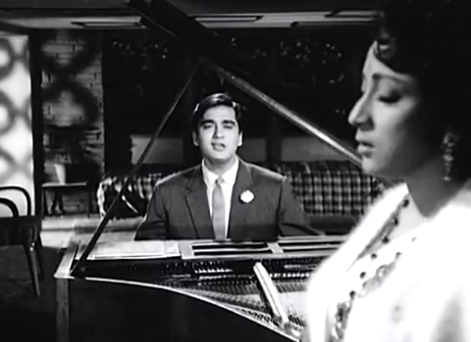
Sunil Dutt sings about the pain of heartbreak at the piano in Gumraah (1963)

In my opinion, I think one of the best parts about being a fan of old Hindi music is that it gives you a fun opportunity to brush up on your Urdu-Hindi language skills. From time to time, Mrs. 55 and I have decided that we will share some of our favorite song lyrics here and provide a glossary and translation so that everyone can follow along!

Our first song is “chalo ek baar phir se,” which is an absolute gem from the 1963 film Gumraah directed by B.R. Chopra. Arguably the best song of his career, this composition was rendered by Mahendra Kapoor, an excellent singer who ultimately carved a niche for himself in the industry after emerging from his initial fame as a Mohammed Rafi clone. The real star here, though, is Sahir Ludhianvi, who was truly one of the most gifted poets that has ever written for Hindi cinema. Known for his cynicism and disillusionment with society, Sahir Ludhianvi wrote lyrics that reflect a great deal of emotional complexity and maturity. In contrast to his contemporaries, Ludhianvi chose to remain unhindered by the constraints set by the prototypical Bollywood love song; many of his songs are refreshing to hear for their expression of biting political satire, heartfelt grief, or outspoken anger.

Sahir Ludhianvi, poet (1921-1980)

In “chalo ek baar phir se” Ludhianvi writes about a situation in which unfortunate societal circumstances prevent two lovers from fulfilling their romantic desires and building a life together. Supposedly, Ludhianvi was inspired to write this song when he encountered an ex-lover of his at a party with her new husband. The encounter must have been incredibly painful for him because these lyrics are devoid of the typical romanticizations of pyar and muhabbat that are often found in songs from this period. Instead of praising love as an ideal, the protagonist of the song suggests that he and his lover should return to becoming strangers because the emotional separation will make it easier for both of them to heal from their pain. The last stanza of the song is especially powerful: the protagonist posits that it is counter-productive to invest energy into doomed romantic relationships when they have become a burden. Ludhianvi’s words here suggest that it is sometimes in everyone’s best interests to put an early end to the love stories that simply cannot have happy conclusions. His eloquence and nuanced use of language to express the pain of unfulfilled love is sublime, and this type of  poetic talent is sorely missed in the Bollywood industry today.  For those of you who haven’t heard this song yet, it’s definitely worth a listen. If you follow along with the glossary below, I’m sure you’ll learn a couple new words that will impress ALL your Urdu-speaking friends (yes, all 2 of them).

SD

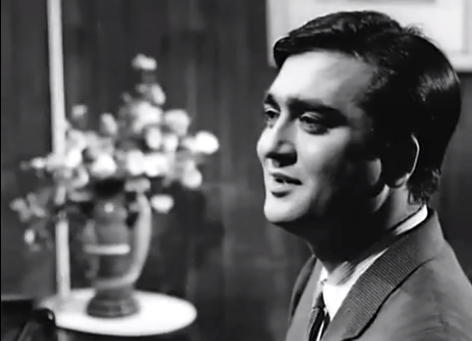
Sunil Dutt masks his internal anguish with a coy smile in Gumraah (1963)

Chalo Ek Baar Phir Se Lyrics and Translation:

chalo ek baar phir se, ajnabii ban jaaye.n ham dono.n
Come, let us become strangers once again.

na mai.n tumse koii ummiid rakhuu.n dilnavaazii kii
I shall no longer maintain hopes of compassion from you
na tum merii taraf dekho ghalat andaaz nazaro.n se
Nor shall you gaze at me with your deceptive glances. 
na mere dil ki dhaDkan laDkhaDaaye merii baato.n me.n
My heart shall no longer tremble when I speak, 
na zaahir ho tumhaari kashm-kash ka raaz nazaro.n se
Nor shall your glances reveal the secret of your torment.

tumhe.n bhii koii uljhan roktii hai pesh-qadmii se
Complications prevent you from advancing further,
mujhe bhii log kahte hai.n ki yeh jalve paraaye hai.n
I too am told that I wear disguises. 
mere hamraah bhi rusvaayiaa.n hai.n mere maazii kii
The disgraces of my past are now my companions,
tumhaare saath bhii guzrii huii raato.n ke saaye hai.n
while the shadows of bygone nights are with you too.

taarruf rog ho jaaye to usko bhuulnaa bahtar
Should knowing one another become a disease, then it is best to forget it. 
taalluq
bojh ban jaaye to usko toDnaa achhaa
Should a relationship become a burden, then it is best to end it. 
voh afsaana jise anjaam tak laanaa na ho mumkin
For that tale which cannot culminate in a conclusion,
use ek khuubsuurat moD de kar chhoDna achhaa
it is best to give it a beautiful turn and leave it be.

chalo ek baar phir se, ajnabii ban jaaye.n ham dono.n
Come, let us become strangers once again. 

Glossary:

ajnabii: stranger; ummiid: hope; dilnavaazii: compassion; ghalat andaaz nazar: deceptive glance; laDkhaDaanaa: to tremble; zaahir: noticeable; kashm-kash: torment, struggle; uljhan: complication; pesh-qadmii karna: to advance; paraayaa jalva: disguise; hamraah: companion; rusvaa: disgrace; maazii: the past; taarruf: mutual acquaintance, knowledge of one another; rog: disease, afflication; taalluq: relationship; afsaanaa: tale; anjaam: conclusion; mumkin: possible; khuubsuurat: beautiful; moD; turn. 

SD

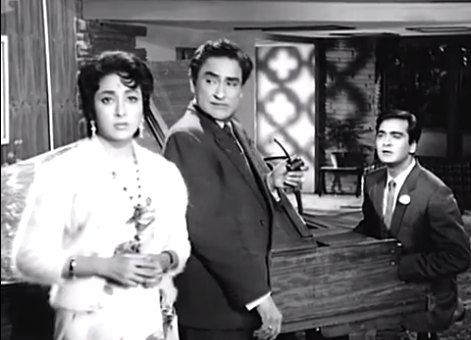
The expressions on the faces of Sunil Dutt, Mala Sinha, and Ashok Kumar  reflect the pervading tension of this situation from Gumraah (1963).