Kahin Door Jab Din Dhal Jaaye Lyrics and Translation: Let’s Learn Urdu-Hindi

The next song in our series will be the lyrics and English translation of the sentimental “Kahin Door Jab Din Dhal Jaaye” from the film Anand (1971). Starring power duo Amitabh Bachhan and Rajesh Khanna, Anand tells the story of how one hardened doctor’s outlook is changed by the optimism and infectious laughter of his terminally ill patient, Anand. Dr. Banerjee faces an enormous dilemma when Anand becomes not merely another patient, but a true and close friend. Through Anand, he is inspired once more to fight desperately for the lives of his patients and must come to terms with when at last to let to go of circumstances beyond his control. The film explores the complex medical ethics of urging and struggling for life instead of palliative care when death is inevitable, as well as the difficulties in transcending the professional comforts of a normal doctor-patient relationship. While bubbly, laugh-a-minute Anand is at times over the top, his character remains always endearing.

Rajesh Khanna plays a vivacious cancer patient in Anand (1971)

“Kahin Door Jab Din” comes as one of the rare moments in the film when Anand displays a softer, introspective side to his character. The translation and lyrics of the song is deeply moving–a dying man watches the sunset, reflecting with a kind of loving wistfulness on his unfulfilled dreams. The beauty of these lyrics in the context of the film evokes a sense of what Japanese art has called mono na aware–a sensitivity to ephemera, a gentle sadness for the transience of things even as they occur (in this case, his own life). It should be noted, that although I have translated some lines as referring to a woman–I think this song can be read in many different ways. The lyrics may speak to the woman Anand once loved who is no longer with him, but the womanly embodiment of his longing may be also symbolic of all unknown experiences of life that Anand will miss, for like the setting sun, his life is slowly ebbing away. To me, “Kahin Door Jab Din” is beautiful, restrained, and one of the finest examples of Rajesh Khanna’s ability to move an audience without the crutches of his famous winking and dancing.

P.S. Some of you may be interested to discover the original Bengali version of this song sung by Hemant Kumar here!

Kahin Door Jab Din Lyrics and Translation:

kahii.N duur jab din Dhal jaaye
Somewhere far away when the day dulls
saa.Njh kii dulhan badan churaaye chhupke se aaye
The dusk sneaks up, shyly like a bride
mere khayaalo.N ke aa.Ngan mei.N
In the courtyard of my imagination
koii sapno.N ke diip jalaaye, diip jalaaye
Someone lights up the lamp of my dreams

kabhii yuu.N hii, jab huii, bojhal saa.Nse.N
Sometimes when my breathing becomes burdensome for no reason
bhar aayii baiThe baiThe, jab yuu.N hii aa.Nkhe.N
When my eyes well up just sitting around
tabhii machal ke, pyaar se chal ke
Then with a loving flutter
chhue koii mujhe par nazar na aaye, nazar na aaye
Someone touches me, but I cannot see her

kahii.N to yeh, dil kabhii, mil nahii.N paate
Somewhere these hearts are unable to come together
kahii.N se nikal aaye, janamo.N ke naate
But somewhere a connection emerges that transcends many lifetimes
ghanii thii uljhan, bairii apnaa man
The problem was deep and my own heart turned against me
apnaa hii hoke sahe dard paraaye, dard paraaye
By belonging to me, yet bearing the pain of another

dil jaane, mere saare, bhed yeh gahare
My heart knows all my deep secrets
ho gaye kaise mere, sapane sunahare
How my dreams became golden
yeh mere sapne, yahii.N to hai.N apne
These are my dreams, these alone belong to me
mujh se judaa na ho.Nge inke yeh saaye, inke yeh saaye
Even their shadows cannot be separated from me

kahii.N duur jab din Dhal jaaye
Somewhere far away when the day dulls
saa.Njh kii dulhan badan churaaye chhupke se aaye
The dusk sneaks up, shyly like a bride

Glossary:

saanjh: evening; aangan: courtyard; bhojal: burdensome; machal: flutter; janamo.n ke naate: connection of many lifetimes; uljhan: problem; paraaye: another person (stranger); bhed: secret; sunahare: golden; saaye: shadow

-Mrs. 55

Making the Cut in Pakeezah: Behind-the-scenes of one of Bollywood’s most elaborate musicals

The ethereal Meena Kumari in Pakeezah (1971)

Few films have more behind-the-scenes gossip and excitement than Pakeezah (1971). If you know anything about classic Hindi film songs, you’ve probably heard some part of the Pakeezah soundtrack from director Kamal Amrohi’s 1971 legend. The film stars tragedy queen Meena Kumari as Pakeezah and gorgeous, gravely-voiced Raajkumar in a story of unforgiving traditional values that collide with the forbidden love of a pure-hearted courtesan. In an ironic twist, Pakeezah is revealed at the climax to be the hero’s long lost cousin, thus at last sanctioning their marriage (the ethical complexities of this kicker are a whole different issue.) But the movie itself is pure cinematic magic–Kamal Amrohi was notorious for his artistry and attention to detail. Pakeezah’s breath-taking production design, Ghulam Muhammed’s haunting semi-classical thumris, and the effortless poetry of the film’s dialogue is like entering one long, opium-induced dream.

But what was happening beneath the surface? A whole lot of drama.

Director Kamal Amrohi married Meena Kumari when she was 19 years old in 1952. They began filming Pakeezah within a few years–in fact, the song Inhi Logon Ne (raga Yaman) was filmed and edited before Amrohi switched to coloured film stock. The 1956 black-and-white version of the song was never used, but many of the shots are extremely similar to the final version. Notice how different young Lata’s voice sounds in this song compared to parts of the soundtrack recorded years later. Even more interestingly, Inhi Logon Ne was originally taken from the film Himmat (1941) in a version sung by none other than Shamshad Begum!

My favorite non-Lata song from the film is, Nazariyan Ki Maari, sung by 1930s playback singer Rajkumari Dubey. During production, when Naushad spotted Rajkumari singing in his chorus to make ends meet (and this is a woman who had been first female playback singer of India!), he reportedly caused an uproar and gave his former collaborator her own solo. This is why we love Naushad.

Pakeezah took over 14 years to complete, mainly because of the famously tumultuous relationship between Kamal and Meena (and her eventual alcoholism). Rumor has it that Meena was such a hot mess during the filming of Chalo Dildar Chalo, Amrohi cut her out and reworked the shot list so that her face is actually never seen in the song. Her condition became so bad that during the filming of the grueling emotional mujraa “Teer-e Nazar,” Meena Kumari collapsed. A body double, none other than filmi vamp Padma Khanna, was recruited to replace her! Meena Kumari personally trained her for the scene, and the song was filmed with the majority of the dancing done with an opaque chunni hiding Padma’s face! I would’ve killed to be a yes-man on that set and drink in all the gossip.

A very convenient camera angle…

Speaking of which, did you know the beautiful Mohammed Rafi-Lata Mangeshkar duet, Chalo Dildar Chalo (raga Pahadi), was actually also recorded as a female solo? Intended for use as a dancing number, the fascinating solo version was cut from both the film and record releases, although in my opinion, coupling the theme of romantic freedom in the lyrics with the close-up imagery of a ghungroo-bound Pakeezah could have been beautiful filmic irony. But it just didn’t make the cut.

And you know what else got cut from this film? I mean, literally, cut off. Turns out Meena Kumari was actually missing her left pinky from an accident that occurred around the time of her marriage! For a film that is so heavily focused on music and dancing, you can imagine that structuring every tiny shot and dance move to hide the left hand was tricky–but if you watch the film closely, Amrohi does a meticulous job of making sure her left hand stays hidden. And Meena Kumari’s right hand works such graceful magic, I dare you to find a prettier dancer with all 10 fingers.

For more information on the classic film, check out our page dedicated to the immortal dialogue from Pakeezah and the songs from Pakeezah!

– Mrs. 55

Chalo Ek Baar Phir Se Lyrics and Translation: Let’s Learn Urdu-Hindi

SD

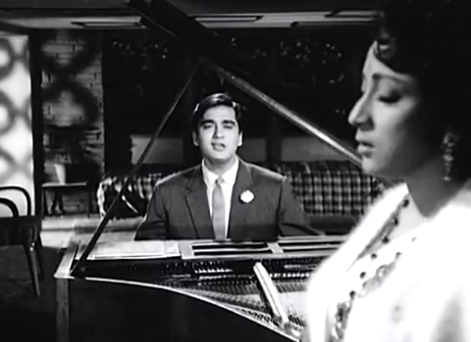
Sunil Dutt sings about the pain of heartbreak at the piano in Gumraah (1963)

In my opinion, I think one of the best parts about being a fan of old Hindi music is that it gives you a fun opportunity to brush up on your Urdu-Hindi language skills. From time to time, Mrs. 55 and I have decided that we will share some of our favorite song lyrics here and provide a glossary and translation so that everyone can follow along!

Our first song is “chalo ek baar phir se,” which is an absolute gem from the 1963 film Gumraah directed by B.R. Chopra. Arguably the best song of his career, this composition was rendered by Mahendra Kapoor, an excellent singer who ultimately carved a niche for himself in the industry after emerging from his initial fame as a Mohammed Rafi clone. The real star here, though, is Sahir Ludhianvi, who was truly one of the most gifted poets that has ever written for Hindi cinema. Known for his cynicism and disillusionment with society, Sahir Ludhianvi wrote lyrics that reflect a great deal of emotional complexity and maturity. In contrast to his contemporaries, Ludhianvi chose to remain unhindered by the constraints set by the prototypical Bollywood love song; many of his songs are refreshing to hear for their expression of biting political satire, heartfelt grief, or outspoken anger.

Sahir Ludhianvi, poet (1921-1980)

In “chalo ek baar phir se” Ludhianvi writes about a situation in which unfortunate societal circumstances prevent two lovers from fulfilling their romantic desires and building a life together. Supposedly, Ludhianvi was inspired to write this song when he encountered an ex-lover of his at a party with her new husband. The encounter must have been incredibly painful for him because these lyrics are devoid of the typical romanticizations of pyar and muhabbat that are often found in songs from this period. Instead of praising love as an ideal, the protagonist of the song suggests that he and his lover should return to becoming strangers because the emotional separation will make it easier for both of them to heal from their pain. The last stanza of the song is especially powerful: the protagonist posits that it is counter-productive to invest energy into doomed romantic relationships when they have become a burden. Ludhianvi’s words here suggest that it is sometimes in everyone’s best interests to put an early end to the love stories that simply cannot have happy conclusions. His eloquence and nuanced use of language to express the pain of unfulfilled love is sublime, and this type of  poetic talent is sorely missed in the Bollywood industry today.  For those of you who haven’t heard this song yet, it’s definitely worth a listen. If you follow along with the glossary below, I’m sure you’ll learn a couple new words that will impress ALL your Urdu-speaking friends (yes, all 2 of them).

SD

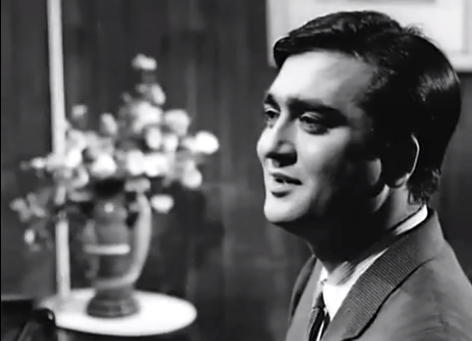
Sunil Dutt masks his internal anguish with a coy smile in Gumraah (1963)

Chalo Ek Baar Phir Se Lyrics and Translation:

chalo ek baar phir se, ajnabii ban jaaye.n ham dono.n
Come, let us become strangers once again.

na mai.n tumse koii ummiid rakhuu.n dilnavaazii kii
I shall no longer maintain hopes of compassion from you
na tum merii taraf dekho ghalat andaaz nazaro.n se
Nor shall you gaze at me with your deceptive glances. 
na mere dil ki dhaDkan laDkhaDaaye merii baato.n me.n
My heart shall no longer tremble when I speak, 
na zaahir ho tumhaari kashm-kash ka raaz nazaro.n se
Nor shall your glances reveal the secret of your torment.

tumhe.n bhii koii uljhan roktii hai pesh-qadmii se
Complications prevent you from advancing further,
mujhe bhii log kahte hai.n ki yeh jalve paraaye hai.n
I too am told that I wear disguises. 
mere hamraah bhi rusvaayiaa.n hai.n mere maazii kii
The disgraces of my past are now my companions,
tumhaare saath bhii guzrii huii raato.n ke saaye hai.n
while the shadows of bygone nights are with you too.

taarruf rog ho jaaye to usko bhuulnaa bahtar
Should knowing one another become a disease, then it is best to forget it. 
taalluq
bojh ban jaaye to usko toDnaa achhaa
Should a relationship become a burden, then it is best to end it. 
voh afsaana jise anjaam tak laanaa na ho mumkin
For that tale which cannot culminate in a conclusion,
use ek khuubsuurat moD de kar chhoDna achhaa
it is best to give it a beautiful turn and leave it be.

chalo ek baar phir se, ajnabii ban jaaye.n ham dono.n
Come, let us become strangers once again. 

Glossary:

ajnabii: stranger; ummiid: hope; dilnavaazii: compassion; ghalat andaaz nazar: deceptive glance; laDkhaDaanaa: to tremble; zaahir: noticeable; kashm-kash: torment, struggle; uljhan: complication; pesh-qadmii karna: to advance; paraayaa jalva: disguise; hamraah: companion; rusvaa: disgrace; maazii: the past; taarruf: mutual acquaintance, knowledge of one another; rog: disease, afflication; taalluq: relationship; afsaanaa: tale; anjaam: conclusion; mumkin: possible; khuubsuurat: beautiful; moD; turn. 

SD

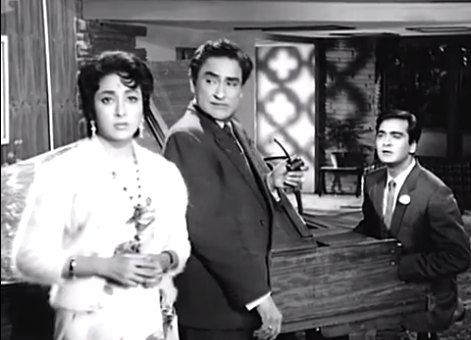
The expressions on the faces of Sunil Dutt, Mala Sinha, and Ashok Kumar  reflect the pervading tension of this situation from Gumraah (1963).

The Strange World of Gumnaam: Agatha Christie meets Bollywood

Helen and Pran forget their worries in Gumnaam (1967)

There’s been some buzz lately about the Italian Heineken “The Date” commercial featuring the music from Mohammed Rafi’s “Jaan Pehchaan Ho.” The commercial is fairly trippy, and sadly cuts out all of the actual singing, leaving only the musical introduction, interludes, and awkwardly enough, strange high-pitched male laughter. I’ve got two comments to make about this:

1. If you’re gonna take a Rafi song, why is the setting of this commercial East Asian instead of Indian? C’mon now, people.

2. More fundamentally, how on earth did the ad agency responsible for this come across this song and convince everyone involved of its advertising magic? Either a. someone had heard it used over the title sequence for the movie Ghost World, or b. someone knew it in its original form and had the guts, craziness, and pride to show it publicly. I can only hope it came from a fellow Rafi fanatic who is willing to boost the cause at any price to personal dignity. If it had been me who had a chance to bring glory to the Rafi name, I might’ve chosen the slightly more melodic/catchy “Badan Pe Sitare” or “Nain Milaakar“, which both seem to fall in the same category of hep cat club song. But that’s just me.

Let’s take a closer look the film, Gumnaam (1965) from where this song actually came. For all the Agatha Christie fans out there (and I’ve read all her books–no seriously, ALL of them), you may have been let down thinking that the best filmic interpretation of And Then There Were None was an obscure 80s Russian adaptation that has not been properly subtitled. Well, it’s your lucky day! Say hello to Gumnaam, a kitschy, melodramatic, and thoroughly enjoyable Bollywood adaptation of the Agatha Christie classic.

The film actually follows the basic outline of the plot pretty closely, adding in some extras for spice including the fantastically diverse soundtrack, an absolutely ridiculous dream sequence, and a mysterious ghostly element rendered by Lata’s vocals with the theme, “Gumnaam Hai Koi.”

As an aside, did you know “Gumnaam Hai Koi” is actually Lata’s cover version of the theme song to the 1963 American film Charade starring Cary Grant and Audrey Hepburn? Life is full of surprises.

The cast of Gumnaam is also a great mix of favorites–Manoj Kumar, Nanda, Pran, Mehmood as Butler, and none other than Helen in an actually fairly significant acting role. Sure, she’s got her usual crazy dance numbers (not to be missed!), but overall, if you have an open mind and three spare hours of your life that you know you will never get back, this film is pure deliciousness. And for all the Christie fans, the brilliant twist of the original novel takes on YET another twist in the climax of this film, so don’t think you know what’s coming!

Poison??! What a total surprise!

-Mrs. 55

Guru Dutt and the Struggle to Break Free of Convention

Guru Dutt’s poetic magnum opus, Pyaasa (1957), is often considered among the greatest cinematic achievements of all time, easily among the top 30 greatest Bollywood films ever made. You’re going to be hard-pressed to find someone more defensive of the genius that is Guru Dutt than yours truly. Pyaasa is an evocative film that explores one man’s search for humanism in the cold cynicism of post-independence Indian society. People often contrast Guru Dutt with his contemporary, famed actor and director Raj Kapoor, who shot hits like Shree 420 (1955)–a song-laden, fun rags-to-riches story with a clean happy ending. In contrast, the melancholic, disillusioned tone of Guru Dutt’s poetic films usually leave me feeling like my heart has been slowly torn out, but so beautifully done, I don’t even want it back anymore.

But I’m going to play devil’s advocate here and ask those who know and love both films, does it not seem that Pyaasa and Shree 420 both actually stemmed from the same reaction to the ideals of Nehru’s India under the “mandate of modernization?” Perhaps the creed of the heroic tramp of Shree 420 that spoke to the working masses is not so far from that of the starving poet of Pyaasa that stirred the minds of the intelligentsia. When Raj Kapoor and Guru Dutt, or any contemporary film-maker for that matter, sought to fill a void in their country’s cinema, despite such seemingly different approaches, they represented the emotions and wants of the same people. When you look closely, in fact, Pyaasa falls into many traps of the very conventions Guru Dutt wanted to break.

According to Raj Khosla, Guru Dutt believed the soul of Pyaasa was contained in the lines of hero Vijay’s song of lament: “Jinhe naaz hai Hind par, woh kahaan hain?” (“Where are those who are proud of this India?”), and Prime Minister Nehru himself is rumored to have been quite upset upon hearing this line, a direct invocation to the government for change.

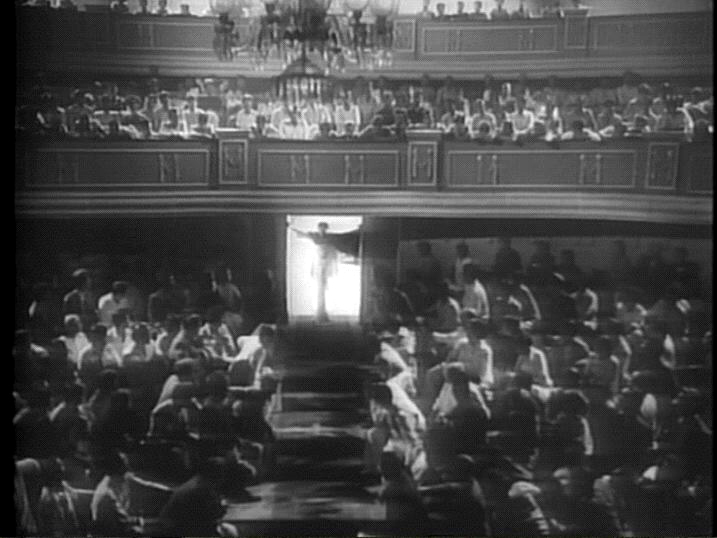
Appalled and disillusioned, Guru Dutt’s hero stands Christ-like in the doorway of a ceremony to honor his own death.

But if that’s the case, what the heck is the chintzy “Hum aapki aankhon mein” dream sequence in which hero Vijay and Meena sing and dance in a heavenly courtyard of swirling mist and starry skies doing in the film? Perhaps it is not entirely surprising to learn that the song was not originally intended to be in the film–it was only added in later to appease the distributors who believed it to be unmarketable without at least one glitzy, expensive Bollywood song. The other songs in his film mesh seamlessly into the narrative, as if they are not songs at all, but mere continuations of dialogue–a novel technique pioneered by Dutt.

A greater travesty is, did you know the film was actually supposed to end with the high-angle crane shot of Meena all alone in the grand room with papers flying everywhere after Vijay leaves? To me, the scattered pages are a symbol of Vijay’s poetry whose role as a commodity in the film is in turn a symbolic attack of the loss of romanticism in the realities of the industrialization process. It’s as if to say, society must also honor the man who breathes life into the poems, not merely the price of the written words.

But as Dutt’s assistant recalls, Guru Dutt, “changed the ending because of how the distributors reacted. They felt the ending was too heavy. The financiers requested, ‘Why don’t you have a happy ending?’” Now Pyaasa finishes with Vijay finding spiritual fulfillment with the companionship of Gulabo and the two making their way into the hopeful sunset. I mean, isn’t this the kind of “all’s well that ends well” of conventional cinema he wanted to fight against?

So ultimately, the very focus on wealth and profitability that Guru Dutt chastises in his film is actually the force that proved overpowering in its production. Though Guru Dutt himself wanted otherwise, the distributors, believing to represent the mass market, were able to convince Dutt to change his plans and take fewer risks. He becomes just another flaw in his own criticism against Nehru’s India, greatly compromising the effectiveness of Pyaasa’s commentary. Essentially, the “solution” presented in a film like Shree 420 to try to work the system as best as possible, is all that Pyaasa shows is possible–try to be “purposeful” (as Guru Dutt wanted) within the limitations of the system. Recalling Vijay’s own lines, “Isko hi jeena kehte hain, to yuhiin jee lenge,” (“If this is life, then this is how we’ll live,”) Pyaasa often invites a sentiment to conform to the status quo rather than fight or question it.

Or am I reading too much into this?

–Mrs. 55