Lymphosarcoma of the Intestine: The Making of a Bollywood Legend

Your average non-Bollywood viewer will probably read “lymphosarcoma of the intestine” and feel nothing. They will also probably pronounce intestine with a normal emphasis on the second syllable and won’t make it rhyme with “shine.” But ask anyone on the streets of Bombay who knows a thing or two about life from the silver screen, and you’ll be amazed. For Hindi cinema, the dreaded diagnosis “lymphosarcoma of the intestine” is synonymous with unavoidable impending doom of a most serious and scientifically complex nature. How did this all start and Bollywood folklore aside, what is lymphosarcoma of the intestine? Let us step back in time to 1971 to the film Anand when the hysteria all began…
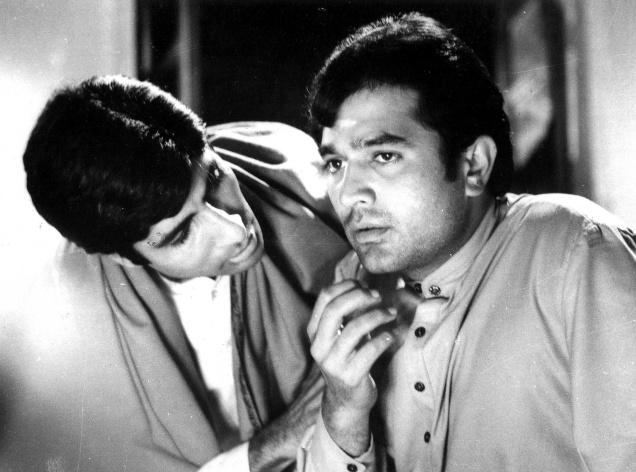
Amitabh Bachhan and Rajesh Khanna both can’t pronounce intestine in Anand (1971)

Anand is a film about a life-loving cancer patient whose optimism touches everyone he encounters. The film’s writer, Hrishikesh Mukherji, had majored in chemistry like his father before him, and started a career in Bollywood as a laboratory assistant in the film development process. Mukherji published the story himself—and was actually about his personal relationship to film great, Raj Kapoor (to whom the film is dedicated!) Kapoor used to call Mukherji babumushai when Kapoor had fallen quite ill himself, and the characters were based upon their interactions. I have discussed more about the songs and plot of the film here, but for now, I will highlight Anand’s unexpected, fatal diagnosis: lymphosarcoma of the intestine. At one point in the film, Anand is explaining his disease and jokes about the name that, “kisi viceroy ka naam lagta hai. Aadmi Vividh Bharati par announce kar sakta hai.” [It sounds like the name of some viceroy. It could be announced on the radio.]

So was the fancy sounding form of cancer just thrown in for the purposes of character development? Or was it perhaps actually the name of a disease he stumbled upon by chance many years ago as a chemistry student? Whatever the reason, clearly no one on their crew knew the correct pronunciation of the word “intestine” or the following it would develop. The tragic diagnosis then took on a cult status in Bollywood movies, memorable for its almost bizarre obscurity, and became de rigeur for anyone needing a terminal disease. It resurfaced most memorably in the smash-hit comedy Munna Bhai, MBBS (2003) about a Bombay thug-turned doctor who fights for the life of a patient with none other than…you guessed it, lymphosarcoma of the intestine! Surely, this was a nod to the original “patient-doctor” film Anand.

There’s probably a reason why you haven’t heard of lymphosarcoma of the intestine in real life.  A 1922 paper that discussed three cases of the disease in-depth in Annals of Surgery remained the definitive word for many years. The paper described it as an extremely rare and obscure condition about which current knowledge was lacking (this was well before the age of DNA). Also discussed is how towards the end of the illness, the patient presents with severe constipation or vomiting—both unpleasant effects that Mukherji failed to include (they probably would not have gone over well on screen). Nearly 100 years later, the term “lymphosarcoma” is obsolete–by definition all neoplasms of the lymphoid tissue are cancerous and simply termed “lymphoma.” So what was perhaps once called the mysterious lymphosarcoma of the intestine is now recognized as intestinal non-Hodgkin’s MALT B-cell lymphoma. Still, this particular form of non-Hodgkin’s lymphoma occurs infrequently (only 8% of B-cell lymphomas), but retains a good prognosis if a particular chromosomal mutation does not occur. It can be caused by chronic inflammation from the bacteria H. Pylori, in which case, antimicrobial agents could cure you. Unfortunately for Anand, H. Pylori would not be discovered until 1982. Still, surgery and chemotherapy were available options for these patients, neither of which seemed to have been advised for Anand. For him, lymphosarcoma of the intestine remained an unavoidable death sentence.

And now you’re saying, so what? So Hrishikesh Mukherji made melodrama from an obscure fatal disease and didn’t stick with its actual forms of progression and treatment, big deal? Well, I’m here to say, for whatever it’s worth, lymphosarcoma of the intestine became ingrained under false pretenses in the imagination of Bollywood when knowledge about something more realistic and with a higher incidence might have actually served some benefit. What if he was just dying from end-stage renal failure due to severe diabetes after a life of eating pure asli ghee? Yes, it’s a stretch. All right, a huge stretch. But someone had to say it.

Let me just end this with some fun trivia. Did you know that Amitabh Bachan and Rajesh Khanna were not originally intended to be cast in this film? I know it’s hard to imagine, but in reality Mehmood and Kishore Kumar were supposed to play their roles! Due to an unfortunate misunderstanding, Hrishikesh Mukherjee and Kishore Kumar had a falling out, so new actors were brought in instead for the roles that would make their as well as lymphosarcoma of the intestine’s careers!

-Mrs. 55

Defining Bollywood Film Noir

Sadhana enters a graveyard as the femme fatale of Woh Kaun Thi? (1964)

In the U.S. historians and film theorists have debated for decades about the meaning of the elusive term: “film noir.” Although many of us conjure an image of a hard-boiled detective and a mystery made more mysterious by the femme fatale, few “film noirs” actually contain these elements. This so-called genre had its roots in German Expressionism with films like Fritz Lang’s M (1931) and in depression-era crime novels. But what does the term “film noir” mean as it applies to Hindi cinema? What are the hallmarks of this genre as it played out in Bollywood and how did it begin?

I will present five films that I propose to be in the genre of Indian film noir. This is no easy task. Just as the term is vague in the American lexicon, so too does it only hazily engulf a variety of Hindi films with low-key lighting. And so I shall begin with an illustrative example. We can debate the precise definition of the genre until the end of time, but I think I can safely say that whatever Indian film noir is, Woh Kaun Thi? (1964) is Indian film noir.

Woh Kaun Thi? has 4 main basic elements. The first is in its distinct cinematographic style and setting—low-key lighting throughout a mysterious mansion and slow unhurried shots with a somber film score to match. The film gives a sense of the world being trapped in a fatalistic dream, whether alone by a graveyard or in a crowd of dancing people.

The second is the film’s overall tone and pacing—there is an uncomfortable sense of being pursued, of an impending doom unless a mystery is solved in time by the hero. Unlike in American film noir, the hero is no cynic and there is no quick sardonic dialogue to off-set the dreary mood. The hero is instead a righteous and innocent man of affairs, an heir to a fortune who becomes a victim. Though mingled with occasional musical highs, the film spirals from a slow and deliberate set-up to a climax closer and closer to complete ruin.

An interesting element of many American film noirs is the flash-back structure, which takes on an interesting form in their Indian counterparts. Woh Kaun Thi? centers around a mysterious background that occurred in the protagonist’s past life. Because the audience of Hindi films was largely composed of practicing Hindus, the world of reincarnation narrative is able to begin on a new and creatively extremely fertile ground. The hero must revisit through song, hearsay, and secrets events that took place in a past life, but whose consequences (whether karma or otherwise) now haunt him. This is the third element.

Fourthly, the film does indeed revolve around the appearance and (mis)guidance of the femme fatale, who is heard singing alluring, tragic songs. The hero is never able to wholly communicate with her, but her intentions are clearly marked with a deadly undertone. The femme fatale remains an elusive character–sometimes he chases after her, sometimes she chases after him—when her story is fully told, only then can the mystery be solved.

The films below can be placed into the category of Indian film noir along with Who Kaun Thi?:

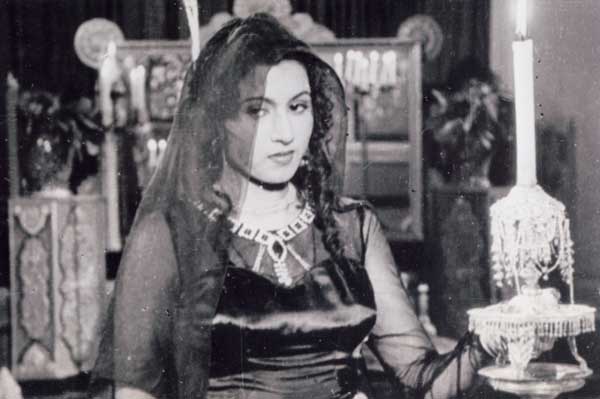
Mahal (1949): Perhaps the grandfather of this genre, Mahal tells of a man tortured and madly in love with an apparition who haunts his mansion and claims a connection from an earlier life. The film also features the haunting vocals of Lata Mangeshkar’s all-time hit Aayegaa Aanewaalaa.

Madhubala mesmerizes Ashok Kumar in Mahal (1949)

Madhumati (1958): This classic Vijayantimala-Dilip Kumar blockbuster is told in flashback to a previous lifetime of the murder of the woman the hero still loves. The gently alluring Aajaa Re Pardesi encompasses the film’s themes of love and debts spanning several lifetimes.

Vijayantimala is reincarnated to find her lover once more in Madhumati (1958)

Bees Saal Baad (1961): A rich man comes to live in his new mansion and must solve a tragedy and murder that occurred 20 years earlier. The film contains a brilliant surprise ending, and Lata Mangeshkar scores once again with the beautiful Kahin Deep Jale, Kahin Dil.

Biswajeet follows a mysterious voice in Bees Saal Baad (1961)

Kohra (1964): This twist on Hitchcock’s Rebecca is told through the eyes of a female protagonist, living in a large, unexplored mansion that is haunted by the apparition of her husband’s first wife. Waheeda Rehman must discover the true circumstances surrounding the first wife’s death before she is driven insane. The song of the femme fatale (Jhoom Jhoom Dhalti Raat) is an absolutely genius and rare example of symbolic imagery in montage to create a feeling of horror from the song.

Waheeda Rehman sees a ghostly vision atop her mansion roof in Kohra (1964)

There are some films that contain one or more of the above elements that I have not classified as Indian film noir. These include Mera Saaya, Gumnaam, and Karz, for different reasons–often overall tone or cinematographic style. Additionally, others might argue that these films should not be categorized at all as Indian film noir, but rather as Indian gothic horror films or other such genres. Watch some of these classics and let us know your take on this chapter in cinematic history!

– Mrs. 55

Khudaa-E-Bartar Lyrics and Translation: Let’s Learn Urdu-Hindi


Our blog probably seems like one huge Sahir Ludhianvi love-fest by now, but I couldn’t help myself from posting and translating this beauty from Taj Mahal (1963). This song is from the same movie as “jurm-e-ulfat pe,” which I translated here a little while ago. While “jurm-e-ulfat pe” tackles the theme of forbidden love, the lesser-known “khudaa-e-bartar” discusses something that doesn’t get much coverage in the world of Bollywood: war. By posing a series of questions, Ludhianvi uses universal and timeless words here to express the futility of war. While the song directly pertains to the Mughal battles depicted in the film, I’ll go out on a limb and say that the pacifism expressed in these lyrics is also Ludhianvi’s response to India’s losses in the Sino-Indian War, which had ended only a year before this film was released.

In addition to its unique thematic content, this song stands out for its nuanced use of language. Such elevated Urdu is truly a rare treat in Hindi cinema. Seriously, when was the last time you heard a song with the words like hidaayat, kibr-o-ghuruur, or fatah-o-zafar? Perhaps my favorite thing about this song is its use of izaafat, a grammatical construct borrowed from Persian where two nouns or a noun and adjective are linked together with the vowel -e- or -o-. When the -e- vowel is used between two nouns, it can generally be translated as “of.” When the -o- vowel is used, it is translated as “and.” This song makes extensive use of izaafat, as evident in compound phrases like rasm-e-jang-o-jadaal (rules of war and disputes) and jashn-e-tiir-o-tafang (celebration of arrows and rifles). Super fancy, no?

Since almost every other word here is a vocab word, you’ll have to take a close look at the glossary below while you follow along with the song. But I guarantee that you’ll learn some new Urdu if you do–enjoy and let us know your thoughts about this song in the comments!

–Mr. 55

P.S. For the classical music enthusiasts out there, this composition is also remarkable for being one of the finest examples of Raga Miyan ki Todi used in a film song.

Lyrics:
khudaa-e-bartar terii zamii.n par zamii.n kii khaatir, yeh jang kyo.n hai?
har ek fatah-o-zafar ke daaman pe khuun-e-insaa.n kaa rang kyo.n hai?

zamii.n bhii terii, hai.n ham bhii tere. yeh milkiiyat kaa savaal kyaa hai?
yeh qatl-o-khuu.n ka rivaaj kyo.n hai? yeh rasm-e-jang-o-jadaal kyaa hai?
jinhe.n talab hai jahaan bhar kii, unhii.n kaa dil itnaa tang kyo.n hai?

ghariib maao.n shariif bahno.n ko aman-o-izzat kii zindagii de
jinhe.n ataa kii hai tuu ne taaqat, unhe.n hidaayat kii roshnii de
saro.n me.n kibr-o-ghuruur kyo.n hai? dilo.n ke shiishe pe zang kyo.n hai?

qazaa ke raste pe jaanevaalo.n ko bach ke aane ki raah denaa
dilo.n ke gulshan ujaD na jaaye.n, muhabbato.n ko panaah denaa
jahaa.n me.n jashn-e-vafaa ke badle, yeh jashn-e-tiir-o-tafang kyo.n hai?

khudaa-e-bartar terii zamii.n par zamii.n kii khaatir, yeh jang kyo.n hai?

Glossary:
khudaa-e-bartar
: superior Lord; zamii.n: land, world; jang: war; fatah-o-zafar: victories and triumphs; daaman: foothills; khuun-e-insaa.n: human blood; milkiiyat: ownership; qatl-e-khuu.n: murders and blood; rivaaj: tradition; rasm-e-jang-o-jadaal: rules of war and disuptes; talab: need, desire; jahaan: world; tang: troubled; ghariib: poor; shariif: noble; aman-o-izzat: peace and respect; ataa karna: to bless; taaqat: strength, courage; hidaayat: guidance; roshnii: light; kibr-o-ghuruur: pride and arrogance; shiishaa: mirror; qazaa: death; bach ke aanaa: to escape; gulshan: garden; ujaD jaana: to be uprooted; panaah: shelter; jashn-e-vafaa: celebration of love; jashn-e-tiir-o-tafang: celebration of arrows and rifles

Rough Translation:
O superior Lord, why is there this war over land in your world? Why does human blood stain the foothills of every victory and triumph?

This land is yours, and we are yours. Then, what is this question of ownership and possession? What are these traditions of bloody murder? What are these rules of wars and disputes? Those who have a desire to rule the world, why are their hearts so troubled?

Give poor mothers and noble sisters a life of peace and respect. Give those whom you have blessed with strength and courage a light of guidance. Why are minds filled with pride and arrogance? Why are the mirrors of people’s hearts blemished by rust?

Give those who are headed on the road to death a way to escape. May the garden of hearts not be uprooted as you provide shelter to love. In this world, instead of a celebration of love, why is there a celebration of arrows and rifles?

O superior Lord, why is there war over land in your world?


O Mere Shah-e Khuban Lyrics and Translation: Let’s Learn Urdu-Hindi

Clad in a tight kimono, Asha Parekh prances about Japan in Love in Tokyo (1966)

Next we will explore the lyrics and translation of the hit song “O Mere Shah-e Khuban” from Love in Tokyo. Shot on location in Japan shortly after the 1964 Olympics, Love in Tokyo (1966) is nothing short of an “exotic” tourist fantasy. The film is one of a trilogy of films I put in this category from the same era with Night in London (1967) and An Evening in Paris (1967). These are movies that dazzled Indian audiences with a glimpse into a lifestyle and culture outside the familiar homeland, and on occasion were almost laughably politically incorrect. Love in Tokyo stars Asha Parekh (playing an Indian woman raised Japanese) and Joy Mukherji who finds himself in Tokyo for reasons almost too complicated to discuss here (or probably anywhere outside a psychiatric ward).

But say what you want about the worth of the film’s plot, Love in Tokyo’s soundtrack is wonderful (the cheesy title song grows on you in spite of its lyrics). The real gem of the album is the love ballad “O Mere Shah-e Khuban”, with music by Shankar-Jaikishen. Lata Mangeshkar and Mohammed Rafi each sing a version at different points in the film. I naturally prefer Rafi’s because of that deep sublime silky voice, but it’s open for argument. The lyrics have some rare Urdu vocabulary and is an example of probably the only time you will ever hear the “h” in “shaah” actually pronounced because of the “-e-” conjunct that follows! This Hasrat Jaipuri ghazal harkens to a famous couplet of Mughal era poet Momin Khan Momin: “Tum mere paas hote ho goyaa/Jab koi doosraa nahii.N hotaa.” The lines can be interpreted on several levels, literal and spiritual, and are a beautiful example of classical Urdu poetry’s rich legacy in contemporary music.

I loved the intro music to this song so much, I actually featured it in my Harvard thesis film. Enjoy our English translation of “O Mere Shah-e Khuban” below!

O Mere Shah-e Khuban Lyrics and Translation:

O mere shaah-e khubaa.N, o meri jaan-e janaana
Oh my beautiful ruler, the love of my life
Tum mere paas hote ho
You are beside me
Koi doosra nahi.N hota
Let no one else take your place

O mere shaah-e khubaa.N…

Kab khayaalo.N ki dhoop dhalti hai
When the sunlight fades from my thoughts
Har qadam par shamaa si jalti hai
Then with every step there is a light as if from a candle
Mera saayaa jidhar bhi jaataa hai
For wherever my shadow goes
Teri tasveer saath chalti hai
It goes with your image

O mere shaah-e khubaa.N…

Tum ho saharaa mei.N, tum gulistaan mei.N
You are in the desert, you are in the rose gardens
Tum ho zarron mei.N tum biyaabaan mei.N
You are in every particle, you are in the wilderness
Mai.N ne tumko kahaa.N kahaa.N dekha
I have seen you everywhere
Chhupke rehte ho tum rag-e-jaan mei.N
You are hidden within my very veins

O mere shaah-e khubaa.N…

Meri aankho.N ki justaju tum ho
You are that for which my eyes are searching
Iltijaa tum ho, aarzoo tum ho
You are my prayer, and you are my desire
Main kisi aur ko to kya jaanuu.N?
What could I know about anyone else
Meri ulfat ki aabroo tum ho
The honor of my love lies with you

O mere shaah-e khubaa.N…

Glossary:

Shaah: ruler; khubaa.N: radiant, beautiful; janaanaa: beloved; doosra: second, other; dhoop: sunlight; shamaa: light, candle; saayaa: shadow; tasveer: photograph, image; saharaa: desert; gulistaan: rose garden; zar: particle; biyaabaan: wilderness, desert; rag: vein, vessel; justaju: quest, search; iltijaa: request, prayer; aarzoo: desire; ulfat: love; aabroo: honor

As a bizarre bit of trivia, in the film Asha Parekh often does her hair in cutsy ponytails with a beaded elastic. The hairdo became known as “The Love in Tokyo” and was enjoyed a brief period of popularity among the masses. But men, don’t think you’re above this sort of fad–that classy plaid fedora from Jewel Thief? Sold-out in Indian stores across the nation after the film’s release. So let’s just try be grateful for what dignity we have.

Sweet ‘do, Asha. You totally blend in now!

-Mrs. 55

Two or Three Things I Know about Mira Nair: Thoughts from a Former Intern

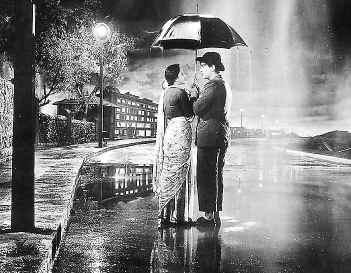
Nargis and Raj Kapoor in one of the most iconic shots of classic Indian cinema from Shree 420 (1955)

A scene from Mira Nair’s Monsoon Wedding (2001) inspired by Raj Kapoor’s classic

After the summer of my sophomore year, I was fortunate enough to intern with my favorite contemporary director Mira Nair. Both of us had studied film production at Harvard University and incidentally under the same professor! I first met Mira at his film screening at the Museum of Modern Art in New York City when I spotted her in the audience. My heart was beating so fast, I could hardly sit still through the screening. After the show, I gave her my impromptu elevator speech and joined the crew at Mirabai Films that summer!

Intern Mira Nair

Mira Nair and I at the MoMA my sophomore year. Note the glazed look in my eyes. Best day ever!

I was twelve years old when I saw Monsoon Wedding (2001) and have yet to find a movie from my generation that I love more. Mira’s other films include Vanity Fair, Salaam Bombay, The Namesake, Kama Sutra, and Amelia, but what does any of this have to do with old Hindi cinema? I want to talk about a side to her movies that you may not have been familiar with—that is, the impact of classic Bollywood on her work.

Perhaps you can recall that scene from Monsoon Wedding in which the wedding planner marries the housemaid beneath an umbrella. Look familiar? It should! Mira was directly inspired by Raj Kapoor’s famous song “Pyaar Hua Iqrar Hua” in directing this scene. Like Nargis and Raj Kapoor walking together on a rainy night, huddled together beneath an umbrella, Mira’s characters strike the same pose to celebrate their romance at the height of the Indian monsoons.

On-set and behind-the-camera with Hollywood director, Mira Nair.

In the front lobby of Mirabai Films hangs an original hand-painted movie poster of Aurat (1940), Mehboob Khan’s little-known precursor to the later smash-hit Mother India (1959). Its relative obscurity (and the eagerness to explain) brings a pride that can only be known to a fellow old Bollywood fanatic. By her desk is a beautiful and fascinating work of photography taken of the interior of R.K. Studios. Mira once explained how the studio in her photograph seems so unassuming and bland, but there, in an inconspicuous back wall besides an empty soda bottle hangs a small, telling picture of the greatest showman of India—Raj Kapoor himself. Despite his wealth and glamour, he and his colleagues maintained an inspiring sense of humility throughout his career that inspired hers.

If you’re looking for more celebrity interest, there is a great scene in her film, Vanity Fair (2004), in which the heroine (played fearlessly by Reese Witherspoon) makes an ill-received attempt to blend in among a high-class dinner party. Guess what? The scene was inspired by none other that the classic song Jaane Woh Kaise from Guru Dutt’s classic Pyaasa! In fact, Mira love it so much and wanted to make sure she captured Dutt’s spirit so precisely, that she got the whole cast together and watched Pyaasa for a movie night before the shoot. You heard me, people. If you have yet to watch Pyaasa yourself and are still looking for reasons to make the commitment, try this: Reese Witherspoon has seen it and you haven’t. Enough said.

Guru Dutt makes the room incredibly uncomfortable in Pyaasa (1957), an inspiration for Reese Witherspoon’s future character in Vanity Fair (2004).

And did you know Mira was very close friends with bold auteur Satyajit Ray? Mira’s favorite of his films include The Apu Trilogy and Days and Night in the Forest (1970), the latter of which was actually screened at the Harvard Film Archive last year with Sharmila Tagore in person! (I obviously had front row seats, almost underwent cardiac arrest upon seeing Sharmila in person, and begged for an autograph that is now framed on my desk. But that’s neither here nor there.) In fact, after growing up on these films, Mira came to respect Sharmila so much as an actress, and eagerly cast her in one of her first indie films called Mississippi Masala (1991)!

There are a million other ways old Bollywood films have influenced her work, and I have highlighted only a few that I know from working with her personally. Watch her films and let us know which others you can spot! Until then, put Pyaasa on your early Christmas list.

-Mrs. 55