Dil Jo Na Keh Saka Lyrics and Translation: Let’s Learn Urdu-Hindi

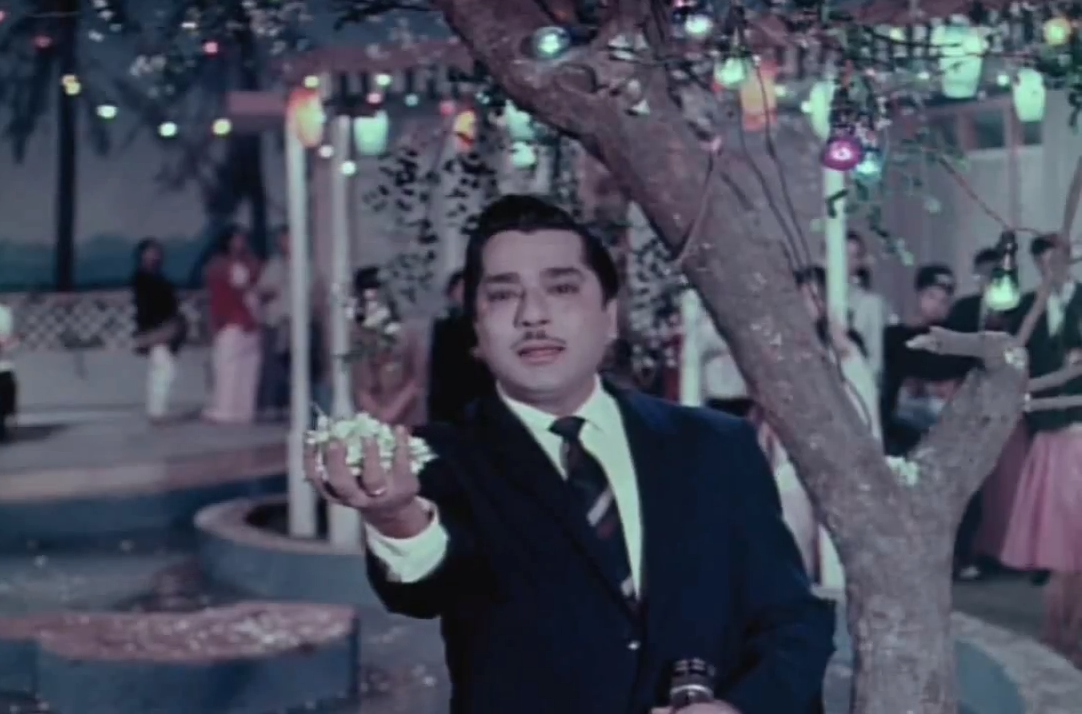
A vengeful Pradeep Kumar taunts Meena Kumari at her engagement party in Bheegi Raat (1965)

Bheegi Raat (1965) stars Ashok Kumar, Meena Kumari, and Pradeep Kumar in a classic Bollywood love triangle story full of messy drama and heartache. The film is not particularly memorable for its plot, but the soundtrack composed by Roshan and penned by Majrooh Sultanpuri contains a beautiful Raga Yaman-based gem that is still remembered today: “dil jo na keh saka.” Here, I’ve provided the lyrics and translation for both the female version (sung by Lata Mangeshkar) and the male version (sung by Mohammed Rafi) found in the film. The lyrics for the female version are standard Bollywood fare, but the male version is surprisingly vengeful and caustic. Hearing these lyrics in context of the film makes more sense: a jealous Pradeep Kumar taunts Meena Kumari using this song at a party celebrating her engagement to Ashok Kumar during the film’s conclusion. Even still, some of these lyrics are pretty wild. For example, he implores Meena’s character to drink blood from the heart (!) (piyo chaahe khuun-e-dil ho, ki piite pilaate hi…). The bitter sentiments found in these lyrics really drive home a theme expressed in Hindi films from this era that we’re all forced to grapple with at some point — love really hurts sometimes, doesn’t it?

–Mr. 55

P.S. Obviously, the Rafi version of this song is more popular than the Lata version, but I really think Lata holds her ground in this case with the tandem rendition. Her version has a segment of humming during the introduction that isn’t found in the Rafi version, which has always sounded absolutely heavenly to me.

Dil Jo Na Keh Saka Lyrics and Translation:


[Male]

dil jo na kah sakaa, vohii raaz-e-dil kahne kii raat aayii
The  night has come to uncover that secret which my heart could not reveal. 

naghmaa saa koii jaag uThaa badan me.n
A melody has awakened in my soul,
jhankaar kii sii thharthharii hai tan me.n
and a tinkling sensation quivered throughout my body.
mubaarak tumhe.n kisii kii laraztii sii baaho.n me.n rahne kii raat aayii
Congratulations to you, for the night has come to spend in someone else’s quivering arms. 

taubaa! yeh kis ne anjuman sajaa ke
Oh! Who has organized this gathering
tukDe kiye hai.n gunchaa-e-vafaa ke?
and destroyed the flowerbud of love?
uchhaalo gulo.n ke tukDe ki rangii.n fizaao.n me.n rehne kii raat aayii
Toss up the pieces of those flowers, for the night has come to spend in this colorful atmosphere.

chaliye mubaarak jashn dosti kaa,
Felications on this celebration of friendship;

daaman to thaamaa aap ne kisii kaa
you have accepted someone else’s embrace. 

hame.n to khushii yahii.n hai, tumhe.n bhi kisii ko apnaa kahne kii raat aayii
I am pleased, as the night has come for you to call someone else your own.

saaghar uThaao, dil kaa kis ko gham hai?
Raise your wine glass; who sulks for the heart?
aaj dil kii qiimat jaam se bhi kam hai
Today, the value of a heart is worth less than that of wine.  

piiyo chaahe khuun-e-dil ho ki piite pilaate hii rahne kii raat aayii
Drink the blood of the heart if you so desire, for the night of endless drinking has come. 

dil jo na kah sakaa, vohii raaz-e-dil kehne kii raat aayii
The night has come to uncover that secret which my heart could not reveal.


[Female]

dil jo na kah sakaa, vohii raaz-e-dil kahne kii raat aayi
The night has come to uncover that secret which my heart could not reveal. 
naghmaa saa koii jaag uThaa badan me.n
A melody has awakened in my soul,
jhankaar kii sii thharthharii hai tan me.n
and a tinkling sensation quivered throughout my body. 

pyaar kii inhii.n dhaDaktii fizaao.n me.n rahne kii raat aayii
The night has come to spend in this pulsating ambience of love.  

ab tak dabii thii ek mauj-e-armaa.n
Until now, a wave of desire was suppressed within me.
lab tak jo aayii ban gayii hai tuufaa.n
When it reached my lips, it became a storm.
baat pyaar ki bahakti nigaaho.n se kahne kii raat aayii
The night has come to speak about love to those wandering eyes. 

guzare na yah shab, khol duu.n ye zulfe.n
As the night passses slowly, I shall let down my hair.
tum ko chhupaa luu.n muund ke ye palake.n
And I will hide you by shutting these eyelids. 
beqaraar sii laraztii sii chhaa.nvo.n me.n rahne ki raat aayii
The night has come to spend in these restless and quivering shadows. 

dil jo na kah sakaa, vohii raaz-e-dil kahne kii raat aayi
The  night has come to uncover that secret which my heart could not reveal.

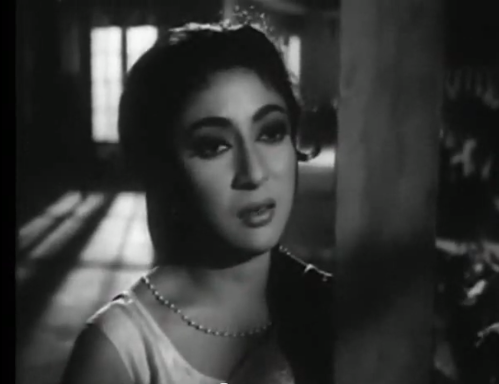
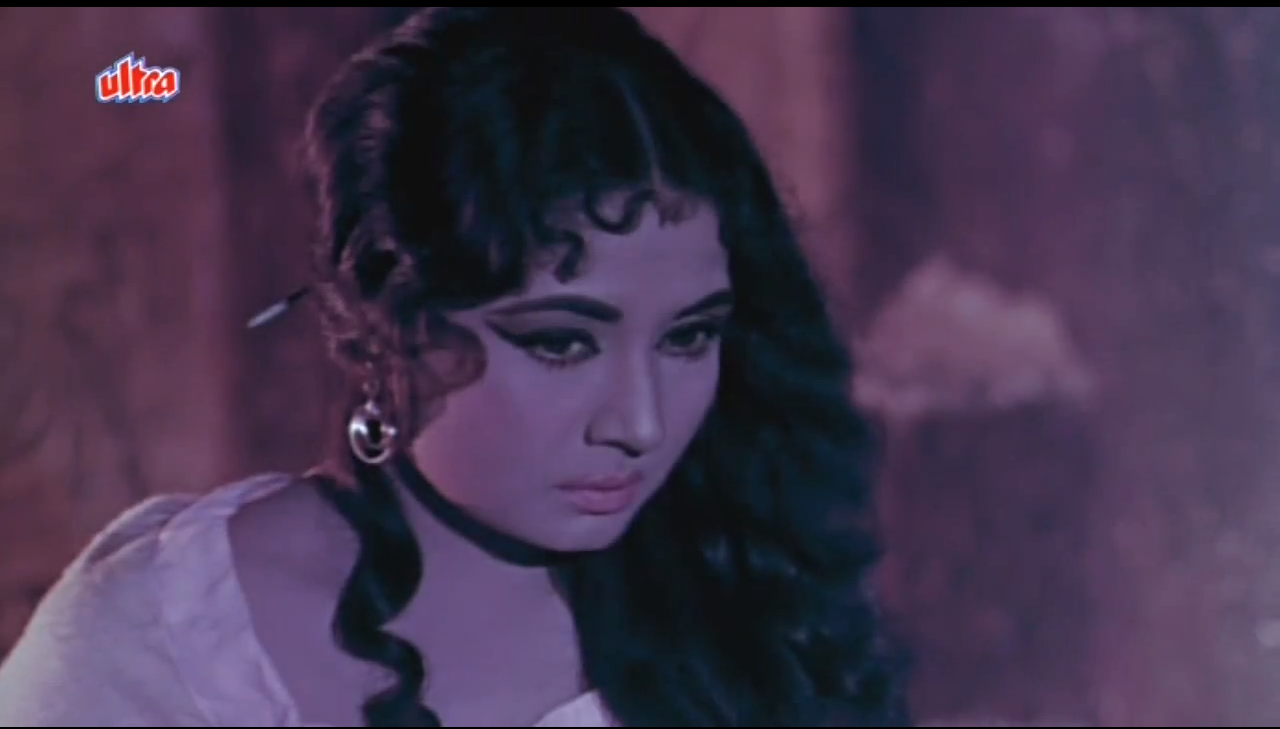
Meena Kumari looking beautiful (and sad) as usual in Bheegi Raat (1965).

Glossary:

raaz-e-dil: secret of the heart; naghmaa: melody, song; thharthharaanaa: to quiver;  jhankaar: tinkle; laraztii: trembling; baaho.n: arms; tauba: oh!; anjuman: gathering; tukDe karna: to crush, destroy; gunchaa-e-vafaa: flowerbud of love; uchhaalna: to throw, toss up; gul: flowerfizaa: atmosphere, ambience; jashn: celebration; daaman thhaamnaa: to accept an embrace; saaghar: wine glass; qiimat: price, value; jaam: wine; khuun-e-dil: blood of heart; dabnaa: to suppress; mauj-e-armaa.n: wave of desire; bahakna: to wander; shab: night; muundna: to shut; palake.n: eyelids; beqaraar: restless

Jani O Jani Lyrics and Translation: Let’s Learn Urdu-Hindi

Next we will discuss the lyrics and translation of the nostalgic Kishore Kumar song “Jani O Jani.” However, this post is going to be a little different since something a little different happened to me this month. My wonderful boyfriend of 2 years proposed to me! We met when he was recruited by a friend to be an extra in the 1950s Bollywood film tribute I was shooting for my thesis at Harvard. The deal was essentially sealed when I realized he had heard more than half the songs on my 60s Mohammed Rafi playlist. Two years later, he planned a surprise engagement proposal straight from a Bollywood dream sequence! I was reminded immensely of an old Kishore Kumar gem, “Jaani O Jaani” from Raja Jani (1972). There is something both nostalgic and hopeful about this song that I love.

Raja Jani (1972) is actually an incredibly fun film–basically the 70s Bollywood version of the American feature-length cartoon Anastasia (1997). It’s colorful, upbeat, and filled with exciting drama at its predictable best. The story is written by the highly-talented Nabendu Ghosh, who also wrote more somber-toned philosophical works like Bandini (1963) and Teesri Kasam (1967).

We don’t often translate Kishore Kumar songs on this site because of my obsession with Mohammed Rafi and Mr. 55’s obsession with Lata (surprise surprise—Mr. 55 and I are just friends!). But this song is special. It’s picturized on Dharmendra driving through the Delhi streets and evokes that sense of travel and beginning a journey found in many of Kishore other great hits (eg. “Musafir Hoo.N Yaaro.N”, “O Maaji Re”, etc.). Very appropriate for the occasion of starting a new life together (oh, give me a break).

Dharmendra and Hema Malini exchange uber cute glances in Raja Jani (1972)

Lyrics and Translation:

Jani O jani
Darling, oh darling
Jaldi se aaja miljaa ke biit jaaye yeh jawaanii
Come meet me quickly because our youth slips away

Bigda naseeba banne ke liye
To correct my misguided fate
Ek ishaaraa tere kaafi hai
Just one signal from you is enough
Aashiq ke jiine marne ke liye
To make the choice between life and death for a lover
Itna sahaara tera kafi hai
That is all the support that is needed
Tujh pe lutadoonga mitadoonga mai.N yeh zindagaani
For you, I would throw away and wipe out this life of mine
Jaani O jaani jaani O jaani
Darling, oh darling

Aankhon mei.N teri tasveer liye
Carrying your picture in my eyes
DhuunDh raha hoo.N tujhe raste mei.N
I search for you along the way
Teri galii mei.N teraa diiwaanaa
In your street, that man who is crazy in love with you
Bech rahaa hai dil saste mei.N
Is selling his heart to you cheaply
Karle yeh sauda leja deja raani dil ki nishani
Accept this bargain and let us exchange, my queen, tokens of our hearts
Jaani O jaani
Darling, oh darling

Glossary:

jaani: darling, sweetheart; jaldi se: quickly; jawaani: youth; naseeba: fate; ishaaraa: signal; aashiq: lover; sahaaraa: support; zindagaani: life; tasveer: picture; sauda: bargain, exchange

I know, I know, this is obnoxious, but I really had to put a picture of my engagement ring here. Is the teal box in the background a subtle enough clue that it’s from Tiffany’s?! Was the complimentary teal background over-doing it?

Why yes, it’s a flawless Tiffany solitaire engagement ring.

OK, OK, I’m done now.

-Mrs. 55

The Bollywood Bromance: Songs of Manly Love

There are few things cuter than a wholesome die-hard Indian bromance. In the past decade, the term “bromance” has become popularized by the American media and by high-grossing summer flicks that explore its comedic aspects—but its roots can be traced back to Hollywood first academy award for best picture Wings (1927). This silent heart-wrenching World War I love-fest between two men inspired dozens of commercial hits down the road from Butch Cassidy and the Sundance Kid (1969) to Top Gun (1986). Say what you want about those films, however, Bollywood was unarguably where this concept blossomed to its colorful fullest.

Perhaps it’s cultural—I can remember visiting Simla when I was younger and seeing teenage boys holding hands as they walked down the street. It was just considered a normal expression of friendship. Things have changed plenty since my childhood, but regardless, the marketability of the bromance genre may also likely stem from what had (and has) been for a long time a male-dominated industry–from directors to screenwriters all the way down to the lowly production assistants. In fact, in the early pre-talkie years of Indian cinema, women were not even allowed to act in films, much less attend viewings. Y-chromosome melodrama sells, and sells big. The bonds of manly love have been a glorified subject of Bollywood expression since time immemorial and has inspired some of the best movies you’ll ever watch.

In this post, we’ll explore our top 5 “bromantic” songs of yesteryear films long before the days of Dostana (2008) and even Qurbani (1980). From declaring eternal devotion to sobbing over betrayal, each one has a special place in our hearts and cinematic history.

Amitabh Bachhan and Dharmendra sing out their love in Sholay (1975)

Yeh Dosti (Sholay 1975):

This song is the crowning jewel of Bollywood bromance. Set at the beginning of an all-time megahit, this song showcases two men (Amitabh Bachhan and Dharmendra) riding a single motorcycle and singing their love for each other. Chest-hair is just blowing in the wind as their friendship is put to the test at the film’s climax. Overdone slightly, but a timeless tear-jerker!

Raj Kapoor pours his heart into his sad song of betrayed trust in Sangam (1964)

Dost Dost Na Raha (Sangam 1964):

Talk about tragedy. Raj Kapoor flies to war and saves his country, only to return and discover that his wife Vijayantimala is really in love with his own best friend Rajendra Kumar. This song of betrayal and lost friendship played morosely on the living room piano makes everyone in the room awkward. Please note that low-cut v-neck top. No, I’m not referring to Vijayantimala.

Rajesh Khanna and Amitabh Bachhan being adorable in Namak Haraam (1978)

Diye Jalte Hai.N (Namak Haraam 1973):

A Rajesh Khanna classic. Although best friends, Rajesh Khanna and Amitabh Bachhan come from two very different socio-economic statuses, ultimately leading to a huge public morally-charged battle of principles. Rajesh Khanna plays the good guy as usual, and his on-screen chemistry with Bachhan evokes the joy audiences loved in Anand! Did I mention the obligatory and visible fluffy chest hair?

Facing starvation and homelessness, two boys find friendship in Dosti (1964)

Chahoonga Mai.N Tujhe (Dosti 1964):

This film was unique in that it is entirely about two teenage boys (neither of whom were big stars then) and the sacrifices they make for each other. Did I mention the hero is blind and homeless? It makes it more endearing. This beautiful Mohammed Rafi song of tragedy is when the hero realizes his best friend is better off without him, and decides to get out of his way forever. These are kids, guys. It’s really, really cute.

Pran works to get a smile out of Amitabh Bachhan in Zanjeer (1973). This is a must-see–Pran is just such a beast in this movie.

Yaari Hai Imaan Mera (Zanjeer 1973):

Oh, Pran, you are a legend. This famous song celebrates the friendship between an Indian (Amitabh Bacchan) and an Afghani patthan (the inimitable Pran). He embodies this character so skillfully—look at how he twirls and gives that sly shake of the head, you’d think he had grown up in a mountainous outskirt of Kabul. See, Bollywood knows how to cross political boundaries too!

An extremely honorable mention goes to “Anhoni Ko Honi” from Amar Akbar Anthony (1979). Does it really count as a bromance if they’re actually supposed to be brothers?

Amitabh Bacchan, Vinod Khanna, and Rishi Kapoor are three brothers on a mission in Amar Akbar Anthony (1979)

Share with us your thoughts and additions to our list!

-Mrs. 55

Woh Hanske Mile Humse Lyrics and Translation: Let’s Learn Urdu-Hindi

Although Asha Bhonsle is perhaps most well-known for her seductive and playful songs (see our translation of “raat akelii hai” here), she was a truly versatile artist who had an excellent command over a range of styles and emotions. When she is in a serious mood, Asha can really tug at your heartstrings with her sad singing. Think “ab ke baras bhej bhaiyya ko babul” from Bandini (1963), “yeh kyaa jagah hai dosto” from Umrao Jaan (1981), or “meraa kuch saamaan” from Ijaazat (1987).  Here, I’ve translated a short yet painfully beautiful Asha solo from Baharein Phir Bhi Aayengi (1966) called woh hanske mile humse.”

Baharein Phir Bhi Aayengi was released posthumuously under Guru Dutt’s film banner after Guru Dutt’s demise in 1964. The film was not even complete half-way before Guru Dutt’s death, so the film was shot again with a new director Shahid Lateef and new hero Dharmendra. Although the movie itself lacks the magic found in older Guru Dutt films, O.P. Nayyar’s soundtrack for the movie is still remembered today, most notably the Rafi number “aap ke hasiin rukh pe aaj nayaa nur hai.”

Mala Sinha in a melancholic mood in Baharen Phir Bhi Aayengi (1966)

The movie’s plot focuses on a love triangle: handsome young news reporter Jitendra (played by Dharmendra) falls in love with the bubbly Sunita (played by Tanuja) while Sunita’s older sister and head of the newspaper Amita (played by Mala Sinha) eventually becomes smitten by Jitendra. Before Amita decides to reveal her feelings to him, she finds out that Jitendra is actually in love with  Sunita. Although she is devastated by this news, she decides to back away for the sake of her sister’s happiness.  Here’s where the song I’ve translated comes in. Backed by Asha’s painstricken vocals and S.H Bihari’s simply crafted lyrics, Amita laments how she misinterpreted Jitendra’s actions to think that he was in love with her when that was not the case (“bekaar hii ulfat kaa izhaar samajh baiThe”). Sigh…

I think this song will strike a chord with those of you who have suffered through a romantic misunderstanding–it certainly did with me.

-Mr. 55

Woh Hanske Mile Humse Lyrics and Translation

woh ha.nske mile ham se, ham pyaar samajh baiThe
He smiled at me when we met, so I thought that he loved me.
bekaar hii ulfat kaa izhaar samajh baiThe
I interpreted it, in vain, as a declaration of love.

aisii to na thii qismat apnaa bhii koii hotaa
It was not in my fate to call someone my own.
kyo.n khud ko muhabbat kaa haqdaar samajh baiThe?
Why did I consider myself entitled to his love? 

roye.n to bhalaa kaise, khole.n to zabaa.n kyo.n kar?
How shall I cry, why should I speak?

Darte hai.n ki jaane kyaa sansaar samajh baiThe.
I fear what society has perceived of this. 

woh ha.nske mile ham se, ham pyaar samajh baiThe
He smiled at me when we met, so I thought that he loved me. 

Glossary

bekaar: useless, in vain; ulfat: love; izhaar: declaration; qismat: fate, destiny; haqdaar: entitled; zabaa.n kholna: to speak; sansaar: society 

Woh Shaam Kuch Ajeeb Thi Lyrics and Translation: Let’s Learn Urdu Hindi

Waheeda Rehman Rajesh Khanna khamoshi

Waheeda Rehman soothes Rajesh Khanna’s aching soul in Khamoshi (1967).

Our next post will explore the stirring lyrics and translation of “Woh Shaam Kuch Ajeeb Thi” from Khamoshi (1967.) A one-of-a-kind film from its generation, Khamoshi is the moving story of patients in an insane asylum and the woman who treats them played by the graceful Waheeda Rehman. In American and European films, the theme of mental illness, the dangers of institutionalism, and the murky line between doctor and patient had been explored quite frequently–such as with famous German Expressionism’s The Cabinet of Dr. Calighari (1931), Hitchcock’s Spellbound (1958), and of course, One Flew Over the Cuckoo’s Nest (1976). However, in Bollywood, the Asit Sen hit Khamoshi vividly remains the only film from that era to have fully explored this theme.

Based on the short story “Nurse Mitra” by Ashutosh Mukhopadhyay, Khamoshi shines with wonderful performances, exquisite musical compositions, and disturbing black-and-white cinematography. Interestingly, Suchitra Sen starred in the original Bengali version Deep Jwele Jaai (1959) also directed by Asit Sen!

In this song, Rajesh Khanna, a patient at the mental institution where Waheeda works, takes her on a boat and declares his love for her. Still recovering from an episode in which he was jilted by a former girlfriend, Rajesh blurs his memories of the two women in these lyrics. Little does he know, his blind, albeit misguided love is the final provocation for Waheeda Rehman to lose her own sanity as she struggles to recover from having also lost one she once loved.

Waheeda Rehman works as a nurse in an insane asylum for the love-sick in Khamoshi (1967)

Woh Shaam Kuch Ajeeb Thi Lyrics and Translation:

Woh shaam kuch ajeeb thi
There was something strange about that evening,
Yeh shaam bhi ajeeb hai
Just as this evening feels strange
Woh kal bhi paas paas thi, woh aaj bhi qareeb hai
She was close to me yesterday, she is near me today as well
Woh shaam kuch ajeeb thi
There was something strange about that evening

Jhukii hui nigaaho.N mei.N, kahii.N meraa khayaal thaa
In her lowered gaze, perhaps there was a thought of me
Dabi dabi ha.Nsii mei.N ek haseen saa gulaal tha
As she suppressed a smile, there was a burst of beautiful color
Main sochtaa thaa meraa naam gungunaa rahi hai woh
I used to think that she was singing my name
Na jaane kyo.N laga mujhe ki muskuraa rahi hai woh
I do not know why it seemed to me that somewhere she is smiling
Woh shaam kuch ajeeb thi
There was something strange about that evening

Meraa khayaal hai abhii jhuki hui nigaaho.N mei.N
Now thoughts of me are in her shy, lowered gaze
Khulii hui hansi bhi hai, Dabii huii sii chaah mei.N
Even though she is laughing openly, there a hidden desire
Mai.N jaanta hoo.N, meraa naam gungunaa rahi hai woh
I know that she is singing my name
Yehii khayaal hai mujhe ki saath aa rahi hai woh
It appears to me that she is coming closer
Woh shaam kuch ajeeb thi
There was something strange about that evening

Glossary:

shaam: evening; ajeeb: strange; qareeb: close, near; jhuka: lowered; khayaal: thought; ha.Nsii: laughter; gulaal: color [like those thrown during the festival of holi]; muskuraanaa: to smile; khula: open; chaah: want, desire

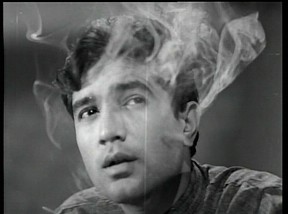
Rajesh Khanna checks in to the kind of hospital where smoking is permitted, and professionalism in doctor-patient relationships remains conveniently undefined…Khamoshi (1967)

For whoever can’t handle the suspense, the film ends with Waheeda being committed to her own institution and Rajesh Khanna declared sane–with the implication that one day perhaps another doctor will fall in love with her and the roles will reverse yet again. It is a cold and disturbing message filmed with some of the purest cinematographic beauty in Bollywood. I’ll spare you from a discussion of subversive political symbolism, but I will point out one last bit of trivia:

In the Bengali version, the Hemant Kumar song “Ai Raat Tomar Amar” is filmed with the same mis-en-scene as “Tum Pukar Lo” in Khamoshi, however, the melodies are not the same! “Ai Raat Tomar Amar” is in fact the musical predecessor of “Yeh Nayan Dare Dare” from Hemant Kumar’s later soundtrack in Kohraa (see our post on Bollywood film noir for more). Music directors back then were notorious for reusing compositions–and we’re sure glad they did!

-Mrs. 55