Dekhi Zamane Ki Yaari Lyrics and Translation: Let’s Learn Urdu-Hindi

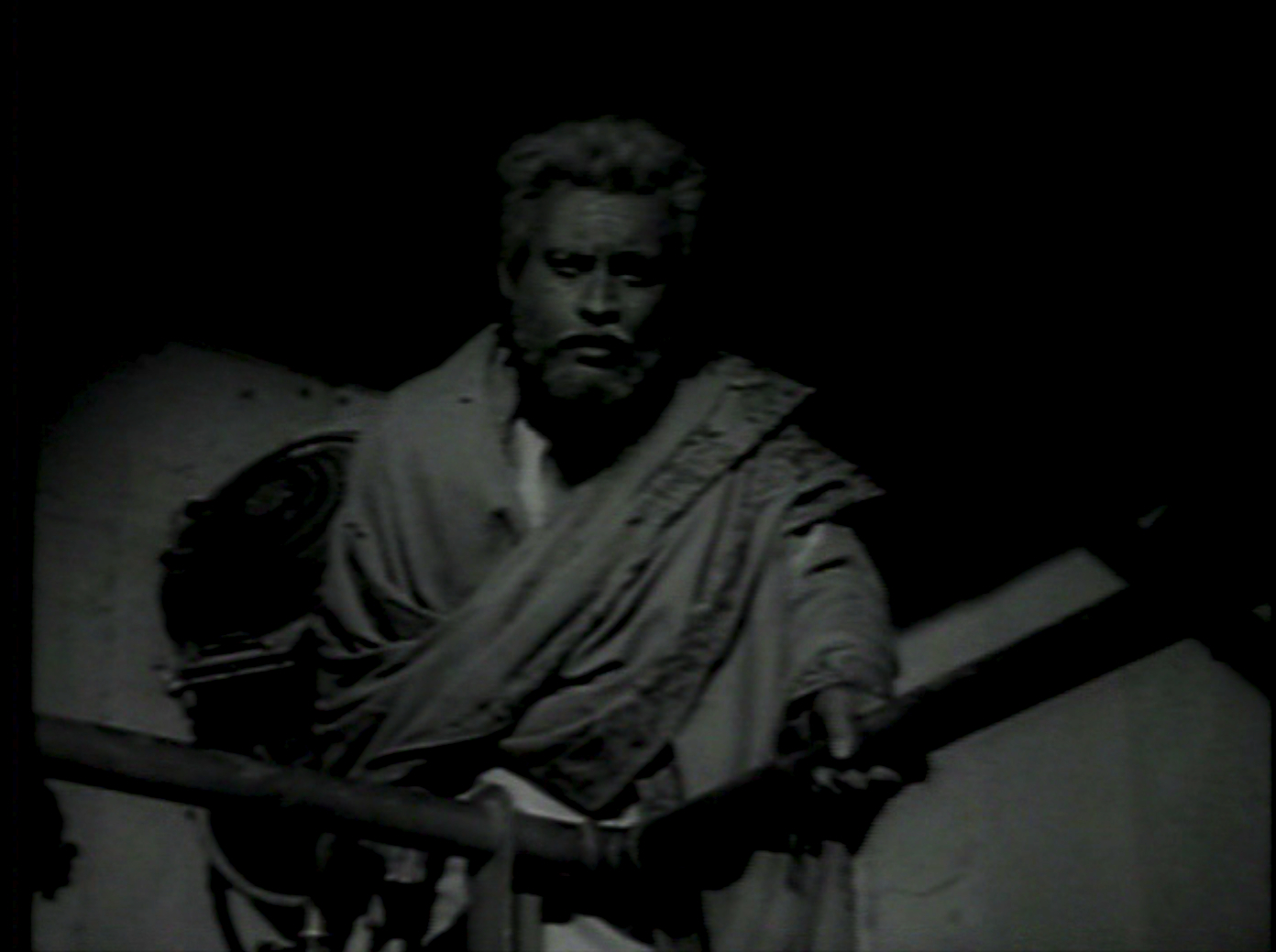
old man Guru Dutt Kaagaz Ke Phool 7

Guru Dutt reflects on his life as a once-great Bollywood director in the semi-autobiographical epic Kaagaz Ke Phool (1957).

The lyrics and English translation of Dekhi Zamane Ki Yaari are among the most beautiful you can find. The very soul of Guru Dutt can be found in the lyrics of Dekhi Zamaane Ki Yaari. The song is the heart of his masterpiece Kaagaz ke Phool (1957), and I contend contains the most passionate poetry you will ever find in a Bollywood song. Mohammed Rafi brings legendary Urdu poet Kaifi Azmi’s lyrics to an unheard of, feverish of climax that evokes a tragedy much deeper and more painful than any normal loss. Indeed, Kaagaz ke Phool tells a story of a different kind, and not one often explored: the slow destruction of an unfulfilled artist. I have already discussed some of the autobiographical parallels in this film in my translation of Waqt Ne Kiya, and will now present the actual story alongside the lyrics. It is one of the most haunting and powerful songs of that era.

Dekhi Zamaane ki Yaari reprises at different chapters in the film. The first starts in the opening as Guru Dutt plays an aged, dying film director who has returned to his old studio set before dawn. He sits up in the rafts and looks down on the empty world of show business below him. The song begins.

Dekhi Zamane Ki Yaari Lyrics and Translation:

Dekhi zamaane ki yaari
I have seen what goes for friendship in this world
Bichhade sabhee, bichhade sabhi baari baari
Everyone disperses,  one by one they all leave
Kya le ke mile.N ab duniya se? Aa.Nsuu ke siva kuch paas nahii.N
What will I take with me now to greet this world? Besides tears I have nothing
Ya phuul hi phuul the daaman mei.N, ya kaanto.N ki bhi aas nahii.N
I was either embraced by flowers, or other times did not even aspire to thorns
Matlab ki duniya hai saari
The whole world is selfish
Bichhade sabhee, bichhade sabhi baari baari
Everyone disperses,  one by one they all leave

The old man flashes back to younger days, when he was at the height of his career as a studio Bollywood director. The flashback transitions through a watery image of a lotus flower and a series of dutch-angled shots of eager fans. The high chorus interlude of the music inspires a sense of the divine, but when coupled with the teetering shots of the silent mob, also foreshadows something unnatural.

Guru Dutt smokes contemplatively on a balcony as fans await him below in Kaagaz Ke Phool (1957).

Waqt hai maherabaan, aarzuu hai javaan
During generous times, desires are young
Fikr kal ki karen, itni fursat kahaa.N
There is no leisure to worry about tomorrow
Daur yeh chaltaa rahe, rang uchaltaa rahe
Let this cycle continue, these colors keep splashing
Roop ko badalta rahe, jaam badalata rahe
Let the attractions keep changing, the intoxicants keep changing

Fans crowd Guru Dutt for signatures on empty pieces of paper that embody the theme of his film.

And here Guru Dutt masterfully transitions, for this is a story that is more than merely a tragic fall from societal grace. He shows us a character who has always felt alone–both when the world stood with him and when it abandoned him, searching for meaning in the dazzling lights of his own studio. It’s the kind of tragedy that doesn’t scream and doesn’t cause a colorful sensation. It’s one that softly and slowly erodes the soul–a desperate hunt for a human connection.

Guru Dutt comes home to a perpetually empty house in Kaagaz Ke Phool (1957)

Raat bhar mahamaan hai.N bahaare.N yahaa.N
Here, Spring is our guest the entire night
Raat gar dhal gayi, phir ye khushiyaa.N kahaa.N
But if the night ends, where do these joys go?
Pal bhar ki khushiyaa.N hai.N saari
All of these joys are only momentary
Badhane lagi beqaraari, badhane lagi beqaraari
And then restlessness begins to grow, restlessness begins to grow

Falling down a spiraling slope, he finds love at last and loses not only her, but his chance at happiness with his daughter, his friends, a wife, and his work. No producer will hire him, no actors will work with him. Everything these people once said and did for him was false. He returns years later to his old studio and sees Waheeda Rehman, the woman he loved and runs away in horror. Mohammed Rafi cries out with a violent passion in this segment–a ferocious plea to society and a desperate call to the suffering of his being. It is here that the meaning of “kaagaz ke phool” is explained–that dangerous unfeeling world of pretense. As the song comes to an end, Rafi gently sings the line, “Yeh khel hai kab se jaaari…” [“This game has been played so long…”] In his voice is the awful beauty of true resignation. You feel how tired this man is.

Utterly defeated, Guru Dutt looks back for a final time at the woman he loved and the world that once belonged to him in Kaagaz Ke Phool (1957).

Ud jaa! Ud jaa pyaase bha.Nvare! Ras na milega khaaro.N mei.N
Fly away thirsty bumblebee! You will not find nectar in these thorny shrubs
Kaaghaz ke phuul jahaa.N khilte hai.N, baiTh na un gulzaaro.N mei.N
Do not sit in those gardens where flowers of paper bloom
Naadan tamanna reti mei.N, ummiid ki kashti khaiti hai
In the sands of innocent desire, the boat of hope struggles to stay afloat
Ek haath se deti hai duniyaa, sau haatho.N se le leti hai
What the world gives with one hand, it takes away with one hundred
Yeh khel hai kab se jaari…
This game has been played for so long…
Bichhade sabhee, bichhade sabhi baari baari
Everyone disperses,  one by one they all pull away

Returning to the director’s chair, Guru Dutt bids farewell to society in Kaagaz Ke Phool (1957)

Then the flashback ends. He is an old man again hiding in the alcoves of his former studio. With careful decision, he sits down once more in the director’s chair in the center of the set.

Dekhi zamaane ki yaari
I have seen what goes for friendship in this world
Bichhade sabhee, bichhade sabhi baari baari
Everyone disperses,  one by one they all leave

Light floods the empty set. Dawn has broke and the crew enters to find an old unfamiliar man who has died sitting in the director’s seat.  The producer yells for his body to be removed so shooting can begin. And the cycle continues.

Kaagaz Ke Phool (1957) finishes over the blurred image of studio lights.

Glossary:

yaari: friendship; aa.Nsuu: tears; matlab: selfish (a homonym translates as “meaning”); duniyaa: society, world; waqt: time; aarzuu: desire; fikr: worry; fursat: leisure; daur: cycle, generation; rang: colour; uchalnaa: to splash, to scatter; jaam: intoxicant; mahamaan: guest; beqaraari: restlessness; bha.Nwara: bumblebee; ras: nectar; khaar: thorny shrub; kaaghaz: paper; gulzaar: garden; naadaan: innocent; reti: sand; ummiid: hope; kashti: boat; khel: game

-Mrs. 55

O Mere Shah-e Khuban Lyrics and Translation: Let’s Learn Urdu-Hindi

Clad in a tight kimono, Asha Parekh prances about Japan in Love in Tokyo (1966)

Next we will explore the lyrics and translation of the hit song “O Mere Shah-e Khuban” from Love in Tokyo. Shot on location in Japan shortly after the 1964 Olympics, Love in Tokyo (1966) is nothing short of an “exotic” tourist fantasy. The film is one of a trilogy of films I put in this category from the same era with Night in London (1967) and An Evening in Paris (1967). These are movies that dazzled Indian audiences with a glimpse into a lifestyle and culture outside the familiar homeland, and on occasion were almost laughably politically incorrect. Love in Tokyo stars Asha Parekh (playing an Indian woman raised Japanese) and Joy Mukherji who finds himself in Tokyo for reasons almost too complicated to discuss here (or probably anywhere outside a psychiatric ward).

But say what you want about the worth of the film’s plot, Love in Tokyo’s soundtrack is wonderful (the cheesy title song grows on you in spite of its lyrics). The real gem of the album is the love ballad “O Mere Shah-e Khuban”, with music by Shankar-Jaikishen. Lata Mangeshkar and Mohammed Rafi each sing a version at different points in the film. I naturally prefer Rafi’s because of that deep sublime silky voice, but it’s open for argument. The lyrics have some rare Urdu vocabulary and is an example of probably the only time you will ever hear the “h” in “shaah” actually pronounced because of the “-e-” conjunct that follows! This Hasrat Jaipuri ghazal harkens to a famous couplet of Mughal era poet Momin Khan Momin: “Tum mere paas hote ho goyaa/Jab koi doosraa nahii.N hotaa.” The lines can be interpreted on several levels, literal and spiritual, and are a beautiful example of classical Urdu poetry’s rich legacy in contemporary music.

I loved the intro music to this song so much, I actually featured it in my Harvard thesis film. Enjoy our English translation of “O Mere Shah-e Khuban” below!

O Mere Shah-e Khuban Lyrics and Translation:

O mere shaah-e khubaa.N, o meri jaan-e janaana
Oh my beautiful ruler, the love of my life
Tum mere paas hote ho
You are beside me
Koi doosra nahi.N hota
Let no one else take your place

O mere shaah-e khubaa.N…

Kab khayaalo.N ki dhoop dhalti hai
When the sunlight fades from my thoughts
Har qadam par shamaa si jalti hai
Then with every step there is a light as if from a candle
Mera saayaa jidhar bhi jaataa hai
For wherever my shadow goes
Teri tasveer saath chalti hai
It goes with your image

O mere shaah-e khubaa.N…

Tum ho saharaa mei.N, tum gulistaan mei.N
You are in the desert, you are in the rose gardens
Tum ho zarron mei.N tum biyaabaan mei.N
You are in every particle, you are in the wilderness
Mai.N ne tumko kahaa.N kahaa.N dekha
I have seen you everywhere
Chhupke rehte ho tum rag-e-jaan mei.N
You are hidden within my very veins

O mere shaah-e khubaa.N…

Meri aankho.N ki justaju tum ho
You are that for which my eyes are searching
Iltijaa tum ho, aarzoo tum ho
You are my prayer, and you are my desire
Main kisi aur ko to kya jaanuu.N?
What could I know about anyone else
Meri ulfat ki aabroo tum ho
The honor of my love lies with you

O mere shaah-e khubaa.N…

Glossary:

Shaah: ruler; khubaa.N: radiant, beautiful; janaanaa: beloved; doosra: second, other; dhoop: sunlight; shamaa: light, candle; saayaa: shadow; tasveer: photograph, image; saharaa: desert; gulistaan: rose garden; zar: particle; biyaabaan: wilderness, desert; rag: vein, vessel; justaju: quest, search; iltijaa: request, prayer; aarzoo: desire; ulfat: love; aabroo: honor

As a bizarre bit of trivia, in the film Asha Parekh often does her hair in cutsy ponytails with a beaded elastic. The hairdo became known as “The Love in Tokyo” and was enjoyed a brief period of popularity among the masses. But men, don’t think you’re above this sort of fad–that classy plaid fedora from Jewel Thief? Sold-out in Indian stores across the nation after the film’s release. So let’s just try be grateful for what dignity we have.

Sweet ‘do, Asha. You totally blend in now!

-Mrs. 55

The Bollywood Horse and Buggy Song

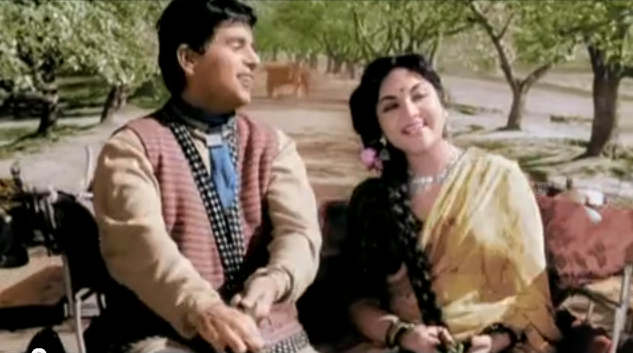
Dilip Kumar and Vijayantimala take a cue from their horse in Naya Daur (1957)

You know what I’m talking about. Guy and girl are falling in love. The setting: indistinct country road. A trotting horse (hay load optional) comes into view. Guy holds the reigns, a gentle clip-clop sets the beat like a metronome, and at last someone can’t resist and bursts into love song. Yes, nothing evokes the pastoral innocence of Bollywood’s rural ideal like a good horse and buggy sequence.

I’ve come up with a list of my top 5 horse and buggy songs. No matter how terrible you’re your day was, these’ll always put you in the mood. Sure, the economy is a mess, and yes, studying/work/dieting is rough. But isn’t it comforting to know that at least there will always be an appropriate forum to burst into song freely with a built-in beat? Just find a horse, grab a partner, and say hello to some fresh village air.

1. Mang Ke Saath Tumhaara (Naya Daur, 1957)

-The epitome of the horse and buggy genre. If this song doesn’t just make you want to join your nearest agrarian values movement, then you are made of steel. Dilip Kumar and Vijayantimala’s dynamic is so cute in this song, you overcome your gag reflex and find yourself basking in the bliss of better, bygone days. This film was recently recoloured following the latest trend, and the whole soundtrack is magic.

2. Haule Haule Chalo More Sajna (Saawan Ki Ghata, 1966)

-I absolutely love this song. It gets my spirits up every time. I think part of it is my love of Sharmila Tagore’s teasing persistence, while Manoj Kumar only pretends he isn’t loving it. This is also a beautiful example of one of the few melodious Asha Bhonsle songs that I honestly think no one else could have sung better (as in, Lata). Her voice is just a joy to listen to as she completely hits the mood of this playful winner.

3. Yun To Hamne Laakh Haseen Dekhe Hain (Tumsa Nahin Dekha, 1957)

-Oh Mohammed Rafi, can you do no wrong? The lyrics are adorable and this time, it’s the heroine playing hard to get. But don’t lie to yourself, girl–these are the days before Shammi Kapoor discovered jalebi, and he’s looking pretty fly with that Elvis ‘do. Asha comes back around later in the film for a brief female version of this song, but it’s a classic case of the ladies getting the shaft and having to sing too high because of the standard set by the male version (more on this issue to come). Until then, enjoy a slim Shammi treat to soothe all your pains.

4. Piya Piya Piya Mora Jiya Pukare (Baap Re Baap, 1955)

-Another incredibly cute duet/cheese-fest—this time brought to you by Chand Usmani and Kishore Kumar (who also acts!) The film itself is completely forgettable, but this Asha-Kishore duet is a fun benchmark for the genre. Please don’t miss their fellow travelers on car, who clearly all wish this had been a chorus song.

5. Aye Neele Gagan Ke Tale (Humraaz, 1967)

-Ok, I admit, this song doesn’t fit the classic definition of horse and buggy song. But hey, watching Raajkumar ride up on a horse like the prince of anyone’s dreams (and the subsequent quasi-dream sequence in the Darjeeling countryside) certainly deserves mention somewhere. And that rich voice of Mahendra Kapoor that gives a perfect song a little something-something? Yes, please.

An extremely honorable mention goes to “Aye Nargis-e Mastana” from Arzoo (1965) starring Sadhana and Rajendra Kumar. She’s definitely riding a horse the entire song, but Rajendra Kumar’s awkwardness brings the cute factor back down to Earth.

-Mrs. 55

The Strange World of Gumnaam: Agatha Christie meets Bollywood

Helen and Pran forget their worries in Gumnaam (1967)

There’s been some buzz lately about the Italian Heineken “The Date” commercial featuring the music from Mohammed Rafi’s “Jaan Pehchaan Ho.” The commercial is fairly trippy, and sadly cuts out all of the actual singing, leaving only the musical introduction, interludes, and awkwardly enough, strange high-pitched male laughter. I’ve got two comments to make about this:

1. If you’re gonna take a Rafi song, why is the setting of this commercial East Asian instead of Indian? C’mon now, people.

2. More fundamentally, how on earth did the ad agency responsible for this come across this song and convince everyone involved of its advertising magic? Either a. someone had heard it used over the title sequence for the movie Ghost World, or b. someone knew it in its original form and had the guts, craziness, and pride to show it publicly. I can only hope it came from a fellow Rafi fanatic who is willing to boost the cause at any price to personal dignity. If it had been me who had a chance to bring glory to the Rafi name, I might’ve chosen the slightly more melodic/catchy “Badan Pe Sitare” or “Nain Milaakar“, which both seem to fall in the same category of hep cat club song. But that’s just me.

Let’s take a closer look the film, Gumnaam (1965) from where this song actually came. For all the Agatha Christie fans out there (and I’ve read all her books–no seriously, ALL of them), you may have been let down thinking that the best filmic interpretation of And Then There Were None was an obscure 80s Russian adaptation that has not been properly subtitled. Well, it’s your lucky day! Say hello to Gumnaam, a kitschy, melodramatic, and thoroughly enjoyable Bollywood adaptation of the Agatha Christie classic.

The film actually follows the basic outline of the plot pretty closely, adding in some extras for spice including the fantastically diverse soundtrack, an absolutely ridiculous dream sequence, and a mysterious ghostly element rendered by Lata’s vocals with the theme, “Gumnaam Hai Koi.”

As an aside, did you know “Gumnaam Hai Koi” is actually Lata’s cover version of the theme song to the 1963 American film Charade starring Cary Grant and Audrey Hepburn? Life is full of surprises.

The cast of Gumnaam is also a great mix of favorites–Manoj Kumar, Nanda, Pran, Mehmood as Butler, and none other than Helen in an actually fairly significant acting role. Sure, she’s got her usual crazy dance numbers (not to be missed!), but overall, if you have an open mind and three spare hours of your life that you know you will never get back, this film is pure deliciousness. And for all the Christie fans, the brilliant twist of the original novel takes on YET another twist in the climax of this film, so don’t think you know what’s coming!

Poison??! What a total surprise!

-Mrs. 55

The Lost Art of the Raga-Mala

For musically-inclined fans of Hindi cinema, the Lata-Rafi duet “Kuhu Kuhu Bole Koyelia” from the film Suvarna Sundari (1957) stands out as one of the finest examples of how Hindustani classical music has been incorporated into the genre of Bollywood music. This song has always been a personal favorite of mine, and it happens to be one of the first pieces of Indian music I adapted for performance on the piano. This song takes on the structure of a ragamala (literally, a garland of ragas), a form derived from Hindustani classical music in which different musical modes are intertwined within a single composition. In “Kuhu Kuhu Bole Koyelia,” four ragas are used beautifully in combination: Sohini, Bahaar, Jaunpuri, and Yaman.

A.N.R and Anjali Devi star in Suvarna Sundari (1957)

Whenever I listen to a song like this, I feel compelled to draw comparisons between the music created during the Golden Age of Hindi cinema and the music produced by the Bollywood industry today. Aside from the occasional gem, the songs found in Hindi movies today fail to impress on all counts. The music produced today simply lacks the magic found in the songs from the yesteryears of Hindi cinema, which reflect the efforts of a host of talented music directors, lyricists, and vocalists.

Take, for example, the skillful manner in which Lata Mangeshkar and Mohammed Rafi render this composition. Their voices navigate through the intricacies of each raga with a level of musical precision and maturity that is sadly missing in the singers who rule the Bollywood industry today. In addition to nailing the technical sargam and harkats, they sing with a graceful ease and poise that allows this complex composition to appeal to a broad audience, regardless of musical background. Will we ever get to hear such a beautifully intricate raag-mala sung in a Bollywood film produced today? Based on current trends, I am skeptical about the prospects of such an opportunity – the industry needs to stop celebrating Sheila’s jawani and return to its roots in order to preserve the rich musical heritage of our culture.

–Mr. 55

P.S. Some of you may be interested to know that a Telegu version of this composition also exists, which was sung by Jikki and Ghantasala.