Which Actor Did Hemant Kumar Sing For Best?

Hemant Kumar (1920-1989) was a legendary Hindi and Bengali film music composer and singer.

Hemant Kumar (1920-1989) was a legendary Hindi and Bengali film music composer and singer.

In classic Bollywood cinema, playback singers could make or break the career actor. Famous actor-singer pairings are legendary. The voice of the singer became the soul of the actor and once a perfect match was made, it was hard to separate them without upheaval. Who could imagine anything but the manly voice of Kishore Kumar with the face Rajesh Khanna? Or the playful sweetness of Mohammed Rafi with fun-loving Shammi Kapoor? When Mukesh passed away, Raj Kapoor (for whose career Mukesh lent his illustrious talent) famously burst into tears and announced, “I have lost my voice.”

But occasionally we find a rogue player in Hindi film music. Hemant Kumar stands out as a unique character, a difficult man to place in the rankings. For he was not merely a singer, but a legendary music director as well in both Hindi and Bengali cinema. Hemant Kumar was heavily influenced by Rabindrasangeet (like his contemporary S.D. Burman!), and first broke into the Bengali industry as a music director in 1947, the year of Indian independence. Hemant Kumar’s unmatched virtuosity led him to not only sing many of the hit songs of the 50s and 60s in Bombay himself, but he actually formed his own production company that made classics such as Bees Saal Baad (1962), Kohra (1964), and Khamoshi (1969). In the 70s he even dabbled as a film director with moderate success.
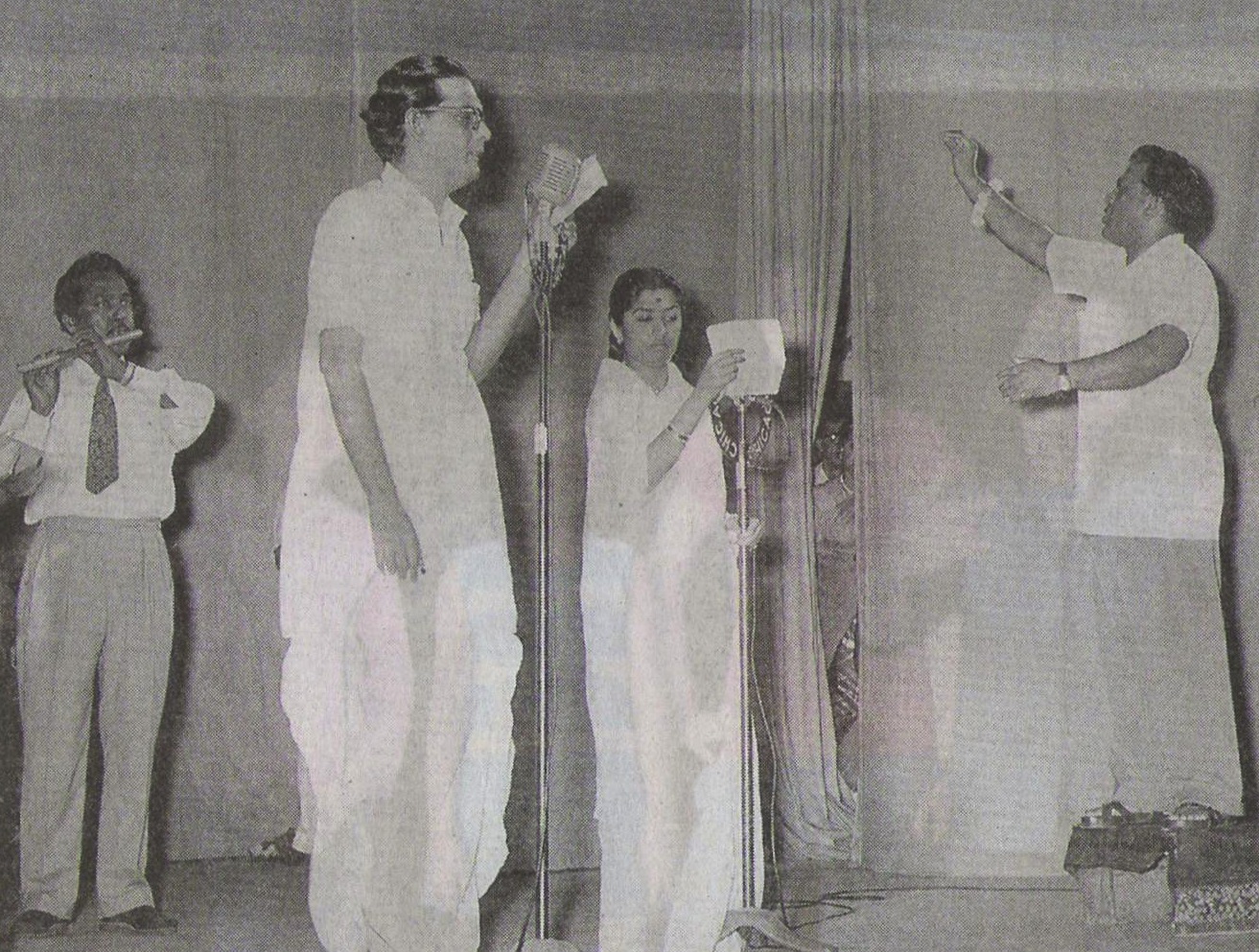
Hemant Kumar recording a song with Lata Mangeshkar

Hemant Kumar and Lata Mangeshkar during the studio recording of “Nain So Nain” from Janak Janak Paayal Baaje (1955).

But for me, it was as a singer that Hemant Kumar always shines and also the category in which history has given him the shaft. His voice was absolutely unlike any other in the industry–a deep and soulful richness that no one could touch. Interestingly, for a man whose talents were so diverse, Hemant Kumar never took to acting and singing his own songs on screen (à la Kishore Kumar). Instead, he sang for a myriad of rising and great actors across the decades–never branding himself with a single artist. Hemant Kumar remained a maverick, and for it, is often brushed aside.

So I now pose to you the question–which actor do YOU think Hemant Kumar sang for best? His voice graced the images of many men, but did it work for all of them? Your contestants are Guru Dutt, Dharmendra, Biswajeet, Dev Anand, and Shammi Kapoor. We present five songs below that illustrate some of Hemant Kumar’s finest collaborations with these actors and the cinematic chemistry that ensued.

1. Guru Dutt: Jaane Woh Kaise

The voice of tragedy, Hemant Kumar sings for Guru Dutt in this timeless lament from Pyaasa (1957). Guru Dutt, who often played the tragic poet, seems a natural choice for the resonant tones of Hemant Kumar in this song that has become iconic for all awkward dinner party songs.

2. Dharmendra: Tum Pukar Lo

Discussed in a previous post, Khamoshi (1968) is a heart-wrenching film about love, loss, and insanity. Although you don’t see much of Dharmendra’s face in this sequence, his subtle performance matches the song’s patient yearning with a hint of a Western flair. But to me, as an actor Dharmendra is somehow too shallow to be worthy of a Hemant Kumar solo. Maybe that’s just me?

3. Biswajeet: Yeh Nayan Dare Dare

A tender sequence from the film Kohra (1964), this song embodies the sweet side to Hemant’s voice that comes in the middle of a spooky film noir. I’m not going to pretend that Biswajeet is anything but a joke, but for me this pairing works–Hemant’s sweet vocals and Biswajeet’s confident, but appeasing motions to Waheeda are a pleasing combination.

4. Dev Anand: Yeh Raat Yeh Chaandni Phir Kahaan

God, I love it. I’ll be the first to tell you that no one sang better for Dev Anand than Mohammed Rafi, but this song is something else. I’ve discussed this sequence already in our earlier translation of the song, but let me just repeat that Hemant Kumar in a seductive mood blends beautifully with that longing gaze of Dev Anand’s. It’s just so exciting and rare, not to mention compliments Dev Anand’s semi-gravely voice in this film.

5. Shammi Kapoor: Aye Dil Ab Kahin Lejaa

This is another beautiful Hemant Kumar tragedy with a touch of mystery. Shammi is clearly giving it his all in this song, but somehow, I think it just doesn’t come together. Shammi Kapoor is too much of a hot mess for me to believe anything but Mohammed Rafi coming out of his mouth–the resonant voice of Hemant seems incongruous with those histrionics, despite its unarguable beauty.

And the winner is…?

I’m gonna have to say Guru Dutt–that song is just sublime on every level, but I’m open to discussion. Who do you think matched Hemant Kumar’s voice best? Let us know YOUR opinion in the comments!

-Mrs. 55

P.S. Wondering why we didn’t mention female playback singers here? It’s because the female side of things worked very differently, ie., it was Lata and Asha or bust. Every actress had them, and with the occasional Geeta Dutt or Shamshad interlude, there was no room for a “signature” playback artist per actress (although Lata will argue she “changed” her voice depending on the actress–more on this to come!)

Aap Ki Nazaron Ne Samjha Lyrics and Translation: Let’s Learn Urdu-Hindi

A musical match for the ages: Lata Mangeshkar and Madan Mohan

The collaboration between Lata Mangeshkar and Madan Mohan has produced some of the most cherished songs in the musical history of Hindi cinema. Think of gems such as  “lag jaa gale,” “nainaa barse rimjhim rimjhim,” or “tu jahaa.n jahaa.n chalegaa,” to name a few. Today, I’m going to share the lyrics and translation for a ghazal from Anpadh (1962) that is widely considered to be one of this duo’s finest: “aap kii nazaro.n ne samjhaa.” Penned by Raja Mehndi Ali Khan, the lyrics of this song are an equal match for the beauty of the musical composition and rendering. The beauty of the lyrics, however, is perhaps best appreciated once you can get over the whole slave-master dynamic that is going on as Mala Sinha sings to Dharmendra in the film. Although I admit that it is bizarre to refer to your lover as “banda-parvar” (master, lord), it is important to remember that these lyrics were written for the society of 1960s India: gender norms from that era differ dramtically from those established in modern times. At this time, the ideal Indian woman was expected to be submissive to her husband, and this sentiment is reflected in many songs like this one from the period.

An interesting piece of trivia: after the ghazals from Anpadh were released, it is said that composer Naushad supposedly told Madan Mohan that he would trade all of his own compositions for this one song! Although Madan Mohan rarely got his due from audiences back then, it’s nice to hear that his fellow music directors recognized his talent.

-Mr. 55

P.S. Please, for my sake, go to YouTube and give a thumbs-down to Bally Sagoo’s atrocious remix of this song. I don’t understand how these people sleep at night after they ruin the classics (seriously, how did they just change the taal here from 7-beat rupak to 8-beat kaharvaa?)

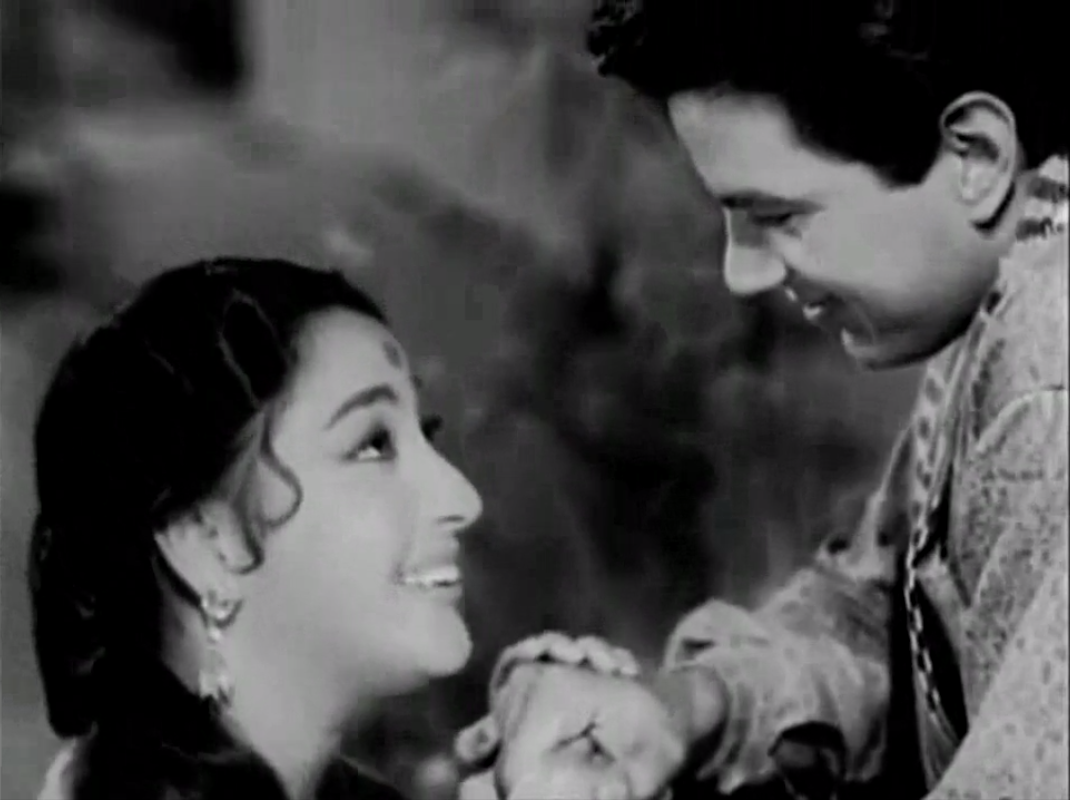
Mala Sinha expresses her devotion to the handsome Dharmendra in Anpadh (1962)

Aap Ki Nazaron Ne Samjha Lyrics and Translation

aap kii nazaro.n ne samjhaa pyaar ke qaabil mujhe
Your glances deemed me worthy of love.
dil kii ai dhaDkan Thahar jaa, mil gayii manzil mujhe
Oh stop, my heartbeats, for I have found my destination.

jii hame.n manzuur hai, aap kaa yeh faislaa
Yes, this decision of yours is acceptable to me.
kah rahii hai har nazar, bandaa parvar shukriyaa
My every glance is saying, “Thank you, oh lord!”
ha.nske apnii zindagii me.n, kar liyaa shaamil mujhe
As you brought me into your life with a smile. 

aap kii manzil huu.n mai.n, aur merii manzil aap hai.n
I am your destination, and you are mine.

kyo.n mai.n tuufaa.n se Daruu.n? meraa saahil aap hai.n
Why shall I fear the storm? You are my shore.
koii tuufaa.no.n se kah de, mil gayaa saahil mujhe
Someone tell the storms that I have found my shore.

paD gayii.n dil par mere aap ki parchhaaiiyaa.n
Your shadows have cast upon my heart.
har taraf bajne lagii.n saikDo.n shahnaaiiyaa.n
In every direction, hundreds of shahnaiis are playing in celebration
do jahaa.n kii aaj khushiyaa.n, ho gayii.n haasil mujhe
Today, I have enjoyed the happiness of both worlds.

aap kii nazaro.n ne samjhaa pyaar ke qaabil mujhe
Your glances deemed me worthy of love.

Glossary

nazar: glance; qaabil: worthy; manzil: destination; manzuur: acceptable; faislaa: decision; bandaa parvar: master, lord; haasil: achieved, obtained; saahil: shore; parchhaaiiyaa.n: shadows; saikDo.n: hundreds; shahnaaiiyaa.n: traditional Indian instrument resembling a clarinet (associated with weddings); shaamil: present.

Jani O Jani Lyrics and Translation: Let’s Learn Urdu-Hindi

Next we will discuss the lyrics and translation of the nostalgic Kishore Kumar song “Jani O Jani.” However, this post is going to be a little different since something a little different happened to me this month. My wonderful boyfriend of 2 years proposed to me! We met when he was recruited by a friend to be an extra in the 1950s Bollywood film tribute I was shooting for my thesis at Harvard. The deal was essentially sealed when I realized he had heard more than half the songs on my 60s Mohammed Rafi playlist. Two years later, he planned a surprise engagement proposal straight from a Bollywood dream sequence! I was reminded immensely of an old Kishore Kumar gem, “Jaani O Jaani” from Raja Jani (1972). There is something both nostalgic and hopeful about this song that I love.

Raja Jani (1972) is actually an incredibly fun film–basically the 70s Bollywood version of the American feature-length cartoon Anastasia (1997). It’s colorful, upbeat, and filled with exciting drama at its predictable best. The story is written by the highly-talented Nabendu Ghosh, who also wrote more somber-toned philosophical works like Bandini (1963) and Teesri Kasam (1967).

We don’t often translate Kishore Kumar songs on this site because of my obsession with Mohammed Rafi and Mr. 55’s obsession with Lata (surprise surprise—Mr. 55 and I are just friends!). But this song is special. It’s picturized on Dharmendra driving through the Delhi streets and evokes that sense of travel and beginning a journey found in many of Kishore other great hits (eg. “Musafir Hoo.N Yaaro.N”, “O Maaji Re”, etc.). Very appropriate for the occasion of starting a new life together (oh, give me a break).

Dharmendra and Hema Malini exchange uber cute glances in Raja Jani (1972)

Lyrics and Translation:

Jani O jani
Darling, oh darling
Jaldi se aaja miljaa ke biit jaaye yeh jawaanii
Come meet me quickly because our youth slips away

Bigda naseeba banne ke liye
To correct my misguided fate
Ek ishaaraa tere kaafi hai
Just one signal from you is enough
Aashiq ke jiine marne ke liye
To make the choice between life and death for a lover
Itna sahaara tera kafi hai
That is all the support that is needed
Tujh pe lutadoonga mitadoonga mai.N yeh zindagaani
For you, I would throw away and wipe out this life of mine
Jaani O jaani jaani O jaani
Darling, oh darling

Aankhon mei.N teri tasveer liye
Carrying your picture in my eyes
DhuunDh raha hoo.N tujhe raste mei.N
I search for you along the way
Teri galii mei.N teraa diiwaanaa
In your street, that man who is crazy in love with you
Bech rahaa hai dil saste mei.N
Is selling his heart to you cheaply
Karle yeh sauda leja deja raani dil ki nishani
Accept this bargain and let us exchange, my queen, tokens of our hearts
Jaani O jaani
Darling, oh darling

Glossary:

jaani: darling, sweetheart; jaldi se: quickly; jawaani: youth; naseeba: fate; ishaaraa: signal; aashiq: lover; sahaaraa: support; zindagaani: life; tasveer: picture; sauda: bargain, exchange

I know, I know, this is obnoxious, but I really had to put a picture of my engagement ring here. Is the teal box in the background a subtle enough clue that it’s from Tiffany’s?! Was the complimentary teal background over-doing it?

Why yes, it’s a flawless Tiffany solitaire engagement ring.

OK, OK, I’m done now.

-Mrs. 55

Woh Hanske Mile Humse Lyrics and Translation: Let’s Learn Urdu-Hindi

Although Asha Bhonsle is perhaps most well-known for her seductive and playful songs (see our translation of “raat akelii hai” here), she was a truly versatile artist who had an excellent command over a range of styles and emotions. When she is in a serious mood, Asha can really tug at your heartstrings with her sad singing. Think “ab ke baras bhej bhaiyya ko babul” from Bandini (1963), “yeh kyaa jagah hai dosto” from Umrao Jaan (1981), or “meraa kuch saamaan” from Ijaazat (1987).  Here, I’ve translated a short yet painfully beautiful Asha solo from Baharein Phir Bhi Aayengi (1966) called woh hanske mile humse.”

Baharein Phir Bhi Aayengi was released posthumuously under Guru Dutt’s film banner after Guru Dutt’s demise in 1964. The film was not even complete half-way before Guru Dutt’s death, so the film was shot again with a new director Shahid Lateef and new hero Dharmendra. Although the movie itself lacks the magic found in older Guru Dutt films, O.P. Nayyar’s soundtrack for the movie is still remembered today, most notably the Rafi number “aap ke hasiin rukh pe aaj nayaa nur hai.”

Mala Sinha in a melancholic mood in Baharen Phir Bhi Aayengi (1966)

The movie’s plot focuses on a love triangle: handsome young news reporter Jitendra (played by Dharmendra) falls in love with the bubbly Sunita (played by Tanuja) while Sunita’s older sister and head of the newspaper Amita (played by Mala Sinha) eventually becomes smitten by Jitendra. Before Amita decides to reveal her feelings to him, she finds out that Jitendra is actually in love with  Sunita. Although she is devastated by this news, she decides to back away for the sake of her sister’s happiness.  Here’s where the song I’ve translated comes in. Backed by Asha’s painstricken vocals and S.H Bihari’s simply crafted lyrics, Amita laments how she misinterpreted Jitendra’s actions to think that he was in love with her when that was not the case (“bekaar hii ulfat kaa izhaar samajh baiThe”). Sigh…

I think this song will strike a chord with those of you who have suffered through a romantic misunderstanding–it certainly did with me.

-Mr. 55

Woh Hanske Mile Humse Lyrics and Translation

woh ha.nske mile ham se, ham pyaar samajh baiThe
He smiled at me when we met, so I thought that he loved me.
bekaar hii ulfat kaa izhaar samajh baiThe
I interpreted it, in vain, as a declaration of love.

aisii to na thii qismat apnaa bhii koii hotaa
It was not in my fate to call someone my own.
kyo.n khud ko muhabbat kaa haqdaar samajh baiThe?
Why did I consider myself entitled to his love? 

roye.n to bhalaa kaise, khole.n to zabaa.n kyo.n kar?
How shall I cry, why should I speak?

Darte hai.n ki jaane kyaa sansaar samajh baiThe.
I fear what society has perceived of this. 

woh ha.nske mile ham se, ham pyaar samajh baiThe
He smiled at me when we met, so I thought that he loved me. 

Glossary

bekaar: useless, in vain; ulfat: love; izhaar: declaration; qismat: fate, destiny; haqdaar: entitled; zabaa.n kholna: to speak; sansaar: society