Mere Desh Ki Dharti Lyrics and Translation: Let’s Learn Urdu-Hindi

Manoj Kumar Mere Desh Ki Dharti

The glory of India’s ancient heritage is celebrated in Manoj Kumar’s “Mere Desh Ki Dharti” from Upkar (1967).

In honor of the great beauty of India we present the patriotic lyrics and English translation of “Mere Desh Ki Dharti” from Upkar (1967). There are few songs that have attained the kind of beloved immortality found in the lyrics of “Mere Desh Ki Dharti.” A rousing declaration of love for the motherland, this song evokes nostalgia, nationalism, and an unwavering pride in traditional values that director Manoj Kumar advocated throughout his career. The film Upkar (1967) from which the song comes is one of many socially responsible movies pioneered by Manoj Kumar in that era–earning him the nickname Mr. Bharat! Like his other works Shaheed (1965), Purab Aur Paschim (1970), and Roti, Kapada, Aur Makaan (1974), Manoj Kumar sought to remind his audience of the beauty of the Indian way of life, of India’s rich history, and of the dangers Westernized modernity could pose to society.

As an interesting contrast to Dev Anand’s somewhat similarly themed-film Prem Pujari (1970), Upkar explores and glorifies the concept of the farmer-soldier, a loyal citizen who selflessly serves the motherland in any way she needs. The hero captures the spirit of self-sacrifice and patriotism in a way that has remained popular even today.
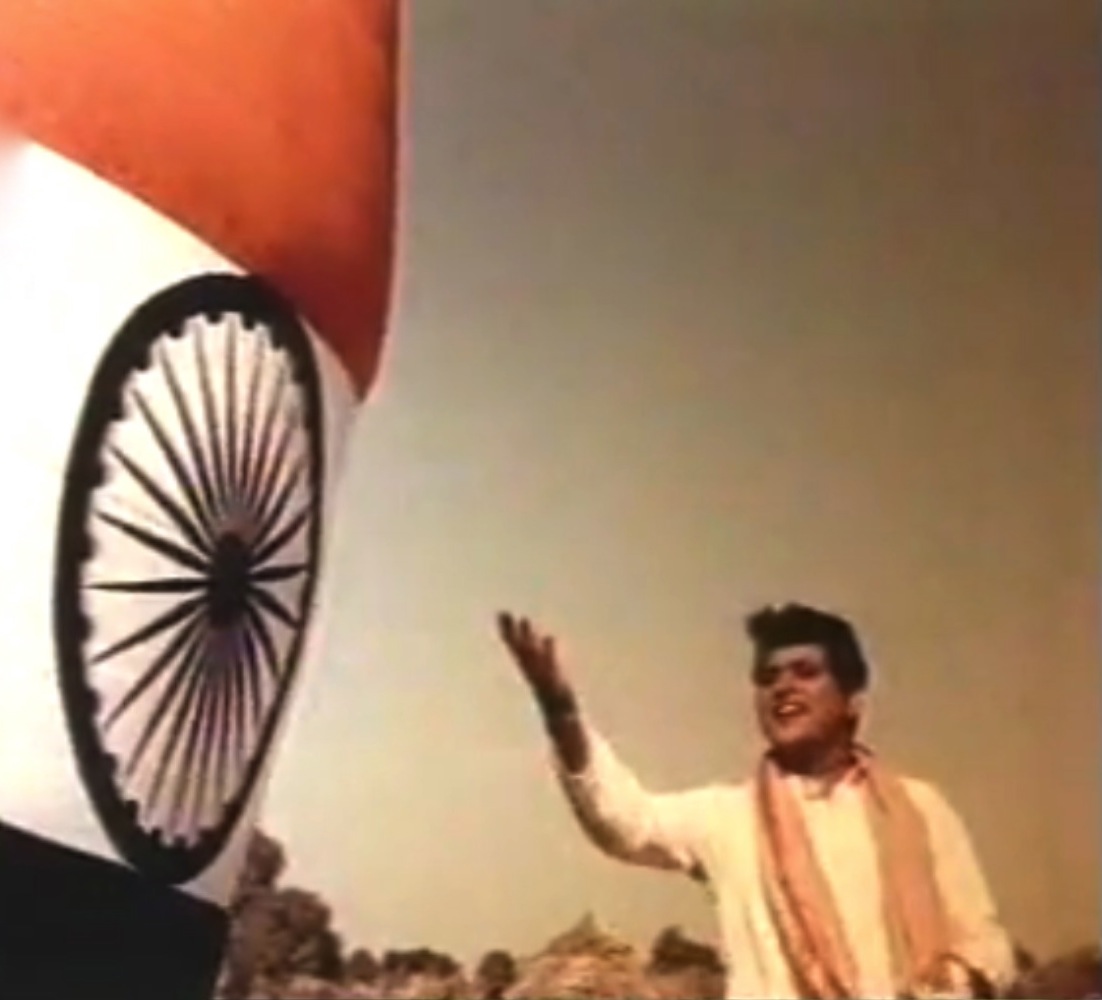
Manoj Kumar pays homage to the tricolor Indian flag in Upkar (1967).

So sure, it’s obviously a propaganda film (the idea of Upkar was after all modeled on Prime Minister Lal Bahadur Shashtri’s slogan, “Jai Jawaan, Jai Kissan!“), but hearing the lyrics to this song rendered stirringly by Mahendra Kapoor, you can feel a true admiration and love for India. Fully understanding a translation of “Mere Desh Ki Dharti” can be quite difficult without some contextual knowledge of Indian history as it is filled with rich allusions and metaphors. I have attempted to explain some of them below each lyric (props to my father for filling in the gaps!) So please enjoy our full English translation to the lyrics of “Mere Desh Ki Dharti” below!

Mere Desh Ki Dharti Lyrics and Translation:

Mere desh ki dharti, sonaa ugale, ugale hiire, moti
The soil of my country is made of gold, diamonds, and pearls
Mere desh ki dharti…


Bailo.N ke gale mei.N jab ghungaruu, jeevan kaa raag sunaate hai
The bells around the necks of the bullocks chime to the melody of life
Gham kos duur ho jaataa hai, khushiio.N ke kamal musakaate hai.N
Sadness and regret go away, and joyous lotuses smile
Sun ke rahaT ki aawaaze, yuu.N lage kahii.N shahanaaii baje
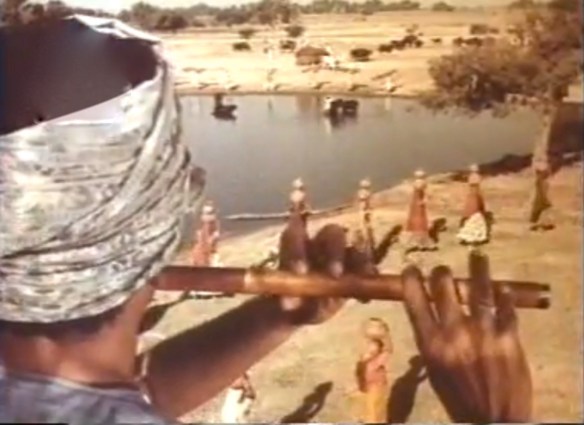
Listening to the sounds of the waterwheels, it seems as if auspicous flutes are playing somewhere
Aate hii mast bahaaro.N ke dulhan ki tarah har khet saje
Every field adorns itself like a bride when the thrill of spring arrives
Mere desh ki dharti…

Jab chalte hai.N is dharti pe hal, mamtaa angadaaiiyaa.N leti hai.N
When ploughs till this land, the love of its mother is activated
Kyu.N na puje is maaTii ko, jo jeevan ka sukh deti hai?
Why would we not worship this soil that gives us the joy of life?
Is dharti pe jis ne janam liyaa, usne hii paayaa pyaar teraa
Whoever was born on this land, obtained your love
Yahaa.N apnaa paraayaa koii nahii.N, hai.N sab pe, Maa.N, upkaar teraa
Here there is no difference between a stranger and one of our own, for Mother, you are benevolent to all
Mere desh ki dharti…

Ye baagh hai.N Gautam Naanak ka, khilte hai.N aman ke phool yahaa.N
This is the garden of Bhudda and Guru Naanak, here bloom the flowers of peace
Gandhi, Subhaash, Tagore, Tilak, aise hai.N chaman ke phool yahaa.N
Gandhi, Subhash, Tagore, Tilak–these are the kinds of flowers of this garden
Rang haraa Hari Singh Nalwe se, rang laal hai Lal Bahadur se
Its green color is from Hari Singh Nalwa , and its red color is from Lal Bahadur
Rang banaa basanti Bhagat Singh, rang aman ka viir Jawaahar se
The color became saffron with Bhagat Singh and the color of peace (white) is from the brave Jawaahar
Mere desh ki dharti…

Glossary:

dharti: soil; hiire: diamonds; moti: pearl [in this case, a metaphor for agricultural treasures]; bail: bullock, ghungruu: bells; kamal: lotus; rahat: waterwheels; dulhan: bride; khet: field; hal: plough; maaTi: soil; paraayaa: stranger; upkaar: benevolence; baagh: garden; guatam: Buddha; Naanak: Guru Nanaak; aman: peace; Gandhi: Mahatma Gandhi; Subhaash: Subhash Chandra Bose; Tagore: Rajindernath Tagore; Tilak: Bal Gangadhar Tilak; rang: color [here is he describing the colors of the Indian Flag]; haraa: green; Hari Singh Nalwa: the commander in chief of the Sikh Emperor, Ranjit Singh; Lal Bahadur: Lal Badur Shastri, one of India’s late Prime Ministers; viir: brave; Jawaahar: Jawaaharlal Nehru, India’s first Prime Minister

As a brief aside to anyone learning Urdu-Hindi, defining the word “angaDaaii” can be complicated when taken out of context (besides also being hard to pronounce if you’re a non-native speaker!). AngaDaaii can be the stretch you take when you wake up in the morning, it can be the way a traditional wrestler slaps his thighs before hopping into a match. In essence, an angaDaaii is any kind of preparatory movement or action you would take before some event. It’s used quite loosely in Hindi songs and must be read in context to understand the full meaning of the line, so watch out for this trickster.

For more patriotic songs from classic Bollywood films, check out our English translation of “Aye Mere Pyare Watan” from Kabuliwala (1961) and “Sarfaroshi Ki Tamanna” from Shaheed (1963)!

– Mrs. 55
Likhe Jo Khat Tujhe Lyrics and Translation: Let’s Learn Urdu-Hindi

Likhe jo Khat Tujhe Shashi Kapoor

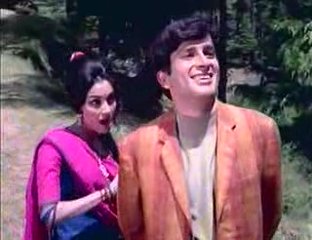
Shashi Kapoor and Asha Parekh star in Kanyadaan (1968)

For our next song, we translate the lyrics of my all-time favorite Mohammed Rafi song, Likhe Jo Khat Tujhe. The lyrics and translation of Likhe Jo Khat Tujhe have no frills, no super complicated Urdu, just verse straight from the heart. The metaphors of the lyrics have a simple beauty to them and the handsome voice of Mohammed Rafi brings them to sublimity. Although the film Kanyadan (1968) glorifies the social oppression of women and child marriages (highly objectionable and not worth the three hours I lost watching it), this song epitomizes what classic Bollywood love is all about. Boy falls for girl. Girl has an extremely cute colorful native outfit on and hides coyly behind local trees. Boy attempts to win over girl by serenading her. Girl and boy do not kiss, but you know by the way the camera pans around the flora that it’s on their minds. Likhe Jo Khat Tujhe is a blissfully adorable reminder of all things magical that Bollywood romance once meant: the charming poetry of innocent love. Can that ever get old?

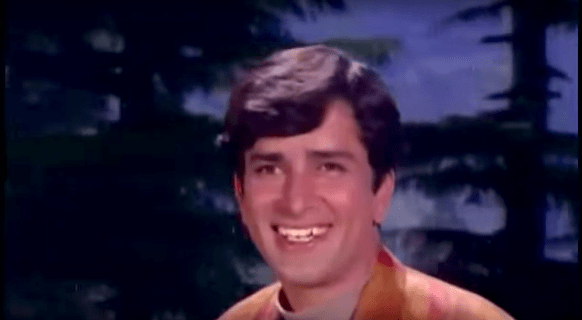
Handsome shashi kapoor smile .png

Shashi Kapoor flashes his famous smile, somehow made even more handsome by the crooked teeth.

Also note the clever use of Shashi Kapoor’s sleek convertible as the object around which the actors flirt and evade each other. As if we weren’t already convinced of how cool it was to be modern in the 60s…

Likhe Jo Khat Tujhe Lyrics and Translation:

Likhe jo khat tujhe woh teri yaad mei.N
Those letters that I wrote to you
Hazaaro.N rang ke nazaare ban gaye
Became a wondrous sight of a thousand colors
Sa.Nveraa jab huaa to phool ban gaye,
When morning came, they became flowers
Jo raat aayi to sitaare ban gaye
When night fell, they became stars
Likhe jo khat tujhe…

Koyi naghma kahii.N goonjaa kahaa dil ne yeh tu aayii
A melody resonated somewhere as my heart sensed your presence
Kahin chatki kali koyi main yeh samjha, tu sharmaayi
Somewhere a flower blossomed and it appeared as if you had blushed
Koi khushboo kahii.N bikhrii lagaa yeh zulf lehraayi
A fragrance filled the air and it seemed to me your hair had billowed

Fiza rangeen, adaa rangeen, yeh ithlaana, yeh sharmaana
The ambiance is colourful, your style is colourful, you sometimes swagger, you are sometimes demure
Yeh angaDaaii, yeh tanhaayii yeh tarsa kar, chale jaana
This preparedness, this isolation, this way you torture me, then walk away
Bana de ga nahii.N kisko jawaa.N jadoo yeh deewaanaa?
Who would not go crazy with your youthful magic?
Likhe jo khat tujhe…

Jahaa.N tu hai, vahaa.N main hoo.N, mere dil ki tu dhaDhkan hai
Wherever you are, I am there. You are my heartbeat
Musaafir mai.N tu manzil hai, main pyaasaa hoo.N tu saawan hai
I am a traveler, you are my destination. I am thirsty, you are the monsoon
Meri duniya yeh nazare.N hai.N, meri jannat yeh daaman hai
My world is held by the way you look at me, my paradise lies in your embrace
Likhe jo khat tujhe…

Glossary:

khat: letter; yaad: memory; sa.Nveraa: morning; khushboo: fragrance; zulf: hair; rangeen: colorful; tanhaayii: loneliness; jadoo: magic; musaafir: traveler; pyaasaa: thirsty; jannat: paradise

For all the Urdu-Hindi grammar junkies, you’ll notice that we’ve written the word “naghma” with an “h” although it’s often seen written without. This because the word naghma in Urdu is actually spelled with a ghain, not a regular “g” (in Hindi, the “ga” would have a dot below to indicate this). Ghain makes the “g” a more gutteral, difficult sound to pronounce, but if you’re trying to impress your friends at your next Bollywood Night, be sure to enunciate this clearly. Other words like kaaghaz (paper), baagh (garden), maghruur (proud) and ghalat (mistake) also contained frequently overlooked ghains.

-Mrs. 55

Dekhi Zamane Ki Yaari Lyrics and Translation: Let’s Learn Urdu-Hindi

old man Guru Dutt Kaagaz Ke Phool 7

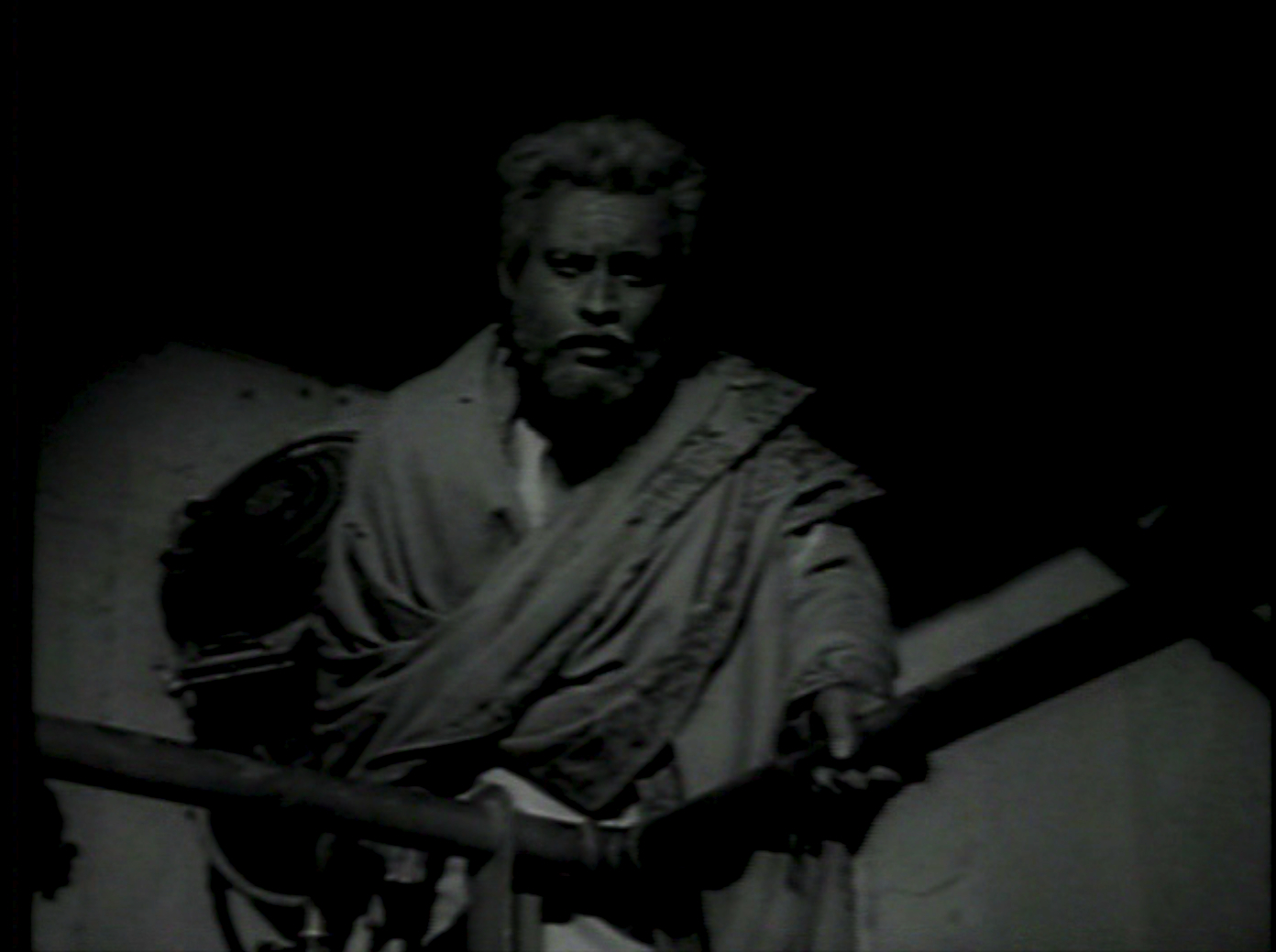
Guru Dutt reflects on his life as a once-great Bollywood director in the semi-autobiographical epic Kaagaz Ke Phool (1957).

The lyrics and English translation of Dekhi Zamane Ki Yaari are among the most beautiful you can find. The very soul of Guru Dutt can be found in the lyrics of Dekhi Zamaane Ki Yaari. The song is the heart of his masterpiece Kaagaz ke Phool (1957), and I contend contains the most passionate poetry you will ever find in a Bollywood song. Mohammed Rafi brings legendary Urdu poet Kaifi Azmi’s lyrics to an unheard of, feverish of climax that evokes a tragedy much deeper and more painful than any normal loss. Indeed, Kaagaz ke Phool tells a story of a different kind, and not one often explored: the slow destruction of an unfulfilled artist. I have already discussed some of the autobiographical parallels in this film in my translation of Waqt Ne Kiya, and will now present the actual story alongside the lyrics. It is one of the most haunting and powerful songs of that era.

Dekhi Zamaane ki Yaari reprises at different chapters in the film. The first starts in the opening as Guru Dutt plays an aged, dying film director who has returned to his old studio set before dawn. He sits up in the rafts and looks down on the empty world of show business below him. The song begins.

Dekhi Zamane Ki Yaari Lyrics and Translation:

Dekhi zamaane ki yaari
I have seen what goes for friendship in this world
Bichhade sabhee, bichhade sabhi baari baari
Everyone disperses,  one by one they all leave
Kya le ke mile.N ab duniya se? Aa.Nsuu ke siva kuch paas nahii.N
What will I take with me now to greet this world? Besides tears I have nothing
Ya phuul hi phuul the daaman mei.N, ya kaanto.N ki bhi aas nahii.N
I was either embraced by flowers, or other times did not even aspire to thorns
Matlab ki duniya hai saari
The whole world is selfish
Bichhade sabhee, bichhade sabhi baari baari
Everyone disperses,  one by one they all leave

The old man flashes back to younger days, when he was at the height of his career as a studio Bollywood director. The flashback transitions through a watery image of a lotus flower and a series of dutch-angled shots of eager fans. The high chorus interlude of the music inspires a sense of the divine, but when coupled with the teetering shots of the silent mob, also foreshadows something unnatural.

Guru Dutt smokes contemplatively on a balcony as fans await him below in Kaagaz Ke Phool (1957).

Waqt hai maherabaan, aarzuu hai javaan
During generous times, desires are young
Fikr kal ki karen, itni fursat kahaa.N
There is no leisure to worry about tomorrow
Daur yeh chaltaa rahe, rang uchaltaa rahe
Let this cycle continue, these colors keep splashing
Roop ko badalta rahe, jaam badalata rahe
Let the attractions keep changing, the intoxicants keep changing

Fans crowd Guru Dutt for signatures on empty pieces of paper that embody the theme of his film.

And here Guru Dutt masterfully transitions, for this is a story that is more than merely a tragic fall from societal grace. He shows us a character who has always felt alone–both when the world stood with him and when it abandoned him, searching for meaning in the dazzling lights of his own studio. It’s the kind of tragedy that doesn’t scream and doesn’t cause a colorful sensation. It’s one that softly and slowly erodes the soul–a desperate hunt for a human connection.

Guru Dutt comes home to a perpetually empty house in Kaagaz Ke Phool (1957)

Raat bhar mahamaan hai.N bahaare.N yahaa.N
Here, Spring is our guest the entire night
Raat gar dhal gayi, phir ye khushiyaa.N kahaa.N
But if the night ends, where do these joys go?
Pal bhar ki khushiyaa.N hai.N saari
All of these joys are only momentary
Badhane lagi beqaraari, badhane lagi beqaraari
And then restlessness begins to grow, restlessness begins to grow

Falling down a spiraling slope, he finds love at last and loses not only her, but his chance at happiness with his daughter, his friends, a wife, and his work. No producer will hire him, no actors will work with him. Everything these people once said and did for him was false. He returns years later to his old studio and sees Waheeda Rehman, the woman he loved and runs away in horror. Mohammed Rafi cries out with a violent passion in this segment–a ferocious plea to society and a desperate call to the suffering of his being. It is here that the meaning of “kaagaz ke phool” is explained–that dangerous unfeeling world of pretense. As the song comes to an end, Rafi gently sings the line, “Yeh khel hai kab se jaaari…” [“This game has been played so long…”] In his voice is the awful beauty of true resignation. You feel how tired this man is.

Utterly defeated, Guru Dutt looks back for a final time at the woman he loved and the world that once belonged to him in Kaagaz Ke Phool (1957).

Ud jaa! Ud jaa pyaase bha.Nvare! Ras na milega khaaro.N mei.N
Fly away thirsty bumblebee! You will not find nectar in these thorny shrubs
Kaaghaz ke phuul jahaa.N khilte hai.N, baiTh na un gulzaaro.N mei.N
Do not sit in those gardens where flowers of paper bloom
Naadan tamanna reti mei.N, ummiid ki kashti khaiti hai
In the sands of innocent desire, the boat of hope struggles to stay afloat
Ek haath se deti hai duniyaa, sau haatho.N se le leti hai
What the world gives with one hand, it takes away with one hundred
Yeh khel hai kab se jaari…
This game has been played for so long…
Bichhade sabhee, bichhade sabhi baari baari
Everyone disperses,  one by one they all pull away

Returning to the director’s chair, Guru Dutt bids farewell to society in Kaagaz Ke Phool (1957)

Then the flashback ends. He is an old man again hiding in the alcoves of his former studio. With careful decision, he sits down once more in the director’s chair in the center of the set.

Dekhi zamaane ki yaari
I have seen what goes for friendship in this world
Bichhade sabhee, bichhade sabhi baari baari
Everyone disperses,  one by one they all leave

Light floods the empty set. Dawn has broke and the crew enters to find an old unfamiliar man who has died sitting in the director’s seat.  The producer yells for his body to be removed so shooting can begin. And the cycle continues.

Kaagaz Ke Phool (1957) finishes over the blurred image of studio lights.

Glossary:

yaari: friendship; aa.Nsuu: tears; matlab: selfish (a homonym translates as “meaning”); duniyaa: society, world; waqt: time; aarzuu: desire; fikr: worry; fursat: leisure; daur: cycle, generation; rang: colour; uchalnaa: to splash, to scatter; jaam: intoxicant; mahamaan: guest; beqaraari: restlessness; bha.Nwara: bumblebee; ras: nectar; khaar: thorny shrub; kaaghaz: paper; gulzaar: garden; naadaan: innocent; reti: sand; ummiid: hope; kashti: boat; khel: game

-Mrs. 55

Khudaa-E-Bartar Lyrics and Translation: Let’s Learn Urdu-Hindi


Our blog probably seems like one huge Sahir Ludhianvi love-fest by now, but I couldn’t help myself from posting and translating this beauty from Taj Mahal (1963). This song is from the same movie as “jurm-e-ulfat pe,” which I translated here a little while ago. While “jurm-e-ulfat pe” tackles the theme of forbidden love, the lesser-known “khudaa-e-bartar” discusses something that doesn’t get much coverage in the world of Bollywood: war. By posing a series of questions, Ludhianvi uses universal and timeless words here to express the futility of war. While the song directly pertains to the Mughal battles depicted in the film, I’ll go out on a limb and say that the pacifism expressed in these lyrics is also Ludhianvi’s response to India’s losses in the Sino-Indian War, which had ended only a year before this film was released.

In addition to its unique thematic content, this song stands out for its nuanced use of language. Such elevated Urdu is truly a rare treat in Hindi cinema. Seriously, when was the last time you heard a song with the words like hidaayat, kibr-o-ghuruur, or fatah-o-zafar? Perhaps my favorite thing about this song is its use of izaafat, a grammatical construct borrowed from Persian where two nouns or a noun and adjective are linked together with the vowel -e- or -o-. When the -e- vowel is used between two nouns, it can generally be translated as “of.” When the -o- vowel is used, it is translated as “and.” This song makes extensive use of izaafat, as evident in compound phrases like rasm-e-jang-o-jadaal (rules of war and disputes) and jashn-e-tiir-o-tafang (celebration of arrows and rifles). Super fancy, no?

Since almost every other word here is a vocab word, you’ll have to take a close look at the glossary below while you follow along with the song. But I guarantee that you’ll learn some new Urdu if you do–enjoy and let us know your thoughts about this song in the comments!

–Mr. 55

P.S. For the classical music enthusiasts out there, this composition is also remarkable for being one of the finest examples of Raga Miyan ki Todi used in a film song.

Lyrics:
khudaa-e-bartar terii zamii.n par zamii.n kii khaatir, yeh jang kyo.n hai?
har ek fatah-o-zafar ke daaman pe khuun-e-insaa.n kaa rang kyo.n hai?

zamii.n bhii terii, hai.n ham bhii tere. yeh milkiiyat kaa savaal kyaa hai?
yeh qatl-o-khuu.n ka rivaaj kyo.n hai? yeh rasm-e-jang-o-jadaal kyaa hai?
jinhe.n talab hai jahaan bhar kii, unhii.n kaa dil itnaa tang kyo.n hai?

ghariib maao.n shariif bahno.n ko aman-o-izzat kii zindagii de
jinhe.n ataa kii hai tuu ne taaqat, unhe.n hidaayat kii roshnii de
saro.n me.n kibr-o-ghuruur kyo.n hai? dilo.n ke shiishe pe zang kyo.n hai?

qazaa ke raste pe jaanevaalo.n ko bach ke aane ki raah denaa
dilo.n ke gulshan ujaD na jaaye.n, muhabbato.n ko panaah denaa
jahaa.n me.n jashn-e-vafaa ke badle, yeh jashn-e-tiir-o-tafang kyo.n hai?

khudaa-e-bartar terii zamii.n par zamii.n kii khaatir, yeh jang kyo.n hai?

Glossary:
khudaa-e-bartar
: superior Lord; zamii.n: land, world; jang: war; fatah-o-zafar: victories and triumphs; daaman: foothills; khuun-e-insaa.n: human blood; milkiiyat: ownership; qatl-e-khuu.n: murders and blood; rivaaj: tradition; rasm-e-jang-o-jadaal: rules of war and disuptes; talab: need, desire; jahaan: world; tang: troubled; ghariib: poor; shariif: noble; aman-o-izzat: peace and respect; ataa karna: to bless; taaqat: strength, courage; hidaayat: guidance; roshnii: light; kibr-o-ghuruur: pride and arrogance; shiishaa: mirror; qazaa: death; bach ke aanaa: to escape; gulshan: garden; ujaD jaana: to be uprooted; panaah: shelter; jashn-e-vafaa: celebration of love; jashn-e-tiir-o-tafang: celebration of arrows and rifles

Rough Translation:
O superior Lord, why is there this war over land in your world? Why does human blood stain the foothills of every victory and triumph?

This land is yours, and we are yours. Then, what is this question of ownership and possession? What are these traditions of bloody murder? What are these rules of wars and disputes? Those who have a desire to rule the world, why are their hearts so troubled?

Give poor mothers and noble sisters a life of peace and respect. Give those whom you have blessed with strength and courage a light of guidance. Why are minds filled with pride and arrogance? Why are the mirrors of people’s hearts blemished by rust?

Give those who are headed on the road to death a way to escape. May the garden of hearts not be uprooted as you provide shelter to love. In this world, instead of a celebration of love, why is there a celebration of arrows and rifles?

O superior Lord, why is there war over land in your world?