Lata Goes Cabaret!

A true fan of old Bollywood movies is all too familiar with the wonderfully awkward genre of songs known as cabaret numbers. Don’t even pretend like you don’t know what I’m talking about. Here at Mr. and Mrs. 55, we don’t judge our readers based on their taste – even if this includes a love for uncomfortably suggestive lyrics, flamboyant dance moves, and scantily clad B-grade actresses. Despite my initial aversion to these types of songs, I have learned to appreciate cabaret numbers for their showiness and sheer entertainment value.

Helen sizzles in her portrayal of "aa-jaan-e-jaa.n" on screen in Inteqaam (1969)

In terms of vocals, the queen of cabaret numbers in those days was the ever-versatile Asha Bhonsle. Asha’s voice was perfect for this type of song; she had the right combination of seduction, silkiness, and charm to execute cabaret songs with finesse.  In fact, Asha’s skill in performing cabaret numbers (think piiyaa tuu ab to aajaa from Caravaan and yeh meraa dil from Don) is one way in which she carved a niche for herself in the industry to emerge from the shadows of elder sister Lata Mangeshkar. However, although Asha was the dominating force when it came to the cabaret genre, you may be surprised to know that Lata also sung her fair share of vamp songs in films. Generally known for her conservative and purist reputation, Lata’s take on this genre is markedly different from her sister’s style: she avoids Asha’s over-the-top histrionics in favor of a more quiet (yet effective) seductive appeal. Let’s take a look at the following examples to see how Lata fares when she goes cabaret:

  1. aa jaan-e-jaa.n, aa meraa yeh husn jawaa.n.  This song from Inteqaam (1969) is perhaps the most well-known example of Lata singing cabaret, and she really nails the execution here by slowly and subtly seducing the listener with her enchanting vocals. Although Lata had an understanding with most music directors that she would not agree to sing cabarets, Laxmikant-Pyarelaal assured her that this song would not be problematic because it was composed with her style and artistic vision in mind. We’re grateful that Lata compromised here because, in my book, this song is one of the finest examples of cabaret singing in Hindi cinema.
  2. mehfil soyii, aisaa koii hogaa kahaa.n. Although this is the second lesser-known cabaret number by Lata in Inteqaam, it’s almost as good as the first. Like aa jaan-e-jaa.n, Lata’s silky vocals and understated seduction make this a cabaret to remember. The little stacatto “oh” that Lata adds to each antara is absolutely precious.
  3. is duniyaa me.n jiinaa ho, to sun lo merii baat. This song from Gumnaam (discussed earlier by Mrs. 55 here) might not qualify as a cabaret using a strict definition, but it’s certainly worth mentioning because it is one of Lata’s best songs picturized on Helen. In an otherwise grim and suspenseful thriller, this song composed by Shankar-Jaikishan provides some interesting contrast with its light-hearted, frothy spirit. The second line of this song’s mukhda has always confused me: “gham chhoD ke manaao rang-relii, man lo jo kahe kitty kelly.” Helen’s character is probably referring to herself in the third-person, but where the heck did this “Kitty Kelly” nickname come from?
  4.  jiinevaale jhuum ke mastaanaa ho ke jii. Penned by Sahir Ludhianvi and composed by Chitragupta, this rare number sung by Lata in Vaasna (1968) has a different feel to it from the typical cabarets we know and love. While its lyrics and music aren’t quite as sultry as the other cabarets here, this song is worth a listen as a strong example of music directors from this time period experimenting with Western fusion. I especially enjoyed the lilting interludes composed by Chitragupta, who was a music director from the Golden Age known for his stylish orchestration.
  5. mera naam rita christina. Though Helen was the undisputed diva of the vamp genre, there are the occasional instances where cabarets were picturized on other actresses. Saira Banu, looking stunning as ever in a red dress, seduces Biswajeet (watch him pretend like he doesn’t love it) with this fun number from April Fool (1964). I won’t say that this is one of Lata’s best renditions, but this song composed by Shankar-Jaikishan was immensely popular when it was released — so much so that it was banned by the Vividh Bharati radio station for being “culturally inappropriate.”

    Saira Banu in "mera naam rita christina" from April Fool (1964)

  6. aur mera naam hai jamiilaa. Before Laxmikant-Pyarelaal had composed the songs in Inteqaam that shot Lata to cabaret super-stardom, they wrote this song for her a couple years earlier in Night in London (1967). Supposedly, Laxmikant-Pyarelaal had traveled to London to become inspired by the locale while writing the music for this film. I’d say they did an excellent job of capturing the right spirit: Lata shines here with a cabaret that is tailored to suit her style. Even if you hate the song, be sure to watch the video for this one because I know you don’t want to miss out on Helen dancing scandalously while she’s surrounded by a gaggle of shirtless men.

After taking a listen to these examples, do you think Lata had what it took to pull off the cabaret genre? We want to hear your thoughts in the comments! Also, don’t forget to follow us on Twitter @themrandmrs55.

–Mr. 55

Waqt Ne Kiya Lyrics and Translation: Let’s Learn Urdu-Hindi

For our next song, we discuss the lyrics and English translation of Waqt Ne Kiya, an evergreen song by Geeta Dutt from Kaaghaz Ke Phool (1957). Although nearly everyone has grown up watching movies, few people have an understanding of what the production of a film entails. I don’t mean just the technical aspects of constructing a shot—I refer to that way of life, to the tinsel-lined world of glamour and infamy, of triumph and ruin, and of the battle for self-respect that challenges a director. Guru Dutt’s final film, Kaaghaz Ke Phool (1957), is an intimate and haunting tragedy that shows the audience just that—a glimpse into the vanished studio era of 1950s Bollywood.

Waheeda Rehman pays a price for her fame in Kaaghaz Ke Phool (1957)

Following in the mesmerizing footsteps of Sunset Boulevard (1950) and The Blue Angel (Der blaue Engel, 1930), Kaaghaz Ke Phool reveals another side to the world of show business through the rise and spiraling downfall of a great director.  It examines the price of the soul of an artist, and is a harsh critique of contemporary values (even including the social condemnation of divorce!). In an ironic twist, the film was a flop at the box office when first released, leading to events in Guru Dutt’s personal life that mirrored the story of his own film. Eerily autobiographical, the film has now achieved a cult status in the history of Indian cinema.

The famous song “Waqt Ne Kiya” comes at a time in the film when the hero and the love of his life both come to an unspoken understanding that they must let each other go. As for the picturization, it is a cinematographer’s dream. Look at the lighting in these shots—at the rich blacks of the shadows, and how the dust from the overhead spotlights is captured floating ethereally in the air. The camera dollies in slowly to each character as they stare at one another and at their unfulfilled dreams enacting before them in the spotlight. There is actually very little movement by the actors—the real player is the camera itself, gracefully gliding through the empty set like a spectre of their own shattered hopes.

Enjoy the lyrics and full English translation of the masterpiece “Waqt Ne Kiya” below:

Waqt Ne Kiya Lyrics and Translation:

Waqt ne kiya kya hasee.N sitam
What a beautiful tragedy time has wrought
Tum rahe na tum
You are no longer you
Hum rahe na ham
I am no longer me
 
Beqaraar dil is tarha mile
Our restless hearts met in such a way
Jis tarha kabhi hum judaa na the
As though we were never apart
Tum bhi kho gaye
You became lost
Hum bhi kho gaye
I was lost too
Ek raah par chalke do qadam
As we walked a few footsteps on the same path
Waqt ne kiya…
 
Jaaye.Nge kahaa.N sujhta nahii.N
We cannot see where we are going
Chal paDe magar raastaa nahii.N
We set forward despite there being no path
Kya talaash hai
For what do we search?
Kuch pataa nahii.N
I do not know
Bun rahe hai.N dil khaab dam ba-dam
With every breath, my heart grows another dream
Waqt ne kiya…

Glossary:

Waqt= time, sitam= tragedy, torture; beqaraar= restless; tarha=manner judaa= apart; qadam= footsteps, talaash= search; dam ba-dam= with every breath

For anyone interested in gossip, the song is sung by Geeta Dutt—wife of none other than director and actor Guru Dutt himself. A major star on her own right, Geeta shot to fame at the age of sixteen when she wowed audiences with her uniquely rich and emotional voice (becoming S.D. Burman’s favorite!) But she too later suffered a personal tragedy from the well-known affair between her husband and his favorite actress, Waheeda Rehman—who actually lip-syncs “Waqt Ne Kiya” and plays the role of “the other woman” in the film! As I said, talk about life mimicking art. For more on Guru Dutt’s films, check out our earlier post on Pyaasa!

-Mrs. 55

Jurm-E-Ulfat Pe Lyrics and Translation: Let’s Learn Urdu-Hindi

This gem penned by Sahir Ludhianvi in Taj Mahal (1963) is probably one of our favorite picks for an old film song that makes the makes the best use of Urdu lyrics. This classic movie narrates the love story between Shah Jahan and Mumtaz Mahal. Ludhianvi’s heart-wrenching lyrics combined with Roshan’s beautiful music (a nuanced use of Raga Gaud Malhar!), Lata’s magical voice, and Bina Rai’s graceful portrayal of Mumtaz Mahal on screen make this song a truly memorable masterpiece.

All the couplets in this song are beautifully constructed, but one of the lines in this song is particularly intriguing. In the fourth couplet, Ludhianvi writes: “takht kyaa chiiz hai aur laal-o-javaahar kya hai?” As a whole, this couplet expresses the sentiment that love is so powerful that it transcends wealth, royalty, and even divinity. However, Ludhianvi’s use of the specific word laal-o-javaahar (red jewels, rubies) to symbolize wealth is interesting because it appears to be a reference to Javaahar Laal Nehru, who happened to be Prime Minister of India at the time that this song was written. Nehru was certainly seated on the “takht” of India in 1963, but what is Ludhianvi’s purpose in referencing him in this line of the song?

Although we can’t know for sure, here’s what we think. Because Ludhianvi is known to use his lyrics as a medium for criticism and political satire, it is likely that he is criticizing Nehru for his role in starting the Sino-Indian War of 1962. Nehru’s stubbornness and refusal to negotiate escalated tensions between India and China, ultimately leading to a war that cost thousands of human lives on both sides. (As a side note, the patriotic classic “aye mere vatan ke logo.n” was written to commemorate the soldiers who lost their lives in this war). Here, I would venture to say that Ludhianvi is using the reference to suggest that lovers are prepared to suffer losses greater than those incurred by Nehru in the war.

If you haven’t heard this song yet, you’re totally missing out–take a listen and pay close attention to the glossary below to learn some new and difficult Urdu vocabulary!

–Mr. 55

Lyrics:
jurm-e-ulfat
pe hame.n log sazaa dete hai.n

kaise naadaan hai.n, sholo.n ko havaa dete hai.n

hamse diivaane kahii.n tark-e-vafaa karte hai.n
jaan jaaye ki rahe, baat nibhaa dete hai.n

aap daulat ke taraazuu me.n dilo.n ko tole.n
ham muhabbat se muhabbat ka silaa dete hai.n

takht kya chiiz hai aur laal-o-javaahar kya hai?
ishqvaale to khudaayii bhii luuTaa dete hai.n

hamne dil de bhii diyaa, aur ahad-e-vafaa le bhii liyaa.
aap ab shauq se de le.n jo sazaa dete hai.n

jurm-e-ulfat pe hame.n log sazaa dete hai.n

Glossary
jurm-e-ulfat: offenses in love; sazaa: punishment; naadaan: naive; sholaa: flame; tark-e-vafaa: end of love; jaan: life; nibhaa dena: to fulfill; daulat: wealth; taraazuu: scales; silaah denaa: to respond; takht: throne; laal-o-javaahar: red jewels, rubies; ishqvaale: lovers; khudaayii: godliness, divinity; luuTaa denaa: to sacrifice; ahad-e-vafaa: vow of loyalty; shauq se: with pleasure

Rough Translation
People punish me for the offenses I have committed in love
How naive they must be, for they are only adding air to a burning flame.

Elsewhere, people crazier than I put an end to their love.
Whether I live or die, I will remain faithful to my word.

You may weigh hearts on scales of wealth,
But I respond to love with love.

What is the value of thrones and rubies?
Lovers can sacrifice even divinity.

I have already given my heart and taken a vow of loyalty.
Now, with pleasure, you may deliver my punishment.

People punish me for the offenses I have committed in love.

The Bollywood Horse and Buggy Song

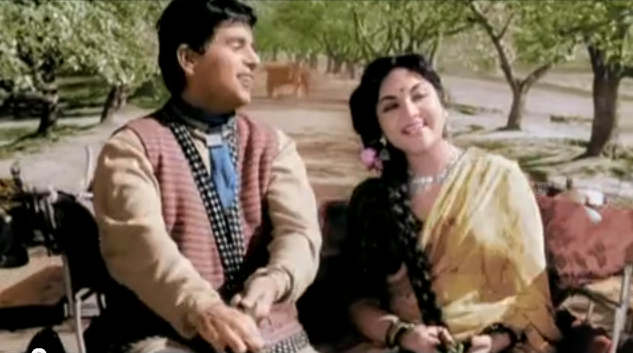
Dilip Kumar and Vijayantimala take a cue from their horse in Naya Daur (1957)

You know what I’m talking about. Guy and girl are falling in love. The setting: indistinct country road. A trotting horse (hay load optional) comes into view. Guy holds the reigns, a gentle clip-clop sets the beat like a metronome, and at last someone can’t resist and bursts into love song. Yes, nothing evokes the pastoral innocence of Bollywood’s rural ideal like a good horse and buggy sequence.

I’ve come up with a list of my top 5 horse and buggy songs. No matter how terrible you’re your day was, these’ll always put you in the mood. Sure, the economy is a mess, and yes, studying/work/dieting is rough. But isn’t it comforting to know that at least there will always be an appropriate forum to burst into song freely with a built-in beat? Just find a horse, grab a partner, and say hello to some fresh village air.

1. Mang Ke Saath Tumhaara (Naya Daur, 1957)

-The epitome of the horse and buggy genre. If this song doesn’t just make you want to join your nearest agrarian values movement, then you are made of steel. Dilip Kumar and Vijayantimala’s dynamic is so cute in this song, you overcome your gag reflex and find yourself basking in the bliss of better, bygone days. This film was recently recoloured following the latest trend, and the whole soundtrack is magic.

2. Haule Haule Chalo More Sajna (Saawan Ki Ghata, 1966)

-I absolutely love this song. It gets my spirits up every time. I think part of it is my love of Sharmila Tagore’s teasing persistence, while Manoj Kumar only pretends he isn’t loving it. This is also a beautiful example of one of the few melodious Asha Bhonsle songs that I honestly think no one else could have sung better (as in, Lata). Her voice is just a joy to listen to as she completely hits the mood of this playful winner.

3. Yun To Hamne Laakh Haseen Dekhe Hain (Tumsa Nahin Dekha, 1957)

-Oh Mohammed Rafi, can you do no wrong? The lyrics are adorable and this time, it’s the heroine playing hard to get. But don’t lie to yourself, girl–these are the days before Shammi Kapoor discovered jalebi, and he’s looking pretty fly with that Elvis ‘do. Asha comes back around later in the film for a brief female version of this song, but it’s a classic case of the ladies getting the shaft and having to sing too high because of the standard set by the male version (more on this issue to come). Until then, enjoy a slim Shammi treat to soothe all your pains.

4. Piya Piya Piya Mora Jiya Pukare (Baap Re Baap, 1955)

-Another incredibly cute duet/cheese-fest—this time brought to you by Chand Usmani and Kishore Kumar (who also acts!) The film itself is completely forgettable, but this Asha-Kishore duet is a fun benchmark for the genre. Please don’t miss their fellow travelers on car, who clearly all wish this had been a chorus song.

5. Aye Neele Gagan Ke Tale (Humraaz, 1967)

-Ok, I admit, this song doesn’t fit the classic definition of horse and buggy song. But hey, watching Raajkumar ride up on a horse like the prince of anyone’s dreams (and the subsequent quasi-dream sequence in the Darjeeling countryside) certainly deserves mention somewhere. And that rich voice of Mahendra Kapoor that gives a perfect song a little something-something? Yes, please.

An extremely honorable mention goes to “Aye Nargis-e Mastana” from Arzoo (1965) starring Sadhana and Rajendra Kumar. She’s definitely riding a horse the entire song, but Rajendra Kumar’s awkwardness brings the cute factor back down to Earth.

-Mrs. 55

Losing Yourself in Jewel Thief

Dev Anand and Vijayantimala dance for their lives in Jewel Thief (1967)

I recently went on a Dev Anand binge after hearing the news of his passing last month. This man was an absolute auteur—his films were always ahead of his time. Among my favorite of his films is the 1967 kitsch classic Jewel Thief–an addictive crime thriller centered around the identity of a mysterious jewel thief who wreaks havoc across the nation. I kid you not, I watched this film 4 times in just as many weeks (not recommended).

The first time you watch the film, you might feel overwhelmed by the clash of colours and intentions in the costume and set design, by the flashy effects, and thrilling soundtrack. You ask yourself superficial questions that don’t have real answers–like why on earth is Helen dressed like a chicken? Who seriously keeps a fridge in their living room? And how did Vijayantimala fit into these outfits?

Helen shimmers proudly in a chicken suit at a bar.

The second time, you can appreciate the rich music direction—from Lata’s lilting swan song in Rulaake Gaye Sapna Mera, to let’s not forget one of Asha’s greatest moments as a seductress in Raat Akeli Hai. Perhaps the greatest strength of Jewel Thief is its evergreen soundtrack—and the exciting dance number Honton Pe Aisi Baat. As you watch this song, you’re almost tempted to believe that Vijayantimala really did dance for Pope Pius XII himself at the Vatican when she was discovered at five years old (true story).

By the third time you see the film, you start to wonder why you’re still doing this instead of studying for exams next week.

But on the fourth pass, it dawns on you that beneath the glitzy exterior, 60s kitsch and melodrama, Dev Anand actually made an extremely sophisticated emulation of the greatest Hitchcock thrillers. The theme of double identities runs rampant in many of Hitchcock’s films—and Jewel Thief take this idea of an average man unwittingly mistaken for a look-alike to a new level. Like Mr. Kaplan of North By Northwest, our hero Vinay is so doggedly mistaken for a mystery man he has never heard of, that he joins the hunt to track down his doppelganger himself. The idea of doubles is cleverly underscored in the film’s mis-en-scene–through mirrors, camera angles, and editing. Dev Anand invites the viewer into a flashy glamorous world of deceit and intrigue–and soon, the reader is forced in the best Hitchcockian style to doubt the credibility of the film’s own hero–after all, has Vinay in turn been tricking the audience all along?

Perhaps then it is not surprising that Jewel Thief carries a deeper message underneath all of Asha Bhonsle’s high notes and crazy strobe lighting. Tanuja, who plays the likeable “modern” girl (and makes some awkwardly forward passes for the 60s), coincidentally only dresses in traditional saris after deciding to stand up for what’s right. And like India herself toying with the colorful lures of a Western way of life, Vinay loses and rediscovers his own identity, fighting to uncover the truth behind a glittering facade.

Do we really look that similar…? Hideous clash of plaids aside, though?

Bottom line? You need to see Jewel Thief. Forget the political commentary, forget the sublime soundtrack–just go for watching Helen in a chicken costume.

-Mrs. 55