
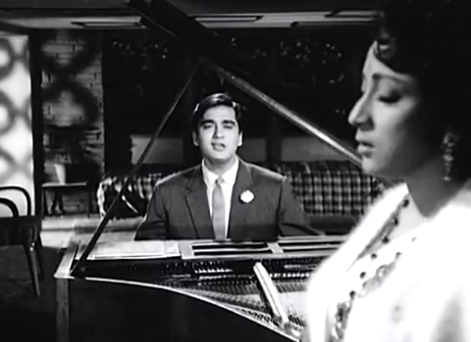
Sunil Dutt sings about the pain of heartbreak at the piano in Gumraah (1963)
In my opinion, I think one of the best parts about being a fan of old Hindi music is that it gives you a fun opportunity to brush up on your Urdu-Hindi language skills. From time to time, Mrs. 55 and I have decided that we will share some of our favorite song lyrics here and provide a glossary and translation so that everyone can follow along!
Our first song is “chalo ek baar phir se,” which is an absolute gem from the 1963 film Gumraah directed by B.R. Chopra. Arguably the best song of his career, this composition was rendered by Mahendra Kapoor, an excellent singer who ultimately carved a niche for himself in the industry after emerging from his initial fame as a Mohammed Rafi clone. The real star here, though, is Sahir Ludhianvi, who was truly one of the most gifted poets that has ever written for Hindi cinema. Known for his cynicism and disillusionment with society, Sahir Ludhianvi wrote lyrics that reflect a great deal of emotional complexity and maturity. In contrast to his contemporaries, Ludhianvi chose to remain unhindered by the constraints set by the prototypical Bollywood love song; many of his songs are refreshing to hear for their expression of biting political satire, heartfelt grief, or outspoken anger.

Sahir Ludhianvi, poet (1921-1980)
In “chalo ek baar phir se” Ludhianvi writes about a situation in which unfortunate societal circumstances prevent two lovers from fulfilling their romantic desires and building a life together. Supposedly, Ludhianvi was inspired to write this song when he encountered an ex-lover of his at a party with her new husband. The encounter must have been incredibly painful for him because these lyrics are devoid of the typical romanticizations of pyar and muhabbat that are often found in songs from this period. Instead of praising love as an ideal, the protagonist of the song suggests that he and his lover should return to becoming strangers because the emotional separation will make it easier for both of them to heal from their pain. The last stanza of the song is especially powerful: the protagonist posits that it is counter-productive to invest energy into doomed romantic relationships when they have become a burden. Ludhianvi’s words here suggest that it is sometimes in everyone’s best interests to put an early end to the love stories that simply cannot have happy conclusions. His eloquence and nuanced use of language to express the pain of unfulfilled love is sublime, and this type of poetic talent is sorely missed in the Bollywood industry today. For those of you who haven’t heard this song yet, it’s definitely worth a listen. If you follow along with the glossary below, I’m sure you’ll learn a couple new words that will impress ALL your Urdu-speaking friends (yes, all 2 of them).
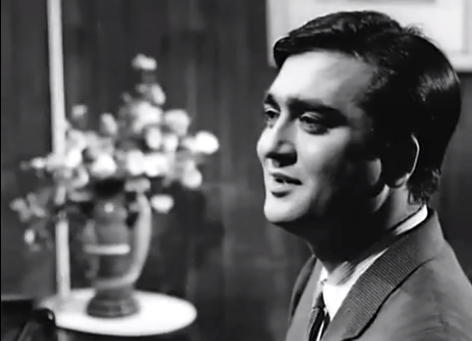
Sunil Dutt masks his internal anguish with a coy smile in Gumraah (1963)
Chalo Ek Baar Phir Se Lyrics and Translation:
chalo ek baar phir se, ajnabii ban jaaye.n ham dono.n
Come, let us become strangers once again.
na mai.n tumse koii ummiid rakhuu.n dilnavaazii kii
I shall no longer maintain hopes of compassion from you
na tum merii taraf dekho ghalat andaaz nazaro.n se
Nor shall you gaze at me with your deceptive glances.
na mere dil ki dhaDkan laDkhaDaaye merii baato.n me.n
My heart shall no longer tremble when I speak,
na zaahir ho tumhaari kashm-kash ka raaz nazaro.n se
Nor shall your glances reveal the secret of your torment.
tumhe.n bhii koii uljhan roktii hai pesh-qadmii se
Complications prevent you from advancing further,
mujhe bhii log kahte hai.n ki yeh jalve paraaye hai.n
I too am told that I wear disguises.
mere hamraah bhi rusvaayiaa.n hai.n mere maazii kii
The disgraces of my past are now my companions,
tumhaare saath bhii guzrii huii raato.n ke saaye hai.n
while the shadows of bygone nights are with you too.
taarruf rog ho jaaye to usko bhuulnaa bahtar
Should knowing one another become a disease, then it is best to forget it.
taalluq bojh ban jaaye to usko toDnaa achhaa
Should a relationship become a burden, then it is best to end it.
voh afsaana jise anjaam tak laanaa na ho mumkin
For that tale which cannot culminate in a conclusion,
use ek khuubsuurat moD de kar chhoDna achhaa
it is best to give it a beautiful turn and leave it be.
chalo ek baar phir se, ajnabii ban jaaye.n ham dono.n
Come, let us become strangers once again.
Glossary:
ajnabii: stranger; ummiid: hope; dilnavaazii: compassion; ghalat andaaz nazar: deceptive glance; laDkhaDaanaa: to tremble; zaahir: noticeable; kashm-kash: torment, struggle; uljhan: complication; pesh-qadmii karna: to advance; paraayaa jalva: disguise; hamraah: companion; rusvaa: disgrace; maazii: the past; taarruf: mutual acquaintance, knowledge of one another; rog: disease, afflication; taalluq: relationship; afsaanaa: tale; anjaam: conclusion; mumkin: possible; khuubsuurat: beautiful; moD; turn.
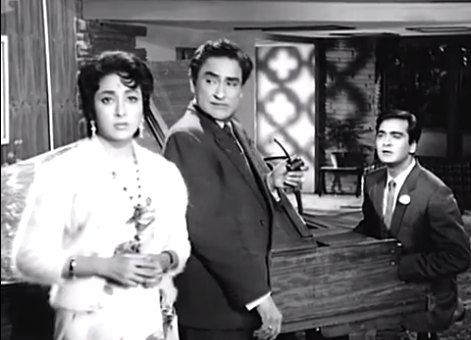
The expressions on the faces of Sunil Dutt, Mala Sinha, and Ashok Kumar reflect the pervading tension of this situation from Gumraah (1963).


 Mr. & Mrs. 55 - Classic Bollywood Revisited!