
Your average non-Bollywood viewer will probably read “lymphosarcoma of the intestine” and feel nothing. They will also probably pronounce intestine with a normal emphasis on the second syllable and won’t make it rhyme with “shine.” But ask anyone on the streets of Bombay who knows a thing or two about life from the silver screen, and you’ll be amazed. For Hindi cinema, the dreaded diagnosis “lymphosarcoma of the intestine” is synonymous with unavoidable impending doom of a most serious and scientifically complex nature. How did this all start and Bollywood folklore aside, what is lymphosarcoma of the intestine? Let us step back in time to 1971 to the film Anand when the hysteria all began…
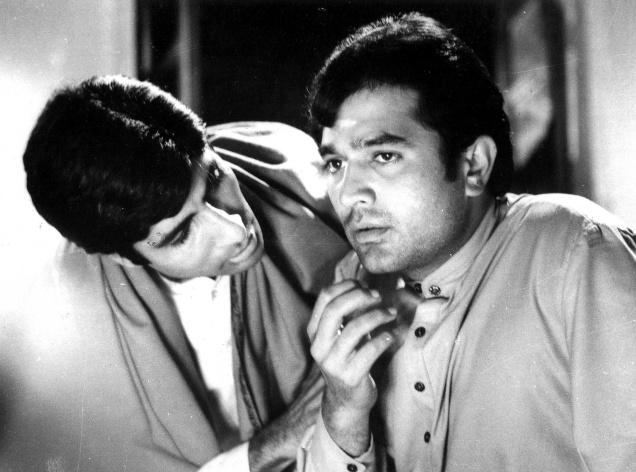
Amitabh Bachhan and Rajesh Khanna both can’t pronounce intestine in Anand (1971)
Anand is a film about a life-loving cancer patient whose optimism touches everyone he encounters. The film’s writer, Hrishikesh Mukherji, had majored in chemistry like his father before him, and started a career in Bollywood as a laboratory assistant in the film development process. Mukherji published the story himself—and was actually about his personal relationship to film great, Raj Kapoor (to whom the film is dedicated!) Kapoor used to call Mukherji babumushai when Kapoor had fallen quite ill himself, and the characters were based upon their interactions. I have discussed more about the songs and plot of the film here, but for now, I will highlight Anand’s unexpected, fatal diagnosis: lymphosarcoma of the intestine. At one point in the film, Anand is explaining his disease and jokes about the name that, “kisi viceroy ka naam lagta hai. Aadmi Vividh Bharati par announce kar sakta hai.” [It sounds like the name of some viceroy. It could be announced on the radio.]
So was the fancy sounding form of cancer just thrown in for the purposes of character development? Or was it perhaps actually the name of a disease he stumbled upon by chance many years ago as a chemistry student? Whatever the reason, clearly no one on their crew knew the correct pronunciation of the word “intestine” or the following it would develop. The tragic diagnosis then took on a cult status in Bollywood movies, memorable for its almost bizarre obscurity, and became de rigeur for anyone needing a terminal disease. It resurfaced most memorably in the smash-hit comedy Munna Bhai, MBBS (2003) about a Bombay thug-turned doctor who fights for the life of a patient with none other than…you guessed it, lymphosarcoma of the intestine! Surely, this was a nod to the original “patient-doctor” film Anand.
There’s probably a reason why you haven’t heard of lymphosarcoma of the intestine in real life. A 1922 paper that discussed three cases of the disease in-depth in Annals of Surgery remained the definitive word for many years. The paper described it as an extremely rare and obscure condition about which current knowledge was lacking (this was well before the age of DNA). Also discussed is how towards the end of the illness, the patient presents with severe constipation or vomiting—both unpleasant effects that Mukherji failed to include (they probably would not have gone over well on screen). Nearly 100 years later, the term “lymphosarcoma” is obsolete–by definition all neoplasms of the lymphoid tissue are cancerous and simply termed “lymphoma.” So what was perhaps once called the mysterious lymphosarcoma of the intestine is now recognized as intestinal non-Hodgkin’s MALT B-cell lymphoma. Still, this particular form of non-Hodgkin’s lymphoma occurs infrequently (only 8% of B-cell lymphomas), but retains a good prognosis if a particular chromosomal mutation does not occur. It can be caused by chronic inflammation from the bacteria H. Pylori, in which case, antimicrobial agents could cure you. Unfortunately for Anand, H. Pylori would not be discovered until 1982. Still, surgery and chemotherapy were available options for these patients, neither of which seemed to have been advised for Anand. For him, lymphosarcoma of the intestine remained an unavoidable death sentence.
And now you’re saying, so what? So Hrishikesh Mukherji made melodrama from an obscure fatal disease and didn’t stick with its actual forms of progression and treatment, big deal? Well, I’m here to say, for whatever it’s worth, lymphosarcoma of the intestine became ingrained under false pretenses in the imagination of Bollywood when knowledge about something more realistic and with a higher incidence might have actually served some benefit. What if he was just dying from end-stage renal failure due to severe diabetes after a life of eating pure asli ghee? Yes, it’s a stretch. All right, a huge stretch. But someone had to say it.
Let me just end this with some fun trivia. Did you know that Amitabh Bachan and Rajesh Khanna were not originally intended to be cast in this film? I know it’s hard to imagine, but in reality Mehmood and Kishore Kumar were supposed to play their roles! Due to an unfortunate misunderstanding, Hrishikesh Mukherjee and Kishore Kumar had a falling out, so new actors were brought in instead for the roles that would make their as well as lymphosarcoma of the intestine’s careers!
-Mrs. 55

 Mr. & Mrs. 55 - Classic Bollywood Revisited!