Losing Yourself in Jewel Thief

Dev Anand and Vijayantimala dance for their lives in Jewel Thief (1967)

I recently went on a Dev Anand binge after hearing the news of his passing last month. This man was an absolute auteur—his films were always ahead of his time. Among my favorite of his films is the 1967 kitsch classic Jewel Thief–an addictive crime thriller centered around the identity of a mysterious jewel thief who wreaks havoc across the nation. I kid you not, I watched this film 4 times in just as many weeks (not recommended).

The first time you watch the film, you might feel overwhelmed by the clash of colours and intentions in the costume and set design, by the flashy effects, and thrilling soundtrack. You ask yourself superficial questions that don’t have real answers–like why on earth is Helen dressed like a chicken? Who seriously keeps a fridge in their living room? And how did Vijayantimala fit into these outfits?

Helen shimmers proudly in a chicken suit at a bar.

The second time, you can appreciate the rich music direction—from Lata’s lilting swan song in Rulaake Gaye Sapna Mera, to let’s not forget one of Asha’s greatest moments as a seductress in Raat Akeli Hai. Perhaps the greatest strength of Jewel Thief is its evergreen soundtrack—and the exciting dance number Honton Pe Aisi Baat. As you watch this song, you’re almost tempted to believe that Vijayantimala really did dance for Pope Pius XII himself at the Vatican when she was discovered at five years old (true story).

By the third time you see the film, you start to wonder why you’re still doing this instead of studying for exams next week.

But on the fourth pass, it dawns on you that beneath the glitzy exterior, 60s kitsch and melodrama, Dev Anand actually made an extremely sophisticated emulation of the greatest Hitchcock thrillers. The theme of double identities runs rampant in many of Hitchcock’s films—and Jewel Thief take this idea of an average man unwittingly mistaken for a look-alike to a new level. Like Mr. Kaplan of North By Northwest, our hero Vinay is so doggedly mistaken for a mystery man he has never heard of, that he joins the hunt to track down his doppelganger himself. The idea of doubles is cleverly underscored in the film’s mis-en-scene–through mirrors, camera angles, and editing. Dev Anand invites the viewer into a flashy glamorous world of deceit and intrigue–and soon, the reader is forced in the best Hitchcockian style to doubt the credibility of the film’s own hero–after all, has Vinay in turn been tricking the audience all along?

Perhaps then it is not surprising that Jewel Thief carries a deeper message underneath all of Asha Bhonsle’s high notes and crazy strobe lighting. Tanuja, who plays the likeable “modern” girl (and makes some awkwardly forward passes for the 60s), coincidentally only dresses in traditional saris after deciding to stand up for what’s right. And like India herself toying with the colorful lures of a Western way of life, Vinay loses and rediscovers his own identity, fighting to uncover the truth behind a glittering facade.

Do we really look that similar…? Hideous clash of plaids aside, though?

Bottom line? You need to see Jewel Thief. Forget the political commentary, forget the sublime soundtrack–just go for watching Helen in a chicken costume.

-Mrs. 55

Making the Cut in Pakeezah: Behind-the-scenes of one of Bollywood’s most elaborate musicals

The ethereal Meena Kumari in Pakeezah (1971)

Few films have more behind-the-scenes gossip and excitement than Pakeezah (1971). If you know anything about classic Hindi film songs, you’ve probably heard some part of the Pakeezah soundtrack from director Kamal Amrohi’s 1971 legend. The film stars tragedy queen Meena Kumari as Pakeezah and gorgeous, gravely-voiced Raajkumar in a story of unforgiving traditional values that collide with the forbidden love of a pure-hearted courtesan. In an ironic twist, Pakeezah is revealed at the climax to be the hero’s long lost cousin, thus at last sanctioning their marriage (the ethical complexities of this kicker are a whole different issue.) But the movie itself is pure cinematic magic–Kamal Amrohi was notorious for his artistry and attention to detail. Pakeezah’s breath-taking production design, Ghulam Muhammed’s haunting semi-classical thumris, and the effortless poetry of the film’s dialogue is like entering one long, opium-induced dream.

But what was happening beneath the surface? A whole lot of drama.

Director Kamal Amrohi married Meena Kumari when she was 19 years old in 1952. They began filming Pakeezah within a few years–in fact, the song Inhi Logon Ne (raga Yaman) was filmed and edited before Amrohi switched to coloured film stock. The 1956 black-and-white version of the song was never used, but many of the shots are extremely similar to the final version. Notice how different young Lata’s voice sounds in this song compared to parts of the soundtrack recorded years later. Even more interestingly, Inhi Logon Ne was originally taken from the film Himmat (1941) in a version sung by none other than Shamshad Begum!

My favorite non-Lata song from the film is, Nazariyan Ki Maari, sung by 1930s playback singer Rajkumari Dubey. During production, when Naushad spotted Rajkumari singing in his chorus to make ends meet (and this is a woman who had been first female playback singer of India!), he reportedly caused an uproar and gave his former collaborator her own solo. This is why we love Naushad.

Pakeezah took over 14 years to complete, mainly because of the famously tumultuous relationship between Kamal and Meena (and her eventual alcoholism). Rumor has it that Meena was such a hot mess during the filming of Chalo Dildar Chalo, Amrohi cut her out and reworked the shot list so that her face is actually never seen in the song. Her condition became so bad that during the filming of the grueling emotional mujraa “Teer-e Nazar,” Meena Kumari collapsed. A body double, none other than filmi vamp Padma Khanna, was recruited to replace her! Meena Kumari personally trained her for the scene, and the song was filmed with the majority of the dancing done with an opaque chunni hiding Padma’s face! I would’ve killed to be a yes-man on that set and drink in all the gossip.

A very convenient camera angle…

Speaking of which, did you know the beautiful Mohammed Rafi-Lata Mangeshkar duet, Chalo Dildar Chalo (raga Pahadi), was actually also recorded as a female solo? Intended for use as a dancing number, the fascinating solo version was cut from both the film and record releases, although in my opinion, coupling the theme of romantic freedom in the lyrics with the close-up imagery of a ghungroo-bound Pakeezah could have been beautiful filmic irony. But it just didn’t make the cut.

And you know what else got cut from this film? I mean, literally, cut off. Turns out Meena Kumari was actually missing her left pinky from an accident that occurred around the time of her marriage! For a film that is so heavily focused on music and dancing, you can imagine that structuring every tiny shot and dance move to hide the left hand was tricky–but if you watch the film closely, Amrohi does a meticulous job of making sure her left hand stays hidden. And Meena Kumari’s right hand works such graceful magic, I dare you to find a prettier dancer with all 10 fingers.

For more information on the classic film, check out our page dedicated to the immortal dialogue from Pakeezah and the songs from Pakeezah!

– Mrs. 55

The Strange World of Gumnaam: Agatha Christie meets Bollywood

Helen and Pran forget their worries in Gumnaam (1967)

There’s been some buzz lately about the Italian Heineken “The Date” commercial featuring the music from Mohammed Rafi’s “Jaan Pehchaan Ho.” The commercial is fairly trippy, and sadly cuts out all of the actual singing, leaving only the musical introduction, interludes, and awkwardly enough, strange high-pitched male laughter. I’ve got two comments to make about this:

1. If you’re gonna take a Rafi song, why is the setting of this commercial East Asian instead of Indian? C’mon now, people.

2. More fundamentally, how on earth did the ad agency responsible for this come across this song and convince everyone involved of its advertising magic? Either a. someone had heard it used over the title sequence for the movie Ghost World, or b. someone knew it in its original form and had the guts, craziness, and pride to show it publicly. I can only hope it came from a fellow Rafi fanatic who is willing to boost the cause at any price to personal dignity. If it had been me who had a chance to bring glory to the Rafi name, I might’ve chosen the slightly more melodic/catchy “Badan Pe Sitare” or “Nain Milaakar“, which both seem to fall in the same category of hep cat club song. But that’s just me.

Let’s take a closer look the film, Gumnaam (1965) from where this song actually came. For all the Agatha Christie fans out there (and I’ve read all her books–no seriously, ALL of them), you may have been let down thinking that the best filmic interpretation of And Then There Were None was an obscure 80s Russian adaptation that has not been properly subtitled. Well, it’s your lucky day! Say hello to Gumnaam, a kitschy, melodramatic, and thoroughly enjoyable Bollywood adaptation of the Agatha Christie classic.

The film actually follows the basic outline of the plot pretty closely, adding in some extras for spice including the fantastically diverse soundtrack, an absolutely ridiculous dream sequence, and a mysterious ghostly element rendered by Lata’s vocals with the theme, “Gumnaam Hai Koi.”

As an aside, did you know “Gumnaam Hai Koi” is actually Lata’s cover version of the theme song to the 1963 American film Charade starring Cary Grant and Audrey Hepburn? Life is full of surprises.

The cast of Gumnaam is also a great mix of favorites–Manoj Kumar, Nanda, Pran, Mehmood as Butler, and none other than Helen in an actually fairly significant acting role. Sure, she’s got her usual crazy dance numbers (not to be missed!), but overall, if you have an open mind and three spare hours of your life that you know you will never get back, this film is pure deliciousness. And for all the Christie fans, the brilliant twist of the original novel takes on YET another twist in the climax of this film, so don’t think you know what’s coming!

Poison??! What a total surprise!

-Mrs. 55

Guru Dutt and the Struggle to Break Free of Convention

Guru Dutt’s poetic magnum opus, Pyaasa (1957), is often considered among the greatest cinematic achievements of all time, easily among the top 30 greatest Bollywood films ever made. You’re going to be hard-pressed to find someone more defensive of the genius that is Guru Dutt than yours truly. Pyaasa is an evocative film that explores one man’s search for humanism in the cold cynicism of post-independence Indian society. People often contrast Guru Dutt with his contemporary, famed actor and director Raj Kapoor, who shot hits like Shree 420 (1955)–a song-laden, fun rags-to-riches story with a clean happy ending. In contrast, the melancholic, disillusioned tone of Guru Dutt’s poetic films usually leave me feeling like my heart has been slowly torn out, but so beautifully done, I don’t even want it back anymore.

But I’m going to play devil’s advocate here and ask those who know and love both films, does it not seem that Pyaasa and Shree 420 both actually stemmed from the same reaction to the ideals of Nehru’s India under the “mandate of modernization?” Perhaps the creed of the heroic tramp of Shree 420 that spoke to the working masses is not so far from that of the starving poet of Pyaasa that stirred the minds of the intelligentsia. When Raj Kapoor and Guru Dutt, or any contemporary film-maker for that matter, sought to fill a void in their country’s cinema, despite such seemingly different approaches, they represented the emotions and wants of the same people. When you look closely, in fact, Pyaasa falls into many traps of the very conventions Guru Dutt wanted to break.

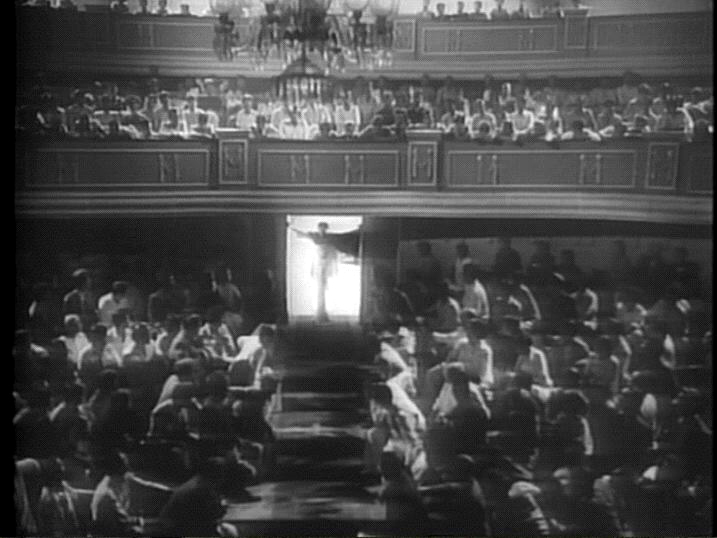
According to Raj Khosla, Guru Dutt believed the soul of Pyaasa was contained in the lines of hero Vijay’s song of lament: “Jinhe naaz hai Hind par, woh kahaan hain?” (“Where are those who are proud of this India?”), and Prime Minister Nehru himself is rumored to have been quite upset upon hearing this line, a direct invocation to the government for change.

Appalled and disillusioned, Guru Dutt’s hero stands Christ-like in the doorway of a ceremony to honor his own death.

But if that’s the case, what the heck is the chintzy “Hum aapki aankhon mein” dream sequence in which hero Vijay and Meena sing and dance in a heavenly courtyard of swirling mist and starry skies doing in the film? Perhaps it is not entirely surprising to learn that the song was not originally intended to be in the film–it was only added in later to appease the distributors who believed it to be unmarketable without at least one glitzy, expensive Bollywood song. The other songs in his film mesh seamlessly into the narrative, as if they are not songs at all, but mere continuations of dialogue–a novel technique pioneered by Dutt.

A greater travesty is, did you know the film was actually supposed to end with the high-angle crane shot of Meena all alone in the grand room with papers flying everywhere after Vijay leaves? To me, the scattered pages are a symbol of Vijay’s poetry whose role as a commodity in the film is in turn a symbolic attack of the loss of romanticism in the realities of the industrialization process. It’s as if to say, society must also honor the man who breathes life into the poems, not merely the price of the written words.

But as Dutt’s assistant recalls, Guru Dutt, “changed the ending because of how the distributors reacted. They felt the ending was too heavy. The financiers requested, ‘Why don’t you have a happy ending?’” Now Pyaasa finishes with Vijay finding spiritual fulfillment with the companionship of Gulabo and the two making their way into the hopeful sunset. I mean, isn’t this the kind of “all’s well that ends well” of conventional cinema he wanted to fight against?

So ultimately, the very focus on wealth and profitability that Guru Dutt chastises in his film is actually the force that proved overpowering in its production. Though Guru Dutt himself wanted otherwise, the distributors, believing to represent the mass market, were able to convince Dutt to change his plans and take fewer risks. He becomes just another flaw in his own criticism against Nehru’s India, greatly compromising the effectiveness of Pyaasa’s commentary. Essentially, the “solution” presented in a film like Shree 420 to try to work the system as best as possible, is all that Pyaasa shows is possible–try to be “purposeful” (as Guru Dutt wanted) within the limitations of the system. Recalling Vijay’s own lines, “Isko hi jeena kehte hain, to yuhiin jee lenge,” (“If this is life, then this is how we’ll live,”) Pyaasa often invites a sentiment to conform to the status quo rather than fight or question it.

Or am I reading too much into this?

–Mrs. 55