Chain Se Humko Kabhi Lyrics and Translation: Let’s Learn Urdu-Hindi

Asha Bhonsle and O.P. Nayyar share a joyful moment together. Photo Credit: indianexpress.com

Today, we present the lyrics and English translation to a soul-stirring melody composed by O.P. Nayyar and sung by Asha Bhonsle that has stood the test of time: chain se ham ko kabhiiAlthough this song was supposed to be included in Pran Jaye Par Vachan Na Jaye (1974) directed by S. Ali Raza, it never made the final cut! In spite of its prominent absence from a movie, this memorable composition has been treasured by Hindi film music lovers for years ever since it was released. While the profound beauty of this rare song never fails to earn universal appreciation, many fans may be surprised to learn about the behind-the-scenes drama surrounding the the making and release of chain se ham ko kabhii.

When Asha Bhonsle was 16 years old, she eloped with her elder sister Lata Mangeshkar’s 31-year-old personal secretary Ganpatrao Bhonsle against the wishes of her family. Over the course of an unhappy marriage, the allegedly abusive Ganpatrao grew suspicious of Asha’s faithfulness to their marriage and eventually cast her out of their home in 1960 . Pregnant with her third child, Asha left the Bhonsle household permanently in order to secure a better future for her children. A few years later, Asha and music director O.P. Nayyar began a nine-year romantic relationship in 1963 that quickly became the talk of the tabloids.  Although both Asha and O.P. were married legally to their spouses, they lived together for many years in O.P.’s penthouse flat at the Miramar building in Mumbai. During this period, the duo churned out a series of memorable musical hits that fans of Hindi film music still hold dear to their hearts: diivaanaa huaa baadal from Kashmir Ki Kali (1964), yeh hai reshmii zulfo.n kaa andheraa from Mere Sanam (1965), zaraa haule haule chalo more saajnaa from Sawan Ki Ghata (1966), yehii woh jagah hai from Yeh Raat Phir Na Aayegi (1966), and aao huzuur tum ko from Kismat (1968), among many other gems.

Sadly, this musical power couple encountered a rough patch in their relationship around 1972. One account of this story claims that Asha decided to leave O.P. when she saw him raising a hand and slapping her grown daughter Varsha. Whatever the reason may have been for their break-up, the couple had one last piece of unfinished business to deal with as they separated: the songs they had made together for the film Pran Jaye Par Vachan Na Jaye. Recorded before the couple had decided to part ways, records of these songs had been released several months in advance of the film’s premiere in 1974. Following the tragic break-up, Asha used her clout in the industry to have chain se ham ko kabhii deleted from the movie before it was released in theaters. However, the song had gained such widespread acclaim on its own that it won Asha her sixth Filmfare Award for Best Female Playback Singer in 1975. Since Asha refused to go to the ceremony to receive this award, O.P. Nayyar accepted the trophy on her behalf. It is said that O.P. then tossed the trophy out the window on his car ride home, ending their relationship on a truly sour note.

To this day, Asha refuses to acknowledge O.P. Nayyar publically and does not credit him for her early successes in the playback singing industry. Interestingly, in his old age, O.P. Nayyar overcame the bitterness of the duo’s break-up and admitted that Asha was “the best person I’ve ever met.

Chain Se Humko Kabhi: Lyrics and Translation

chain se ham ko kabhii aap ne jiine na diyaa
You have never let me live in peace.
zahar bhii chaahaa agar, piinaa to piine na diyaa
Yet, even if I asked to die by poison, you would not let me drink it.

chand ke rath me.n raat kii  dulhan jab jab aayegii
When the Night arrives as a bride on the Moon’s chariot,
yaad hamaarii aap ke dil ko taDpaa jaayegii
memories of me will continue to cause you heartache.
pyaar ke jalte zakhmo.n se jo dil me.n ujaalaa hai
The light in your heart emanating from our love’s burning wounds
ab to bicchaD ke aur bhii zyaadaa baDhnevaalaa hai
will continue to shine more brightly now that we are apart.
aap ne jo hai diyaa, vah to kisii ne na diyaa
What you have given to me, no one else has been able to replicate.
zahar bhii chaahaa agar, piinaa to piine na diyaa
Yet, even if I asked to die by poison, you would not let me drink it.

aap kaa gham jo is dil me.n din-raat agar hogaa
To bear your sorrow in my heart all day and night,
soch ke yah dam ghuTataa hai, phir kaise guzar hogaa?
the very thought of this is suffocating. How can I endure it?
kaash na aatii apnii judaayiimaut hii aa jaatii
If only death had come to me instead of this separation,
koii bahaane chain hamaari ruuh to paa jaati
then, under this pretext, my soul could finally rest at peace.
ek pal ha.nsnaa kabhii dil kii lagii ne na diyaa
My heart’s emotions have never let me smile for a moment.
zahar bhii chaahaa agar, piinaa to piine na diyaa
Yet, even if I asked to die by poison, you would not let me drink it.

chain se ham ko kabhii aap ne jiine na diyaa
You have never let me live in peace.

Glossary

chain: peace; zahar: poison; rath: chariot; dulhan: bride; ujaalaa: light; sulagnaa: to smolder; dam ghuTnaa: to suffocate; guzar honaa: to endure, subsist; kaash: if only; judaayii: separation; maut: death; bahaanaa: pretext; ruuh: soul; lagii: emotion, feeling.

In the context of this tumultuous backstory, the lyrics of chain se ham ko kabhii (penned by S.H. Bihari) are aptly fitting as Asha’s final swan song under O.P. Nayyar’s baton. Thank you to our reader Tanushree for requesting a post on this beautiful song and its interesting history–keep those requests coming! Until next time…

-Mr. 55
Pran

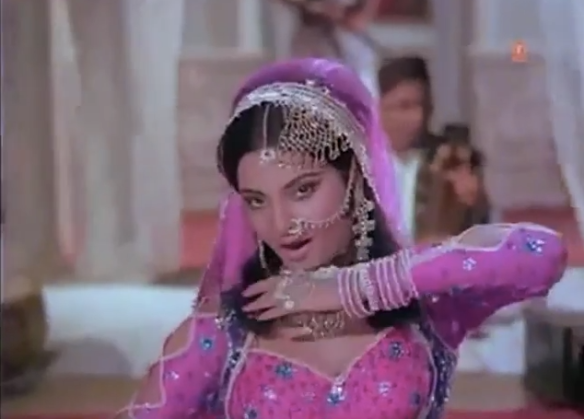
A young Rekha stars in Pran Jaye Par Vachan Na Jaye (1964). Since the song was deleted from the released film, details surrounding the picturization of chain se ham ko kabhii remain a mystery to this day.
Mera Joota Hai Japani Lyrics and Translation: Let’s Learn Urdu-Hindi

Raj Kapoor Shree 420 Charlie Chaplin

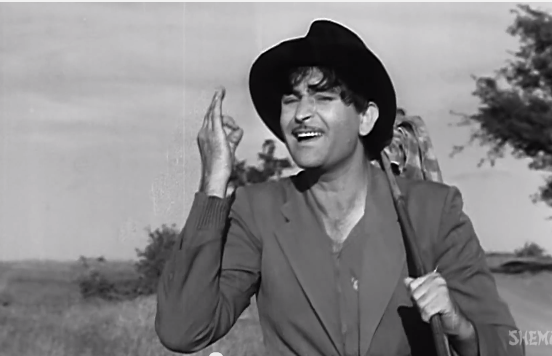
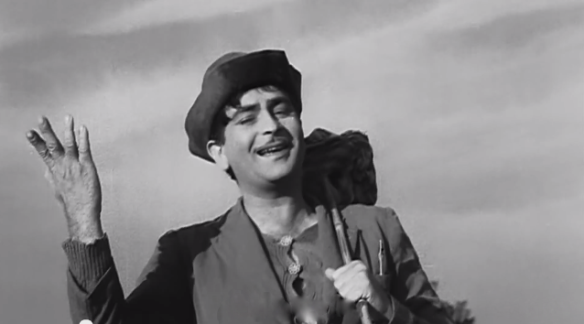
Raj Kapoor in his famous Charlie Chaplin incarnation from hit film Shree 420 (1955)

Today we showcase the lyrics and English translation of “Mera Joota Hai Japani” from Raj Kapoor’s Shree 420 (1955) to mark the occasion of India’s Independence Day! Shree 420 is truly a landmark film in Hindi cinema starring a legendary showman who became known from Bombay to Bulgaria. To understand the film and the ramifications of the enormously popular song of patriotism, “Mera Joota Hai Japani,” we turn to the context of the nation’s not-so-distant past.

When India awakened to independence from British rule in the summer of 1947, the country faced many barriers to united prosperity under Prime Minister Jawaharlal Nehru’s integrated social programs. While the freedom for which it had fought for generations was now realized, the Partition divided the Northern boundary of the nation between Muslims and Hindus, bolstering a mutual fear and hatred that seeped into the many ethnically diverse major cities. There, in turn, a rapid industrialization ideologically distanced the surrounding villagers from the urbanites, and a booming economy further isolated and redefined the gentry and the working class. While the geographic and cultural bars of much of Southern India allowed for a lesser degree of revolution, the Northern states, especially in the metropolises like Bombay where Bollywood blossomed, underwent a dramatic change that was felt at some level by the majority of inhabitants. Some strove to achieve a balance between the traditions of old and the advantages of Westernization, others the romanticism of rural life versus modern city life, and as always, the penniless lower classes wished to close the widening economic gap between themselves and the teeming wealth of the industrialists. In this maze of contradictions and extremes, Nehru tried nobly to guide the nation into forming a unique identity of its own as it moved into the future.

Raj Kapoor phir bhi dil hair hindustani shree 420

Raj Kapoor famously reminds his audience that “Phir bhi dil hai Hindustani” in Shree 420 (1955).

The elaborate family dramas and mythologicals of pre-independence Bollywood, therefore, no longer completely satisfied the country’s cinematic needs. Raj Kapoor was among the major influential directors and actors that emerged in the early years of independence whose work changed the face of Indian film. With the surfacing of a new middle and lower class audience, he sought to restructure the accessibility and impact of Indian cinema. Raj Kapoor (whose self-proclaimed audience was the underdog and downtrodden) responded to the socio-economic tensions of Nehru’s India through highly stylistic proletariat films that glorified the virtuous poor. His Chaplin-esque comedic appeal and playful optimism made him an iconic figure domestically and across the Middle East and Soviet Union. As a director of many of the era’s greatest hits such as the classic comedy, Shree 420, he established in the 1950s what now seems to be the “formulaic” Bollywood film. His plots mingled wholesome entertainment with social tension, dramatic one-liners, catchy show tunes, and the invariable triumph of Indian purity in the poor over the decadent Westernized ways of the rich.

Shree 420 is the story of a young man, Raju, who wanders from the countryside to find opportunity in city society. With an innocent smile and optimism, he strolls down the street famously singing love for his homeland in “Mera Joota Hai Japani.” His humble cheerfulness and patriotic pride captures the spirit of Nehru’s hopes and ideals for the blooming nation of a newly independent India threatened by corruption. 420, the well-known number from which the film derives its title, is the Indian penal code for fraud and dishonesty, and foreshadows Raju’s discovery of the means to survive in “modern” society.

Raj Kapoor mera joota hai japani

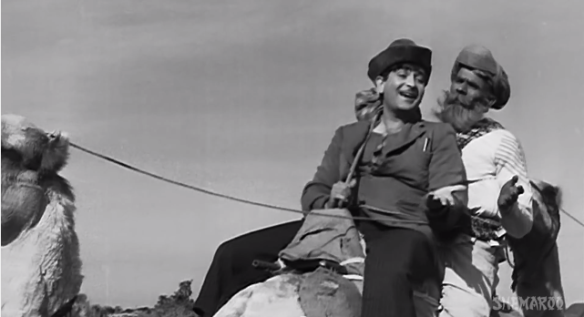
Raj Kapoor hops on a camel with an old guy who doesn’t seem to mind in Shree 420 (1955)

Shree 420 was a milestone production under the R.K. Studios banner that was among the first to be produced, directed, and acted in by Raj Kapoor himself. The son of a widely respected and extremely wealthy actor of the previous era, Prithviraj Kapoor, Raj Kapoor was nurtured in the film industry and had little difficulty in starting his own company with a very liberal amount of freedom. Formed in 1946, R.K. Studios went on to create some of the most successful films of Indian cinema. With lyrics by Shailendra and the soulful voice of Mukesh, we hope you enjoy our English translation of the lyrics to one of the thespian’s most beloved solos, “Mera Joota Hai Japani!”

Mera Joota Hai Japani Lyrics and Translation:

Meraa juuta hai Japaanii, yeh patluun Englishtaanii
My shoes are Japanese, these pants are British
Sar pe laal topii Ruusi, phir bhi dil hai Hindustanii
On my head is a red Russian hat, nonetheless my heart is Indian

Nikal paDe hai khulii saDak par, apnaa seenaa taane
I set out upon the wide open road confidently
Manzil kahaa.N, kahaa.N ruknaa hai, uparwaalaa jaane
Where is my destination, where must I stop, only God knows
BaDhte jaaye.N hum sailaanii, jaise ek Dariyaa toofanii
We advance forward relentlessly, as if a hurricane in a river
Sar pe laal topi Ruusi phir bhi dil hai Hindustani
On my head is a red Russian hat, nonetheless my heart is Indian
Mera juuta hai Japaanii…

Uupar-niiche niiche-uupar, leher chale jeevan kii
High to low, low to high, the waves of life flow
Nadaa.N hai jo baiThe kinaare, puuchhe raah watan kii
Those who wait by the shore are naive, ask for the path toward the motherland
Chalna jeevan kii kahaanii, rukna maut kii nishaanii
Going is the story of life while stopping is a sign of death
Sar pe laal topi Ruusi phir bhi dil hai Hindustani
On my head is a red Russian hat, nonetheless my heart is Indian
Mera juuta hai Japaanii…

Ho.Nge raaje rajkanwar ham bigaDe dil shehzaade
I will become the prince of fallen hearts
Ham singhaasan par jaa baithe.N jab jab kare.N iraade.N
I will sit upon a throne whenever I desire
Surat hai jaani-pehchaanii, duniyaa walo.N ko hairanii
My face will become familiar, it will be a surprise to the world
Sar pe laal topi Ruusi phir bhi dil hai Hindustani
On my head is a red Russian hat, nonetheless my heart is Indian
Mera juuta hai Japaanii…

Glossary:

juuta: shoe; Japaanii: Japanese; patluun: pants; Englishtani: British; sar: head; laal: red; topii: hat; Ruusii: Russian; phir bhi: nonetheless; however; dil: heart; Hindustani: Indian; nikal paDnaa: to set out; khulii: open; saDak: road; seenaa taannaa: (literally) to puff out the chest with pride, confidently; manzil: destination; ruknaa: to stop; uparwaalaa: God, he who is above; sailaanii: relentlessly; Dariyaa: river; toofaan: hurricane; uupar: high; niiche: low; leher: wave; jeevan: life; nadaa.N: naive; foolish; baiThnaa: to sit; kinaaraa: shore; raah: path; watan: motherland; country; maut: death; nishaanii: sign, symbol; raajaa: king; rajkanwar: prince; bigaDnaa: to fall; shehzaadaa: prince; singhaasan: throne; iraadaa: desire; surat: face; jaan-pehchaan: familiar; hairaani: surprise

Rural India to city transition

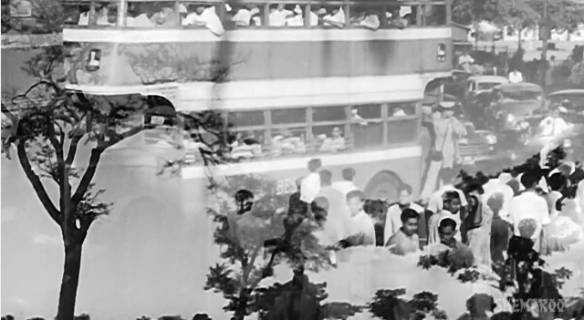
Raj Kapoor elegantly transitions with a cross-fade from rural India to a bustling city at the end of “Mera Joota Hai Japani.”

In the 1960s Raj Kapoor would drop his former image of the lovable proletariat and direct movies that resonated as family dramas of the wealthy, an increasing surrender to commercialism. The socio-political atmosphere of India had changed, and with it, the wants of the people. Movies that emphasized the difficulties of the developing period of the nation, or the unforgiving nature of that society were not the sell-outs they once were. The transition to a new era was over.

– Mrs. 55

camel

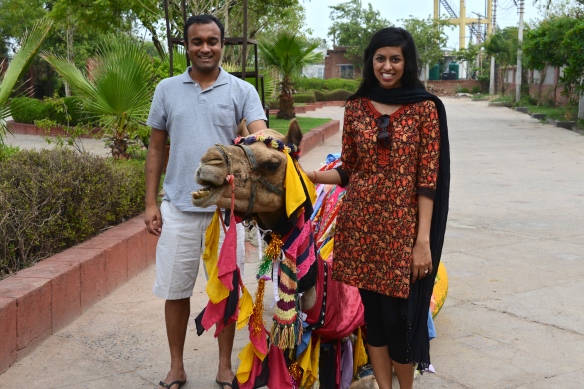
My fiance and I camel-spotting à la Raj Kapoor on our journey from New Delhi to Agra in a recent trip! Phir bhi dil hai Hindustani, as they say…