Rahe Na Rahe Hum Lyrics and Translation: Let’s Learn Urdu-Hindi

Suchitra Sen Ashok Kumar Mamta

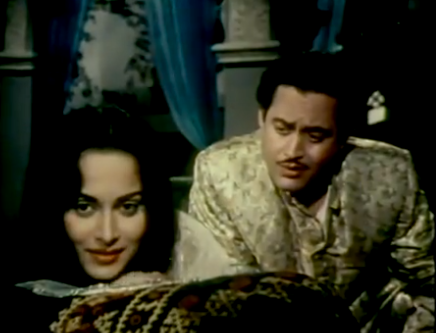
Ashok Kumar and Suchitra Sen star in the beautiful Asit Sen film Mamta (1966).

Today we showcase the lyrics and English translation of the melodious “Rahe Na Rahe Hum” from the film Mamta (1966). This gentle beauty sung by Lata Mangeshkar captures an inspiring philosophy on losing a loved one. An optimistic melody balances the tragic sentiments of its lyrics. While Ashok Kumar must leave Suchitra Sen to study law abroad, he pledges his loyalty to her upon the forthcoming separation and asks her to sing for him before he leaves.

The film Mamta explores the sacrifices Suchitra makes upon becoming a mother and like the thematically-similar blockbuster Aradhana (1969) demonstrates the resilience of a woman wronged by society. Majrooh Sultanpuri wrote the lyrics to Roshan’s superb compositions for Mamta that have kept the film’s legacy alive today. “Rahe Na Rahe Hum” continues to be a favorite with its playful chime opening and nectar-sweet vocals that betray the heartache of the scene.

Suchitra Sen in Mamta

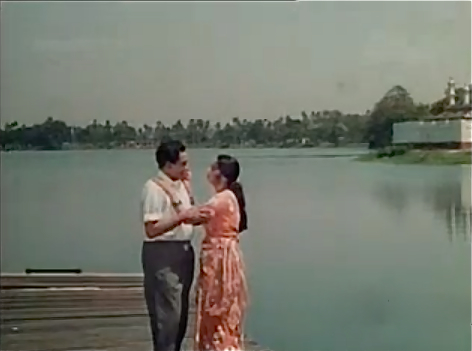
Suchitra Sen tears the petals from a flower on the eve of her separation from Ashok Kumar (right) and tosses the torn petals into the pond (left). The imagery of Suchitra’s identification with a flower recurs throughout the song and film–note how even her saari is decorated with a floral pattern!

“Rahe Na Rahe Hum” captures an appreciation of transience, framed as a neglected yet wonderous consequence of continuity, and highlights the transcendence of attachment to worldly phenomena such as seasons, physical proximity, and even time itself.

The tender line “ashqo.N se bhiigii chandnii mei.N ek sadaa si sunoge chalte chalte” allows simultaneously for mourning and recovery. While Suchitra acknowledges he will miss her, those tears of sadness will not last through the end of his journey that both know he must continue without her. Like the flowers petals that fall away drifting into the pond, Suchitra’s presence is not fettered by a set manifestation. Ultimately “Rahe Na Rahe Hum” is far more than mere words of consolation—it is an ode to love that celebrates the permanence of memory.
Suchitra Sen in Mamta

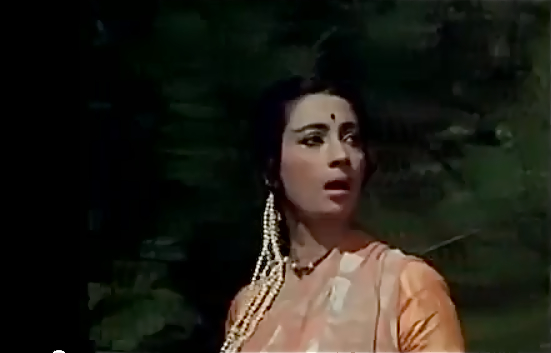
Suchitra Sen sings “Rahe Na Rahe Hum” as a parting gesture to the man she loves in Mamta (1966).

We hope you enjoy the full lyrics and English translation to the beautiful “Rahe Na Rahe Hum” below. Note that the plural pronoun “hum” can be translated as either “we” or “I.” I’ve chosen the singular for poetic purposes, but you can see how this no-doubt deliberate subtlety on the part of Sultanpuri sahib may color the translation slightly differently with each read. Watch the original song here!

Rahe Na Rahe Hum Lyrics and Translation: Let’s Learn Urdu-Hindi

Rahe na rahe hum mahakaa kareN.ge
Whether or not I am here, this fragrance will remain
Banke kali banke sabaa baagh-e-wafaa mei.N
As if a flower, as if a breeze in our devoted garden

Mausum koi ho, is chaman mei.N rang barse rahe.Nge hum khiraamaa
Whatever the weather may be in our garden, I will fill it gracefully with color
Chaahat ki khushbuu yuu.N hii zulfo.N se uDegii khizaa ho ya bahaare.N
The sweet fragrance of our love will still fly from my hair, whether Autumn or Spring
Yuu.N hii jhuumte aur khilte rahe.Nge
I will continue to sway and blossom
Banke kali banke sabaa baagh-e-wafaa mei.N
As if a flower, as if a breeze in our devoted garden
Rahe na rahe hum…
Whether or not I am here…

Khoye hum aise kyaa hai milnaa kyaa bichhaDnaa nahii.N hai yaad humko
I am so deeply lost in love that I no longer know separation from unity
Kooche mei.N dil ke jab se aaye sirf dil ki zameen hai yaad humko
Ever since you entered the lanes of my heart, I can only remember its world of love
Ise sarzameen pe hum to rahe.Nge
In that realm I will remain
Banke kali banke sabaa baagh-e-wafaa mei.N
As if a flower, as if a breeze in our devoted garden
Rahe na rahe hum…
Whether or not I am here…

Jab hum na ho.Nge, jab hamaare khaak pe tum rukoge chalte chalte
When I am gone, when you pause by my ashes as you walk
Ashqo.N se bhiigi chaandnii mei.N ek sadaa si sunoge chalte chalte
In the rainy moonlight that is wet from my tears, you will hear my call as you walk
Wohii pe kahii.N hum tum se mile.Nge
There somewhere, we both will meet again
Banke kali banke sabaa baagh-e-wafaa mei.N
As if a flower, as if a breeze in our devoted garden

Rahe na rahe hum mahakaa kareN.ge
Whether or not I am here, this fragrance will remain
Banke kali banke sabaa baagh-e-wafaa mei.N
As if a flower, as if a breeze in our devoted garden

Glossary:

mahaknaa: [a fragrance] to spread, kali: flower; sabaa: breeze; baagh: garden; wafaa: loyalty, devotedness; mausam: weather, atmosphere; chaman: garden; rang: color; khiraamaa: gracefully; chaahat: love, desire; khushbuu: sweet fragrance; zulf: hair; khizaa: Autumn; bahaar: Spring; jhuumnaa: to sway; khilnaa: to blossom; milnaa: to meet; bichhaDnaa: to separate; kooche: lane; zameen: world; yaad: memory; sarzameen: realm, society; khaak: ashes; ashq: tears; bhiigii: wet, rainy; chaandnii: moonlight, sadaa: call, voice

You may be interested to note that there is a duet version of this gem that is reprised at the end of the film by Mohammed Rafi and Suman Kalyanpur. Yes, it was the days of the famous Rafi-Mangeshkar feud–hence why the duets of the film necessitated recruiting additional singers (also from the same film, the flirtatious hit “In Baharo.N Mei.N Akeli” by Rafi and Asha as well as “Chhupa Lo Yuu.N Dil” featuring Lata and Hemant Kumar).

This song was requested by the one and only “lalten“! Let us know in the comments, does this song make you feel happy or bring tears to your eyes?

– Mrs. 55

Aye Mere Pyare Watan Lyrics and Translation: Let’s Learn Urdu-Hindi

IndianIndependenceDay

In honor of India’s 67th Independence Day on August 15th, we offer the lyrics and English translation to a patriotic classic from Kabuliwala (1961): ai mere pyaare vatan.

Inspired by a Tagore short story of the same name, Hemen Gupta’s Kabuliwala (1961) narrates the story of a dry fruit seller named Rehman (played by Balraj Sahni) who leaves Afghanistan to come do business in India. Missing the daughter he was compelled to leave behind in his homeland, Rehman finds comfort in befriending a young Bengali girl named Mini in Calcutta.

This emotionally stirring film is accompanied by an equally beautiful soundtrack composed by Salil Chowdhury and penned by Prem Dhawan. By all accounts, the most memorable song from this soundtrack is ai mere pyaare vatan. Sung with incredible pathos by Manna De, this song has become one of the filmi world’s greatest contributions to the oeuvre of Indian patriotic music. The prominence that this song has gained in the desh-bhakti genre of Indian music is somewhat ironic given its context in the film: it is picturized on Rehman, an alienated Pathan in India who yearns for his homeland of Afghanistan.

In the sphere of Hindi film music, ai mere pyaare vatan is considered one of the most beautiful expressions of love for one’s homeland–a universal force that can transcend all cultural boundaries. On this special day, let us embrace the patriotic spirit of these lyrics and remember always to treat our homelands with honor, love and respect.

-Mr. 55
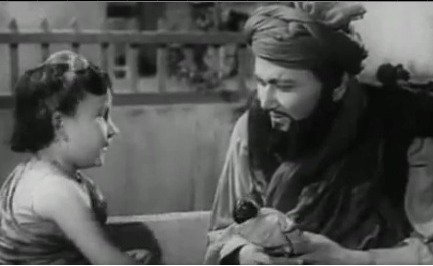
Balraj Sahni befriends a young girl who reminds him of his daughter back home in Afghanistan in Kabuliwala (1961)

Chhabi Biswas befriends a young girl who reminds him of his daughter back home in Afghanistan in the Bengali version of Kabuliwala (1957)

Aye Mere Pyare Watan: Lyrics and Translation

ai mere pyaare vatan, ai mere bichhDe chaman
Oh my dearest homeland, oh my lost garden!
tujh pe dil qurbaan
I shall sacrifice my heart for you.
tuu hii merii aarzuu, tuu hii merii aabruu 
You are my desire, you are my honor.
tuu hii merii jaan 
You are my life.

tere daaman se jo aaye un havaao.n ko salaam
I shall salute the winds that pass through your foothills.
chuum luu.n mai.n us zubaa.n ko jis pe aaye teraa naam
I shall kiss those lips that take your name. 
sab se pyaarii subaah terii sab se ra.ngii.n terii shaam 
You have the most beautiful of dawns and the most colorful of evenings.
tujh pe dil qurbaan 
I shall sacrifice my heart for you.

maa.n kaa dil ban ke kabhii siine se lag jaataa hai tuu
Sometimes you cling to my chest as my mother’s heart,
aur kabhii nanhii.n sii beTii ban ke yaad aataa hai tuu
and sometimes I remember you as my little daughter.
jitnaa yaad aataa hai mujhko utnaa taDpaataa hai tuu
The more I remember you, the more you torment me.
tujh pe dil qurbaan
I shall sacrifice my heart for you.

chho.D kar terii zamii.n ko duur aa pahu.nche hai.n ham
Having left your land, I have arrived somewhere far from home.
phir bhii hai yahii.n tamannaa tere zarro.n kii qasam
Swearing by every particle of your essence, I still harbor the desire
ham jahaa.n paidaa hue us jagah pe nikle dam
to take my last breath where I was born.
tujh pe dil qurbaan 
I shall sacrifice my heart for you.

ai mere pyaare vatan, ai mere bichhDe chaman
Oh my dearest homeland, oh my lost garden!
tujh pe dil qurbaan
I shall sacrifice my heart for you.

Glossary

vatan: homeland; bichhaDnaa: to be separated, lost; chaman: garden; qurbaan: sacrifice; aarzuu: desire; aabruu: honor; daaman: foothills; zubaa.n: tongue, lips, language; rangii.n: colorful; siinaa: chest; nanhii.n: little, young; taDpaanaa: to torment; tamanna: desire; zarra: particle; dam: breath.

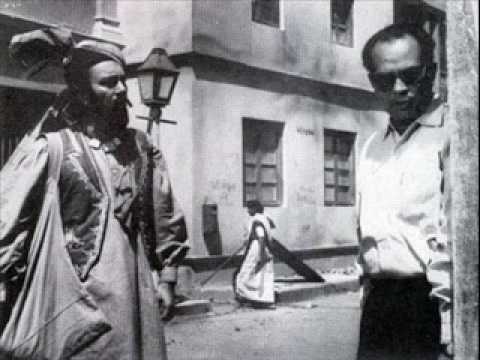
Balraj Sahni on-screen with producer Bimal Roy in Kabuliwala (1961)

Balraj Sahni on-screen with producer Bimal Roy in Kabuliwala (1961)

Chaudavin Ka Chand Ho Lyrics and Translation: Let’s Learn Urdu-Hindi

GD

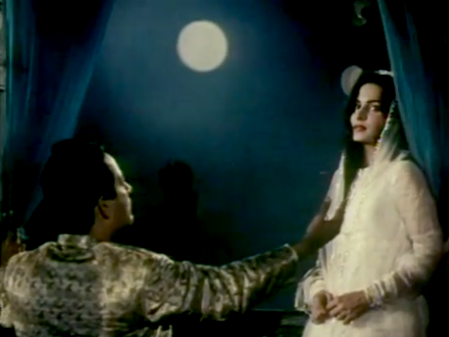
Guru Dutt compares the beauty of his beloved Waheeda Rehman to the full moon of the night sky in Chaudavin Ka Chand (1960).

Today, we present the lyrics and English translation to the title track from Mohammed Sadiq’s Chaudavin Ka Chand (1960).  After Kaaghaz Ke Phool (1959) proved to be a box office disaster, Chaudavin Ka Chand salvaged Guru Dutt’s production studio by garnering  widespread commercial success at the time of its release. Reflecting on the failure of Kaaghaz Ke Phool and the success of Chaudavin Ka Chand, Guru Dutt said,

 “Life me.n, yaar, kyaa hai? Do hii to chiize.n hai.n: –kamiyaabii aur failure. There is nothing in between.”

Although the success of Chaudavin Ka Chand as a comeback film for Guru Dutt Productions can be attributed to number of factors, one of the most important is the film’s outstanding musical score. Composed by Ravi and penned by Shakeel Badayuni, this soundtrack is full of memorable gems like the sassy Asha-Shamshad qawwali sharmaa ke ye kyo.n sab pardaanashii.n and the pain-filled badle badle mere sarkaar (Lata Mangeshkar’s only foray into singing for Guru Dutt Films!).

Among these gems, the film’s title track chaudavii.n ka chaa.nd ho steals the show as one of the most beautiful expressions of love in Hindi film music. Tuned to Raga Pahadi, Shakeel Badayuni’s Filmfare Award winning Urdu poetry abounds with metaphors to describe the film’s heroine Waheeda Rehman. Reminiscent of Shakespeare’s Sonnet No. 18 (“Shall I compare thee to a summer’s day?”), the the poet employs natural imagery to characterize his beloved’s beauty through references to the full moon (chaudavii.n kaa chaa.nd), the sun (aftaab), a lotus (ka.nval), wine (sharaab), and more. Ultimately, the poet concludes that his beloved is so beautiful that her beauty is beyond comparison to any object (jo bhii ho tum khudaa kii qasam laajavaab ho).

No discussion about chaudavii.n ka chaa.nd ho can be complete without giving credit to Mohammed Rafi for his magical rendition. Here, Rafi offers a technically brilliant performance but it is the warmth, passion, and soul in his voice that renders this song a timeless masterpiece. About fifteen years following his Bollywood debut, Rafi received his first well-deserved Filmfare Award for this song in 1961.

Did you know that the Censor Board objected to chaudavii.n kaa chaa.nd ho when Guru Dutt re-released a version of the song shot in color? As the color version was being filmed, Waheeda Rehman’s eyes became irritated from the heat of the high-powered lights used during the shoot. Upon seeing the red color of the heroine’s eyes, the Censor Board claimed that the colored picturization of the song contained suggestive and lustful implications inappropriate for audiences. What a bizarre and unfair objection placed on such an innocently romantic song! Don’t let it stop your from enjoying this classic gem along with our lyrics and translation below. Until next time…

-Mr. 55
WR

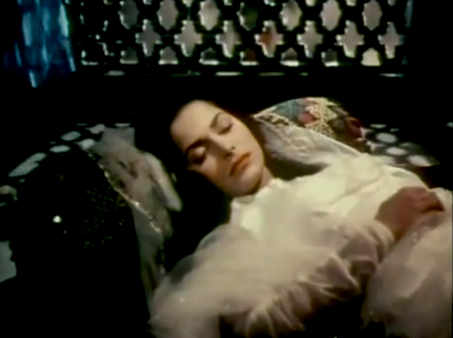
Sleeping in a white dress, Waheeda Rehman’s angelic beauty shines in Chaudavin Ka Chand (1960).

Chaudavin Ka Chand Ho: Lyrics and Translation

chaudavii.n kaa chaa.nd ho yaa aftaab ho?
Are you the full moon of the night or the sun of the day? 
jo bhii ho tum khudaa kii qasam laajavaab ho

Whatever you are, I swear by the Lord that you are incomparable.

zulfe.n hai.n jaise kaandho.n pe baadal jhuke hue
Your tresses are like dark clouds sloping down your shoulders.
aa.nkhe.n hai.n jaise mai ke pyaale bhare hue
Your beautiful eyes are like wine-filled goblets.
mastii hai jis me.n pyaar kii tum vah sharaab ho
You are the wine that abounds with the intoxication of love.

chaharaa hai jaise jhiil me.n ha.nstaa huaa ka.nval
Is your face like a smiling lotus in the brook,
yaa zindagii ke saaz pe chheDii huii ghazal?
or like an ode tuned to the music of life?
jaan-e-bahaar tum kisii shaayar kaa khvaab ho
My beloved, you are a poet’s dream.

ho.nTho.n pe kheltii hai.n tabassum kii bijliyaa.n
The current of your bright smile runs through your beautiful lips.
sajde tumhaarii raah me.n kartii hai kahkashaa.n
Even galaxies lay prostrate with reverence in your path.
duniyaa-e-husn-o-ishq kaa tum hii shabaab ho
 Only your youthful splendor shines in this world of love and beauty.

chaudavii.n kaa chaa.nd ho yaa aftaab ho?
Are you the full moon of the night or the sun of the day?

Glossary

chaudavii.n kaa chaa.nd: moon of the fourteenth night, full moon; aftaab: sun; laajavaab: incomparable; kaandhaa: shoulder; mai: wine; pyaalaa: goblet; mastii: intoxication; sharaab: wine, alcohol; jhiil: brook; ka.nval: lotus; saaz: musical instrument; ghazal: song, ode; jaan-e-bahaar: beloved; shaayar: poet; khvaab: dream; tabassum: smile; bijlii: current; sajde karnaa: to lay prostrate; kahkashaa.n: galaxy; duniyaa-e-husn-o-ishq: world of love and beauty; shabaab: youth.

GD

Guru Dutt and Waheeda Rehman’s on-screen chemistry in Chaudavin Ka Chand (1960) reflected their passionate off-screen affair.