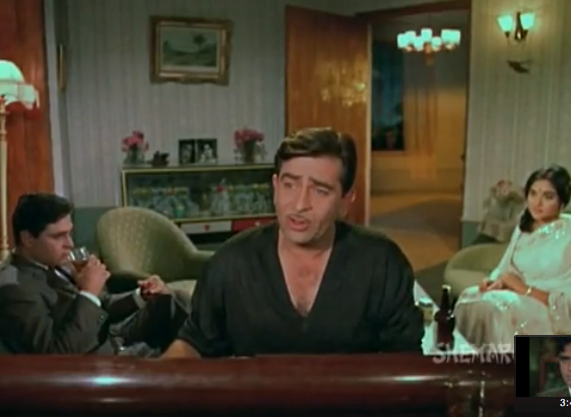
Raj Kapoor sings about betrayal in love and friendship at the piano in Sangam (1965)
Our next translation comes from Sangam (1965), a film starring Raj Kapoor as Sundar, Vijayntimala as Radha, and Rajendra Kumar as Gopal in a classic love triangle story gone wrong. The plot of Sangam is somewhat complex, but it can be boiled down to a few key points:
- From a young age, Sundar has been attracted to his childhood friend Radha. However, Radha only has eyes for another friend Gopal and persistently rejects Sundar’s advances. In secret, Gopal reciprocates Radha’s feelings for him.
- To prove his worthiness as a man and impress Radha, Sundar enlists in the Indian Air Force. Before his departure, Sundar asks Gopal to make sure no man comes in between him and Radha while he is gone.
- One day, Gopal and Radha receive the terrible news that Sundar is presumed dead after a plane crash. Although they are deeply saddened, this news means that Gopal and Radha can pursue their feelings for each other with a clear conscience. During their courtship, Gopal writes an unsigned love letter to Radha that will become important later in the story.
- Much to Gopal and Radha’s surprise, Sundar returns happy and healthy from the Air Force–the rumors of his death were inaccurate. The self-sacrificing Gopal keeps his word and steps out of the picture so that Sundar can woo Radha.
- Eventually, Radha and Sundar get married. It is difficult for Radha to reject Sundar now because his heroic accomplishments in the Air Force have elevated his status to that of a worthy suitor. The newly wedded couple have an extravagant European honeymoon.
- After their return, the couple enjoy marital bliss. Yet, their happiness is short-lived: Sundar finds the unsigned love letter and assumes that Radha has been an unfaithful wife (although she has stopped all relations with Gopal post-marriage).
- In the days that follow, Sundar becomes insane with jealousy and makes Radha’s life miserable with constant threats and aggression. Radha flees to Gopal’s house for refuge without knowing that Sundar will end up doing the same thing.
- The three characters now have a dramatic confrontation where Gopal admits that he is the author of the unsigned love letter. Tensions flare, and to avoid giving too much away, I’ll just say that the movie ends with a tragic death….
Placed into the context of this film, Sundar pours his heart out by singing “dost dost na rahaa” after discovering the unsigned love letter that Radha has hidden from him. With heart-wrenching lyrics penned by Shailendra and a touching melody based on Raga Bhairavi composed by Shankar-Jaikishan, this song is Bollywood’s quintessential anthem for those who have been betrayed in love or friendship. Mukesh’s pathos-laden voice is perfectly suited to express the pain that Sundar must feel after he comes to believe that his two closest companions in life have been unfaithful to him. The intensity of emotion is heightened by this song’s picturization: the camera captures close-up shots of facial expressions when Sundar sings the antara addressed to Gopal followed by the one addressed to Radha. From watching this scene, it seems like you can cut the tension in the air with a knife! Although no one should ever have to endure being spurned like this in real life, we hope that the lyrics and English translation provided below will allow you to acquire a greater appreciation for one of Hindi cinema’s finest expressions of angst and betrayal that is still a fan-favorite today.
-Mr. 55

Vijayantimala quietly endures Raj Kapoor’s misguided accusations of infidelity in Sangam (1965)
Dost Dost Na Raha: Lyrics and Translation
dost dost na rahaa, pyaar na pyaar rahaa
My friend no longer remains a friend; my love no longer remains love.
zindagii, hame.n teraa aitbaar na rahaa
Life, I have lost my faith in you.
amaanate.n mai.n pyaar kii gayaa thaa jisko sau.np kar
The one to whom I entrusted my belongings of love,
vah, mere dost, tum hii the, tum hii to the
My friend, you were him. Only you.
jo zindagii kii raah me.n bane the mere hamsafar
The one who had become my fellow traveler in the journey of life,
vah mere dost tum hii the, tum hii to the
My friend, you were him. Only you.
saare bhed khul gaye, raazdaar na rahaa
All my secrets are now exposed, the secret-bearer no longer remains.
zindagii, hame.n teraa aitbaar na rahaa
Life, I have lost my faith in you.
gale lagii saham saham, bhare gale se boltii
The one who embraced me fearfully while speaking in a somber voice,
vah tum na thii.n to kaun thaa? tum hii to thii.n
If she wasn’t you, then who was she? It was only you.
safar ke vaqt me.n palak pe motiyo.n ko toltii
The one who shed tears of pearls at the parting hour,
vah tum na thii.n to kaun thaa? tum hii to thii.n
If she wasn’t you, then who was she? It was only you.
nashe kii raat Dhal gayii, ab khumaar na rahaa
The night of intoxication is over, the inebriation no longer remains.
zindagii, hame.n teraa aitbaar na rahaa
Life, I have lost my faith in you.
vafaa kaa leke naam jo dhaDak rahe the har ghaDii
The one who beat each moment in the name of faithfulness
vah, mere nek nek dil, tum hii to ho
My good heart, you are it.
jo muskuraake rah gaye zahar kii jab suii gaDii
The one who continued to smile when pierced with a needle of poison
vah, mere nek nek dil, tum hii to ho
My good heart, you are it.
ab kisii kaa, mere dil, intazaar na rahaa
Now, my heart, I am not waiting for anyone.
zindagii, hame.n teraa aitbaar na rahaa
Life, I have lost my faith in you.
dost dost na rahaa, pyaar na pyaar rahaa
My friend no longer remains a friend; my love no longer remains love.
Glossary
aitbaar: trust, faith; amaanat: property, belongings; sau.npnaa: to entrust, hand over; hamsafar: traveler, companion; bhed: secret; raazdaar: secret-bearer; gale lagnaa: to embrace; saham: fearfully; bharaa galaa: somber voice; palak: eyelid; motiyaa.n: pearls; tolnaa: to weigh; nashaa: intoxication; khumaar: inebriation; vafaa: faithfulness; dhaDaknaa: to beat; nek: good, worthy; zahar: poison, suii: needle; gaDnaa: to pierce, thrust in; intazaar: wait.

Rajendra Kumar, with a distressed and guilty expression, listens to Raj Kapoor’s allegations of disloyalty during this song from Sangam (1965).


 Mr. & Mrs. 55 - Classic Bollywood Revisited!