
The Bollywood Bromance: Songs of Manly Love

There are few things cuter than a wholesome die-hard Indian bromance. In the past decade, the term “bromance” has become popularized by the American media and by high-grossing summer flicks that explore its comedic aspects—but its roots can be traced back to Hollywood first academy award for best picture Wings (1927). This silent heart-wrenching World War I love-fest between two men inspired dozens of commercial hits down the road from Butch Cassidy and the Sundance Kid (1969) to Top Gun (1986). Say what you want about those films, however, Bollywood was unarguably where this concept blossomed to its colorful fullest.

Perhaps it’s cultural—I can remember visiting Simla when I was younger and seeing teenage boys holding hands as they walked down the street. It was just considered a normal expression of friendship. Things have changed plenty since my childhood, but regardless, the marketability of the bromance genre may also likely stem from what had (and has) been for a long time a male-dominated industry–from directors to screenwriters all the way down to the lowly production assistants. In fact, in the early pre-talkie years of Indian cinema, women were not even allowed to act in films, much less attend viewings. Y-chromosome melodrama sells, and sells big. The bonds of manly love have been a glorified subject of Bollywood expression since time immemorial and has inspired some of the best movies you’ll ever watch.

In this post, we’ll explore our top 5 “bromantic” songs of yesteryear films long before the days of Dostana (2008) and even Qurbani (1980). From declaring eternal devotion to sobbing over betrayal, each one has a special place in our hearts and cinematic history.

Amitabh Bachhan and Dharmendra sing out their love in Sholay (1975)

Yeh Dosti (Sholay 1975):

This song is the crowning jewel of Bollywood bromance. Set at the beginning of an all-time megahit, this song showcases two men (Amitabh Bachhan and Dharmendra) riding a single motorcycle and singing their love for each other. Chest-hair is just blowing in the wind as their friendship is put to the test at the film’s climax. Overdone slightly, but a timeless tear-jerker!

Raj Kapoor pours his heart into his sad song of betrayed trust in Sangam (1964)

Dost Dost Na Raha (Sangam 1964):

Talk about tragedy. Raj Kapoor flies to war and saves his country, only to return and discover that his wife Vijayantimala is really in love with his own best friend Rajendra Kumar. This song of betrayal and lost friendship played morosely on the living room piano makes everyone in the room awkward. Please note that low-cut v-neck top. No, I’m not referring to Vijayantimala.

Rajesh Khanna and Amitabh Bachhan being adorable in Namak Haraam (1978)

Diye Jalte Hai.N (Namak Haraam 1973):

A Rajesh Khanna classic. Although best friends, Rajesh Khanna and Amitabh Bachhan come from two very different socio-economic statuses, ultimately leading to a huge public morally-charged battle of principles. Rajesh Khanna plays the good guy as usual, and his on-screen chemistry with Bachhan evokes the joy audiences loved in Anand! Did I mention the obligatory and visible fluffy chest hair?

Facing starvation and homelessness, two boys find friendship in Dosti (1964)

Chahoonga Mai.N Tujhe (Dosti 1964):

This film was unique in that it is entirely about two teenage boys (neither of whom were big stars then) and the sacrifices they make for each other. Did I mention the hero is blind and homeless? It makes it more endearing. This beautiful Mohammed Rafi song of tragedy is when the hero realizes his best friend is better off without him, and decides to get out of his way forever. These are kids, guys. It’s really, really cute.

Pran works to get a smile out of Amitabh Bachhan in Zanjeer (1973). This is a must-see–Pran is just such a beast in this movie.

Yaari Hai Imaan Mera (Zanjeer 1973):

Oh, Pran, you are a legend. This famous song celebrates the friendship between an Indian (Amitabh Bacchan) and an Afghani patthan (the inimitable Pran). He embodies this character so skillfully—look at how he twirls and gives that sly shake of the head, you’d think he had grown up in a mountainous outskirt of Kabul. See, Bollywood knows how to cross political boundaries too!

An extremely honorable mention goes to “Anhoni Ko Honi” from Amar Akbar Anthony (1979). Does it really count as a bromance if they’re actually supposed to be brothers?

Amitabh Bacchan, Vinod Khanna, and Rishi Kapoor are three brothers on a mission in Amar Akbar Anthony (1979)

Share with us your thoughts and additions to our list!

-Mrs. 55
Guru Dutt and the Struggle to Break Free of Convention

Guru Dutt’s poetic magnum opus, Pyaasa (1957), is often considered among the greatest cinematic achievements of all time, easily among the top 30 greatest Bollywood films ever made. You’re going to be hard-pressed to find someone more defensive of the genius that is Guru Dutt than yours truly. Pyaasa is an evocative film that explores one man’s search for humanism in the cold cynicism of post-independence Indian society. People often contrast Guru Dutt with his contemporary, famed actor and director Raj Kapoor, who shot hits like Shree 420 (1955)–a song-laden, fun rags-to-riches story with a clean happy ending. In contrast, the melancholic, disillusioned tone of Guru Dutt’s poetic films usually leave me feeling like my heart has been slowly torn out, but so beautifully done, I don’t even want it back anymore.

But I’m going to play devil’s advocate here and ask those who know and love both films, does it not seem that Pyaasa and Shree 420 both actually stemmed from the same reaction to the ideals of Nehru’s India under the “mandate of modernization?” Perhaps the creed of the heroic tramp of Shree 420 that spoke to the working masses is not so far from that of the starving poet of Pyaasa that stirred the minds of the intelligentsia. When Raj Kapoor and Guru Dutt, or any contemporary film-maker for that matter, sought to fill a void in their country’s cinema, despite such seemingly different approaches, they represented the emotions and wants of the same people. When you look closely, in fact, Pyaasa falls into many traps of the very conventions Guru Dutt wanted to break.

According to Raj Khosla, Guru Dutt believed the soul of Pyaasa was contained in the lines of hero Vijay’s song of lament: “Jinhe naaz hai Hind par, woh kahaan hain?” (“Where are those who are proud of this India?”), and Prime Minister Nehru himself is rumored to have been quite upset upon hearing this line, a direct invocation to the government for change.

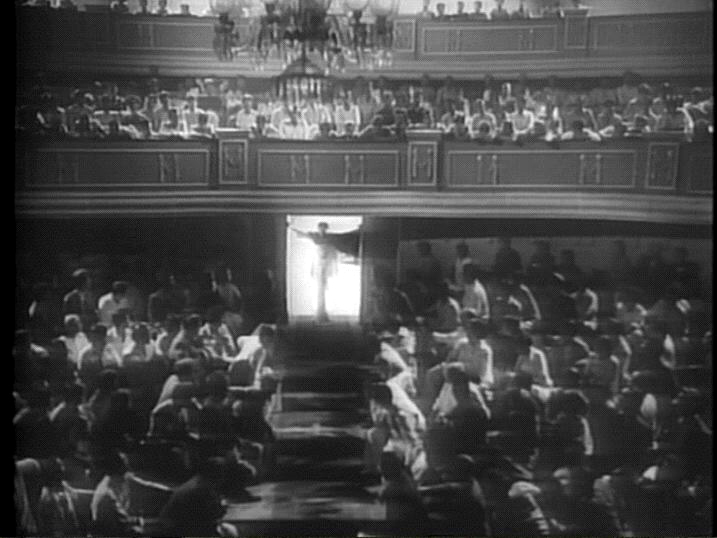
Appalled and disillusioned, Guru Dutt’s hero stands Christ-like in the doorway of a ceremony to honor his own death.

But if that’s the case, what the heck is the chintzy “Hum aapki aankhon mein” dream sequence in which hero Vijay and Meena sing and dance in a heavenly courtyard of swirling mist and starry skies doing in the film? Perhaps it is not entirely surprising to learn that the song was not originally intended to be in the film–it was only added in later to appease the distributors who believed it to be unmarketable without at least one glitzy, expensive Bollywood song. The other songs in his film mesh seamlessly into the narrative, as if they are not songs at all, but mere continuations of dialogue–a novel technique pioneered by Dutt.

A greater travesty is, did you know the film was actually supposed to end with the high-angle crane shot of Meena all alone in the grand room with papers flying everywhere after Vijay leaves? To me, the scattered pages are a symbol of Vijay’s poetry whose role as a commodity in the film is in turn a symbolic attack of the loss of romanticism in the realities of the industrialization process. It’s as if to say, society must also honor the man who breathes life into the poems, not merely the price of the written words.

But as Dutt’s assistant recalls, Guru Dutt, “changed the ending because of how the distributors reacted. They felt the ending was too heavy. The financiers requested, ‘Why don’t you have a happy ending?’” Now Pyaasa finishes with Vijay finding spiritual fulfillment with the companionship of Gulabo and the two making their way into the hopeful sunset. I mean, isn’t this the kind of “all’s well that ends well” of conventional cinema he wanted to fight against?

So ultimately, the very focus on wealth and profitability that Guru Dutt chastises in his film is actually the force that proved overpowering in its production. Though Guru Dutt himself wanted otherwise, the distributors, believing to represent the mass market, were able to convince Dutt to change his plans and take fewer risks. He becomes just another flaw in his own criticism against Nehru’s India, greatly compromising the effectiveness of Pyaasa’s commentary. Essentially, the “solution” presented in a film like Shree 420 to try to work the system as best as possible, is all that Pyaasa shows is possible–try to be “purposeful” (as Guru Dutt wanted) within the limitations of the system. Recalling Vijay’s own lines, “Isko hi jeena kehte hain, to yuhiin jee lenge,” (“If this is life, then this is how we’ll live,”) Pyaasa often invites a sentiment to conform to the status quo rather than fight or question it.

Or am I reading too much into this?

–Mrs. 55