Allah Tero Naam Lyrics and Translation: Let’s Learn Urdu-Hindi

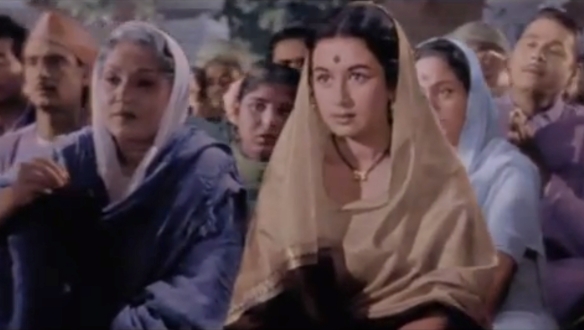
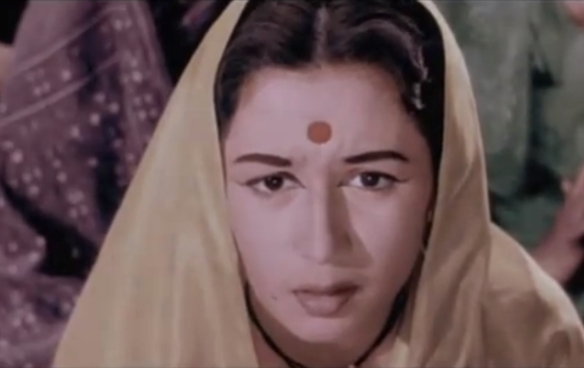
Nanda prays for her husband in the army in Hum Dono (1961).

Nanda prays for her husband in the army in Hum Dono (1961).

Happy New Year’s to all our readers! What an incredible year it’s been for us to write this blog and to have enjoyed discovering so many fellow fans of classic Bollywood cinema! I grew up in a Hindu Punjabi family, and in my house, we always celebrate the New Year’s with a havan the morning of January 1st with friends in the community. There’s something calming and cozy about these annual gatherings–we keep it casual where I’m from while taking a break to reflect on the year behind on us and what lies ahead. In the spirit of auspicious beginnings, we shall present the lyrics and full English translation to one of Bollywood’s greatest bhajansAllah Tero Naam” from Hum Dono (1961). Rendered impeccably by Lata Mangeshkar, “Allah Tero Naam” soars with bi-partisan Hindu-Muslim appeal in a humble call to God for wisdom and strength. The iconic number is one of Lata’s personal favorite Jaidev compositions!
nanda allah tero naam 3

Nanda sings the gentle bhajan “Allah Tero Naam” in Hum Dono (1961) as a special expression of bipartisan devotion in Hindi films.

For me, Hum Dono (1961) is one of the finest films of Dev Anand’s illustrious career: it glows with a constantly-twisting plot and a golden soundtrack that places the film among the legends of cinematic history. Dev Anand was well-known for pushing the envelope of societal norms as a director, and the troubling predicaments his characters find themselves in always astound–whether falling in love with a woman who thinks he’s her brother (Bombay Ka Babu), conducting whirlwind affairs with three women at once (Teen Devian) or romancing another man’s wife who believes he’s her real husband (Hum Dono). The plots are scintillating and the acting invariably superb. Furthermore, did I mention Hum Dono a quasi-twin movie too? Couple that with a war-time theme and you can readily imagine the opportunities for confusion of epic Bollywood proportions. See our earlier translation of “Main Zindagi Ka Saath” from the same film!

The Lata Mangeshkar solo is one of the film’s many high points, arriving midway through the film as Nanda prays for her husband’s safe return from the war. The time period was arguably when Lata’s voice was at her most angelic, and the graceful, gentle maneuvers of this song will leave you breathless for more!

Perhaps one of the greatest aspects to “Allah Tero Naam” is the Hindu-Muslim crossover lyrics. Reminiscent of “Ishwar Allah Tero Naam” later rendered by Mohammed Rafi in Nayaa Raastaa (1970), this bhajan encompasses an important and unique aspect of Indian spirituality–the transcendence of religious barriers (which holds a particular intrigue in a war-time themed filmed!) You guessed it, the lyrics are penned by that sensitive soul Sahir Ludhiviani, who’s feelings against war and it’s horrors are a theme in many later works (“Khuda-e-bartar,” anyone?). So whether you adore this song for the lyrics, the rendition, or just for Nanda’s emotive eye-batting, we hope you enjoy the lyrics and our English translation to “Allah Tero Naam” and wish you a happy New Year!

Allah Tero Naam Lyrics and Translation:

Allah tero naam, Ishwar tero naam
Your name is Allah, your name is Ishwar
Sab ko sanmatii de, Bhagwan
Bless everyone with equanimity, God

Maango.N kaa sindoor na chhuuTe
Do not let the sindoor disappear from the part of our hair [Let us not be widowed]
Maa.N bahano.N kii aas na TuuTe
Do not shatter the hopes of mothers and sisters
Deha binaa, Daataa
Without a body, Lord…
Deha binaa bhaTake na praan
Let the soul not wander without a body

O saare jag ke rakhwaale
O keeper of the whole world
Nirbal ko bal denewaale
The giver of strength to the weak
Balwaano.N ko
To the strong…
Balwaano.N ko de de gyaan
Bestow wisdom to the strong

Glossary:

Allah: God [Muslim]; Ishwar: God [Hindu]; sanmatii: equanimity, advise; maaNg: the parting line in a woman’s hair; sindoor: red powder worn in a woman’s hair part to signify marriage; maa.N: mother; bahan: sister; aas: hope; TuuTnaa: to break, to shatter; deha: body; Daataa: Lord; bhataknaa: to wander; praan: soul, life; rakhwaalaa: the keeper; nirbal: weak; bal: strength; balwaan: one who is strong, a warrior; denewaalaa: the giver; gyaan: wisdom, knowledge
dev anand hum dono allah tero naam

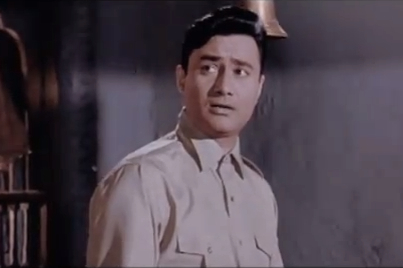
Dashing as always Dev Anand is torn from his family and caught in a moral dilemma in Hum Dono (1961).

Ever wondered why some songs use the term “tero” instead of “teraa” such as in this devotional? It’s a grammatical exception in the Hindustani language that you’ll only find in a direct address to God! It’s always nice to start a new year with linguistic trivia. Here at Mr. and Mrs. 55, our New Year’s resolution is to blog more often–we’re almost nearing our 100th post!

– Mrs. 55
Koi Jab Tumhara Hriday Lyrics and Translation: Let’s Learn Urdu-Hindi

Manoj Kumar Purab Paschim

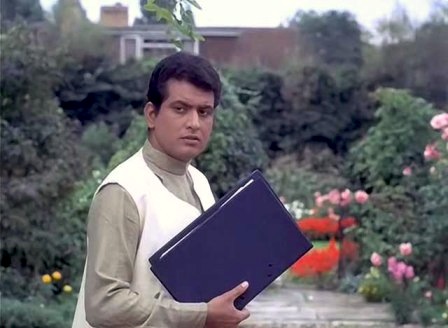
Manoj Kumar plays the righteous Mr. Bharat wooing a wayward Westernized girl in Purab Aur Paschim (1970).

We now present the lyrics and English translation to the haunting love song “Koi Jab Tumhara Hriday” from Manoj Kumar’s cult classic Purab Aur Paschim (1970). The film was one of many patriotic hits by Manoj Kumar that etched his niche as a fighter of Indian values on screen that no other producer or actor could replace. Shot with an entirely overt pro-India agenda that is really more endearing than offensive, Purab Aur Paschim rides on the righteousness of traditional values over the decay and corruption of societies lost to drugs, sex, and disregard for elders. It’s the anti-thesis to Orientalism–a vibrant, exotic lens coloured by everything India wanted to believe existed in the wild, wild West. It’s a film that only Manoj Kumar in his quiet Nehru coats, quivering upper lip, and a sincere belief in the Indian way of life could truly pull off. While the exaggerations of  London decadence may seem heavy-handed at times, there’s a real heart in this film that will win you over. See our translation of “Mere Desh Ki Dharti” for more!

“Koi Jab Tumhara Hriday” is a haunting Mukesh solo that stands wonderfully alone without fancy back-up music or elaborate picturization. From the plucking of strings that mark its opening to the quietly fading finale, his song has a unique power. Plus, keeping in line with the extremist traditionalism, how often will you find hardcore Sanskrit-based Hindi films in lyrics like “hriday” or “kanwal“?!

All that said, you can’t ignore that the lyrics are borderline groveling–they are sung by a traditional Mr. Bharat who finds himself in “modern” London and unused to the fast and easy ways of the West. Manoj Kumar falls hard for smoking playgirl Saira Banu–blonde wig, miniskirt, and all–to the point that he proclaims he will wait for her until the end to reciprocate after her other lovers grow tired of her. Is this truly what the perfect Indian man is supposed to be? My former Urdu professor used to have a really negative reaction to Manoj Kumar putting up with a girl like that–and found it pathetic he accepted she had so many other men in her life! Is he really pathetic or just blindly in love? Perhaps Manoj Kumar is simply trying to express that the unconditional love and devotion of the Indian way of life will outlast the fickle West shifting back and forth from empty pleasure to pleasure.

Saira Banu Purab Paschim

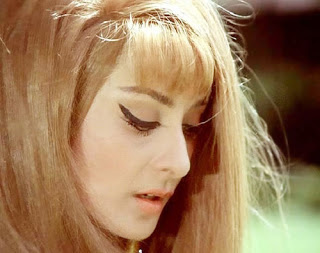
Saira Banu feigns nonchalance with her painfully fake blonde bouffant in Purab Aur Paschim (1970).

But say what you want about the lyrics, the melody is beautiful and Mukesh’s rendition is filled with emotion that I adore every time. Enjoy our English translation and lyrics to “Koi Jab Tumhara Hriday” below! Follow along here on youtube and let us know your thoughts in the comments!

Koi Jab Tumhara Hriday Lyrics and Translation

Koi jab tumhaaraa hriday toD de
When someone breaks your heart
Tadaptaa huaa jab koii chhoD de
When someone leaves you in suffering
Tab tum mere paas aanaa priye
Then come to me, beloved
Meraa dar khulaa hai, khulaa hii rahegaa tumhaare liye
My door is open, and will always remain open for you
Koi jab tumhaaraa hriday toD de
When someone breaks your heart

Abhii tumko merii zaruurat nahii.N
At the moment you do not need someone like me
Bahut chaahanewaale mil jaaye.nge
You will meet many people who fall in love with you
Abhii ruup ka ek saagar ho tum
For now you are an ocean of beauty
Kanwal jitne chaahoge khil jaaye.Nge
As many lotuses as you desire will bloom for you
Darpan tumhe jab Daraane lage
When your own image in the mirror starts to scare you
Jawaanii bhi daaman chuDaane lage
When your youth begins to leave you
Tab tum mere paas aanaa priye
Then you will come to me, beloved
Meraa sar jhukaa hai, jhukaa hii rahegaa tumhaare liye
My head is bowed to you, and will always bow to you
Koi jab tumhaaraa hriday toD de
When someone breaks your heart

Koii shart hotii nahii.N pyaar mei.N
There are no conditions in love
Magar pyaar sharto.N pe tum ne kiyaa
But your love is based on conditions
Nazar mei.N sitaare jo chamake zaraa
Those stars in your eyes that glittered for a while
Bujhaane lagii aartii ka diiyaa
They have begun to extinguish the candles of devotion
Jab apnii nazar mei.N hii girne lago
When that image of yourself falls in your own esteem
Andhero.N mei.N apne hii ghirne lago
When your own darkness starts to surround you
Tab tum mere paas aanaa priye
Then you will come to me, beloved
Yeh deepak jalaa hai, jalaa hii rahegaa tumhaare liye
This light is burning, it will always remain burning for you

Koi jab tumhaaraa hriday toD de
When someone breaks your heart
Tadaptaa huaa jab koii chhoD de
When someone leaves you in suffering
Tab tum mere paas aanaa priye
Then come to me, beloved
Meraa dar khulaa hai, khulaa hii rahegaa tumhaare liye
My door is open, and will always remain open for you
Koi jab tumhaaraa hriday toD de
When someone breaks your heart

Glossary

hriday: heart, liver; priya: beloved; dar: door; zaruurat: need; ruup: beauty, saagar: ocean; kanwal: lotus; Darpan: mirror; Daraane: to scare; jawaanii: youth; sar jhuknaa: to bow your head; shart: condition; sitaaraa: star; chamaknaa: to sparkle, to glitter; aartii: a common Hindu devotional prayer; diiyaa: small clay candle; girnaa: to fall; ghirnaa: to cloud, to surround; andheraa: darkness; deepak: light

Note: Take careful note of the use of the verbs ghirnaa and girnaa that are found side-by-side in these lyrics. They sound extremely similar but mean different things!

Saira Banu reformed Purab Paschim

Yes, surprise surprise, Saira Banu reforms her wicked Western ways by the end of the film and bursts into a beautiful Lata rendition of aarti back in the motherland. Oh, looks like you forgot to remove and burn that blonde wig. Woops.

Did you know this song was actually filmed at Oxford University? Watch the video carefully–the trimmed lawns and elegantly gated deer are from none other than Magdalen college! I only wonder what all the hip 60s British college students must have been thinking as they watched the filming take place…

-Mrs. 55

Jayen To Jayen Kahan Lyrics and Translation: Let’s Learn Urdu-Hindi

Dev Anand Taxi Driver

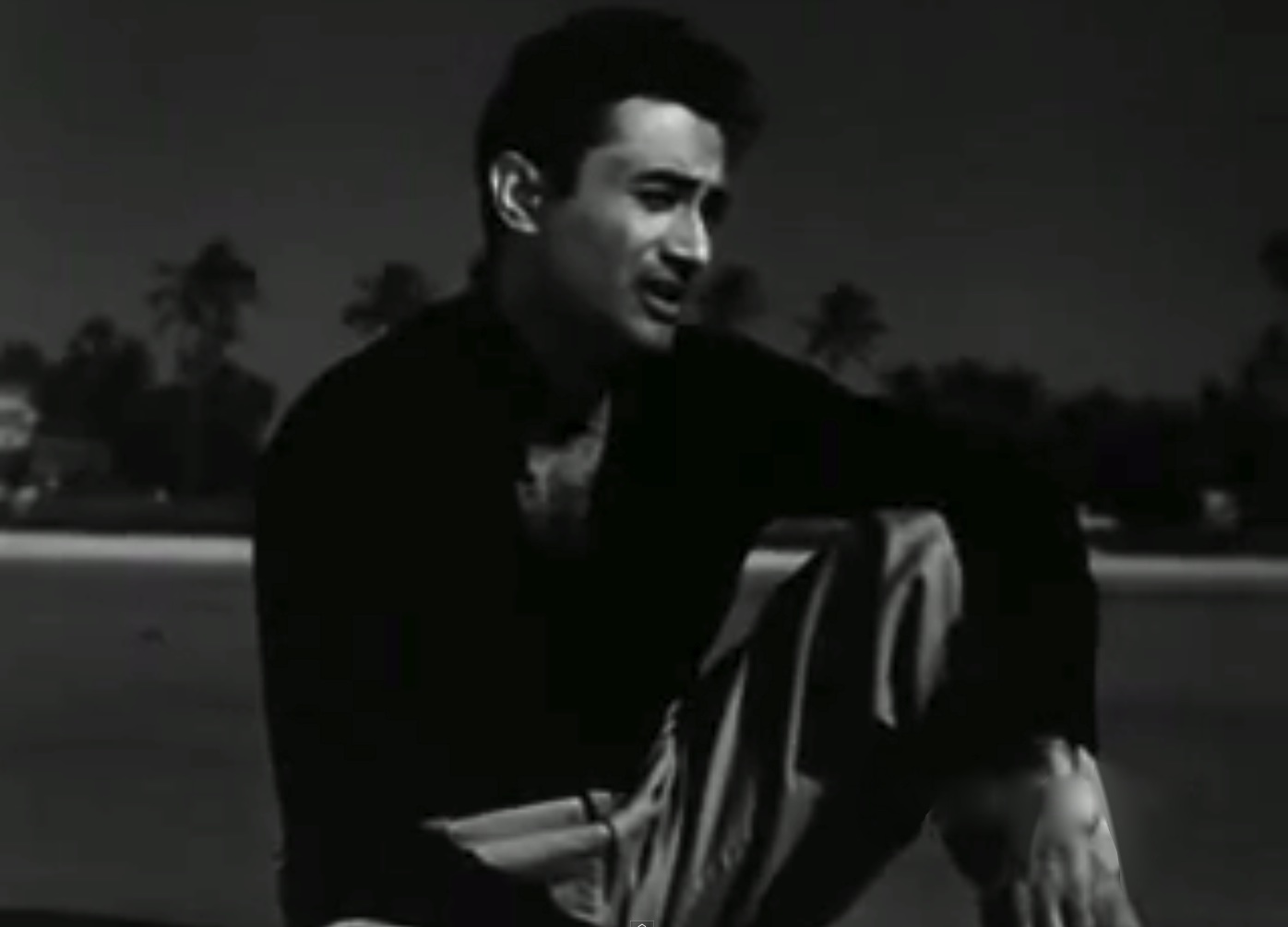
Dev Anand stares at the lonely beach in “Jayen To Jayen Kahan” from Taxi Driver (1954).

Next we present the full lyrics and English translation of “Jayen To Jayen Kahan” from Taxi Driver (1954). It’s one of yesteryear star Talat Mehmood’s most beloved solo hits. For anyone in the crowd who is unfamiliar with Talat, I’m truly saddened for your sake, but actually not entirely surprised. He’s one of the great unsung heroes of Bollywood who’s place in musical history was undermined with the rise and domination of Mohammed Rafi and Mukesh by the 60s. At least Hemant Kumar wrote his own film compositions and could conveniently cast himself as singer! But Talat was classy. While largely remembered for his legendary mark in ghazal-dom, Talat actually gave Shammi Kapoor his first hits in the 50s before Mohammed Rafi entered the scene. Yes, Talat was edged out of the business like a budding flower before Autumn. And did I mention he was so incredibly good-looking for a playback singer that he also acted in several films?

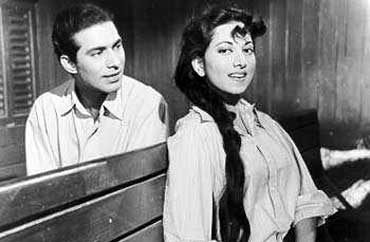
Dapper Talat Mehmood sings and acts with Suraiya in Waris (1954). Hottie, right?!

I could go on and on about my love for Talat and his velvety smooth voice, but let’s stay focused. Like later Dev Anand hit CID (1956), Taxi Driver is a really wonderful glimpse at chaotic and quaint 1950s Bombay city life. Told through the creative eyes of Chetan Anand (director and Dev Anand’s brother), the film is forever locked in its own charmingly antiquated society and street life of a bygone era. Most importantly, behind-the-scenes, Dev Anand was falling in love with his sensuous on-screen partner, Kalpana Kartik who would become his wife! It’s one of the few times you’ll see the two together (check out Baazi (1951) or Nau Do Gyarah (1957) for more!) and the juiciness of it all makes the film fun for the whole family. As Kalpana (AKA Mona Anand) later recalled:

I still remember our midnight marriage on the sets of “Taxi Driver” in 1954. Dev was a shy, youthful person, very co-operative and sensitive. We passed six decades together amid a lot of thick and thin. Whenever I heard rumours that he would desert me, I laughed my heart out. I knew that nomadic Dev would always be mine.

Cute, right? The hit philosophical song of the film “Jayen To Jayen Kahan” is sung first by Talat and later by Lata in the reprise–adding a touch of melodrama to the action. It’s beautifully picturized–the Talat version feels like an early Ozu film and carries a heavy weight with it. The careful cinematography allows time to pass slowly in a way that removes the viewer from the material world of the film and completely engulfs them in the philosophical queries of the song. Lyrics are, of course, by the great Sahir Ludhianvi. It’s a must-see for fans of early cinema!

Kalpana Karthik Taxi Driver

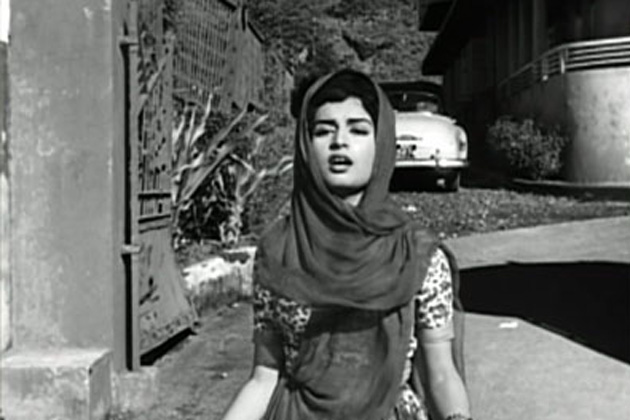
Gorgeous Kalpana Karthik and wife of Dev Anand, sings with Grace Kelly style in Taxi Driver (1954).

So without further ado, enjoy the lyrics and English translation to “Jayen To Jayen Kahan“! We’ve got you the male and female versions below (click here for the Talat version video!).

Jayen To Jayen Kahan Lyrics and Translation:

Male:

Jaaye.N to jaaye.N kahaa.N?
If I must go, where could I go?
Samjhegaa kaun yahaa.N dard bhare dil ki zubaa.N?
Who here will understand the words of a heart full of pain?

Mayuusiio.N kaa majamaa hai.N jee mei.N
A crowd of disappointments resides in my soul
Kya reh gayaa hai is zindagi mei.n
What is left for me in this life?
Ruuh mei.N gham, dil mei.N dhuuaa.N
In my soul is sadness, in my heart is smoke

Unka bhi gham hai, apna bhi gham hai
She has her sorrows, I have my own
Ab dil ke bachne kii ummiid kam hai
Now there is little hope of saving my heart
Ek kashTii, sau tuufaa.N
For it is like a single boat against a hundred storms

Jaaye.N to jaaye.N kahaa.N?
If I must go, where could I go?
Samjhegaa kaun yahaa.N dard bhare dil ki zubaa.N?
Who here will understand the words of a heart full of pain?

Female:

Jaaye.N to jaaye.N kahaa.N?
If I must go, where could I go?
Samjhegaa kaun yahaa.N dard bhare dil ki zubaa.N?
Who here will understand the words of a heart full of pain?

O jaanewaale daaman chhuDaake
Oh traveler who is leaving my embrace
mushkil hai jeenaa tujhko bhuulaake
Forgetting you and continuing to live is difficult
Is se to hai maut aasaan
Even death is easier than this

Seene.N mei.N shole, saa.Nso.N mei.N aahe.N
In my chest are embers, in my breaths are sighs
Is zindagii se kaise nibhaaye
What is there for me to fulfill in this life?
Har jazabaat hai viiraan
My every emotion is empty

Jaaye.N to jaaye.N kahaa.N?
If I must go, where could I go?
Samjhegaa kaun yahaa.N dard bhare dil ki zubaa.N?
Who here will understand the words of a heart full of pain?

Glossary:

dard: pain; zubaa.N: words, language; mayuusii: disappointment; majamaa: crowd; ruuh: soul; gham: sadness; dhhuuaa.N: smoke; ummiid: hope; kashTii: boat; tuufaa.N: storm; mushkil: difficult; maut: death; ahsaan: easy; seenaa: chest; shole: embers; saans: breath; aah: sigh; jazabaat: emotion; viraan: empty, wasted

I think the most important question here is, who sang it better: Lata or Talat? At the risk of being strangled by Mr. 55, I think it’s pretty clear the answer is Talat. It’s one of the few songs that just was not written for Lata–it sounds a little strained coming from her, if I dare say so. Talat, meanwhile, sounds like an effortless dream as always. A Talat Mehmood hit was requested by reader Suman! Send us a message if you’ve got a request too!

An adorable early rare photograph of Dev Anand with his wife Kalpana Kartik.

An adorable early rare photograph of Dev Anand with his wife Kalpana Kartik.

-Mrs. 55

Jaane Woh Kaise Log Lyrics and Translation: Let’s Learn Urdu-Hindi

Guru Dutt evokes classic Christ-like imagery in his depiction of Vijay the struggling poet in Pyaasa (1957).

We now present the lyrics and full English translation to one of my all-time favorite Guru Dutt songs “Jaane Woh Kaise” from Pyaasa (1957). I think my undying love for Guru Dutt is pretty evident at this point, but in case you need some convincing to get over the bold Clark Gable ‘stache, start here. Pyaasa is no ordinary film. When released to roaring accolades in 1957, Pyaasa broke precedent upon precedent in both impact and style. Notice how every song in this film seems to flow naturally as a consequence of the plot, as if the lyrics of the songs were a poetic continuation of the spoken dialogue? It was a technique pioneered by Guru Dutt that was later emulated by every great director in Bollywood. And the film hit some hard topics. I discuss more of the political stance of the film and the fascinating struggle Guru Dutt faced behind-the-scenes earlier, but now let us look instead to the classic “Jaane Woh Kaise” hit from the immortal pen of Sahir Ludhviani. It’s a mixture of everything right in the world: Guru Dutt as actor, Hemant Kumar with vocals, S.D. Burman composing, and Sahir in the back with the words of wisdom. This Hemant Kumar gem is truly the industry standard for awkward dinner party songs–even copied in modern times by Mira Nair in her film Vanity Fair (2004)!

Guru Dutt is employed as a dinner party waiter for his rich boss, Rehman, where he is confronted by the reality of his former lover, Mala Sinha, having abandoned him for wealth by marrying none other than the man currently employing him. The injustice of it all gets to him, and by chance, he’s a poet at heart who does what any other tragic poet would do in the situation: drop everything and throw a pity party.

Mala Sinha plays a cold-hearted social climber in Pyaasa (1957).

I love the cinematography in this song–Guru Dutt and his brilliant Director of Photography V.K. Murthy were known for their overblown yet graceful dolly-ins (watch the camera fly in “Waqt Ne Kiya“!), and so too in this song, the camera acts as a silent messenger of emotional turmoil, extracting a beautifully devastating toll on each of the key players in the room. And Guru Dutt holds his ground with arms outstretched as if crucified–a soft-spoken martyr against a background of bookshelves in which his own spoken words will later be immortalized and massacred. Again, you really need to see the film to appreciate the poetic genius of Guru Dutt film-making.

So enough talk, onto the lyrics and English translation of “Jaane Woh Kaise” from Pyaasa (1957)! Check out the picturization on youtube and let us know what you think in the comments!

Jaane Woh Kaise Log Lyrics and Translation

Jaane woh kaise log the jinke pyaar ko pyaar mila
I wonder what kind of people find their love reciprocated
Humne to jab kaliyaa.N maangii kaa.NTo.N kaa haar milaa
Whenever I asked for flowers, I received a garland of thorns

Khushiyo.N kii manzil DhoonDii to gham kii gard milii
I searched for a destination of joy, but I found a circle of sadness
Chaahat ke naghme chaahe to aahe.N sard milii
I desired tales of love, but I received only the coldness of sighs
Dil kii bojh ko duunaa kar gayaa, jo ghamkhwaar milaa
The burdens of my heart only doubled if I met someone meant to relieve my sorrow

BichhaD gayaa har saathii dekar pal do pal kaa saath
Every companion gave me a few moments of company, and left
Kisko fursat hai jo thaame diiwaano.N kaa haath
After all, who has the free time to hold a crazy man’s hand?
Humko apnaa saayaa tak aksar bezaar milaa
Even my own shadow is often weary of me

Isko hii jiina kehte hai.N to yuu.N hii jii le.Nge
If this is what they called life, then I will live like this
Uff na kare.Nge, lab sii lenge, aa.Nsuu pii lenge
I will not sigh, I will seal my lips, and swallow my tears
Gham se ab ghabraana kaisaa, gham sau baar milaa
After all, how can I be concerned by sadness? I have met sadness a hundred times

Humne to jab kaliyaa.N maangii.N kaaTo.N kaa haar milaa
When I asked for flowers, I found a garland of thorns
Jaane woh kaise log the jinke pyaar ko pyaar mila
I wonder what kind of people find their love reciprocated

Glossary:

kali: flower; kaanTaa: thorn; haar: garland; manzil: destination; gham: sadness; gard: circle; chaahat: love, desire; naghma: tale; aah: sigh; sard: chilly, cold; bhoj: burden; duunaa karna: to double; ghamkhwaar: a remover of sadness (note: the w is silent, as in khwaab); bichhaD jaanaa: to become separated; saathi: companion; fursat: free time; haath thaamnaa: to hold hands; saayaa: shadow; bezaar: fed up, weary; lab: lips; aa.Nsuu: tears; gham: sadness: ghabraanaa: to become anxious, concerned

Singing his heart out, Guru Dutt transforms Rehman’s classy dinner gathering into a awkwardly personal pity party in Pyaasa (1957).

Guru Dutt revives the martyr-style mis-en-scene in the reprise of “Yeh Duniya Agar Mil Bhi Jaaye” at the famous finale of the film! The scene has got to be one of the all-time greatest of Hindi cinematic history. For this and about a million other reasons, Pyaasa is absolutely mandatory classic Bollywood viewing!

-Mrs. 55

Ek Pyar Ka Nagma Hai Lyrics and Translation: Let’s Learn Urdu-Hindi

Nanda runs in two directions at once, coming and leaving, in “Ek Pyaar Ka Naghma Hai” from Shor (1972).

We next present the lyrics and full English translation to the eternal love ode “Ek Pyar Ka Nagma Hai” from Shor (1972). What makes “Ek Pyar Ka Nagma” so timeless? It is on everyone’s list of favorites. Part of it is that the lyrics are some of the best poetry written in accessible language (don’t get me wrong, personally if someone wants to burst into the Urdu-textbook “Mere Mehboob Tujhe,” I’m down for that too!). “Ek Pyar Ka Nagma” is rendered with almost magical emotion by Lata Mangeshkar and Mukesh–simultaneously a song of dream-like ecstasy and of tender nostalgia. It’s incomparable. The song speaks to a deep love between two souls undergoing hardship, to cherishing those brief precious moments spent together in happiness, and most of all, to remaining hopeful. The song is simple and evocative–and one of the most beautiful you’ll ever hear.

Manoj Kumar picturizes the famous violin introduction to “Ek Pyaar Ka Naghma” at a family beach outing.

Arriving about midway through the politcally-charged film, Shor, the song is partly told in golden-hued flashback of a family trip to the beach. Manoj Kumar plays a hard-luck activist and single father who’s wife, Nanda, is killed in a train accident.

Now some of you may at first be confused, if not disturbed, by Manoj Kumar’s radical cinematography in this sequence, typical of his edgy style. He experiments with several epigenetic, if you will, modifications at once that create an entirely signature effect: slow-motion, still photography inserts, split mirror screens. It was the 70s, and it was the time to experiment–and he’s one of the few Indian directors who did indeed drizzle these new techniques into his big screen productions. It’s unexpected, but upon closer analysis, I’ll argue works brilliantly. Manoj Kumar is no fool. To picturize a song about ephermal bliss, of prolonging a brief moment–he actually freeze frames his film to highlight the transience and importance of memory. His split frames, showing Nanda walking in and out of the center of the screen, of two halves of the beach merging, capture the duality of life that the lyrics speak of. In context, these techniques actually bring together the reflective themes of the film itself and of the love shared between its protagonists. For it, Manoj Kumar won the Filmfare Award Best Editing in 1972!

Nanda’s own reflection stares back at her as a symbolic representation of past and future in Manoj Kumar’s radical cinematography of Shor (1972).

So follow along below with our English translation of this lovely ode to carpe diem and unconditional devotion, “Ek Pyar Ka Nagma Hai” and watch the youtube version here!

Ek Pyaar Ka Naghma Hai Lyrics and Translation

Ek pyaar kaa naghmaa hai
Life is a tale of love
Maujo.N kii ravaani hai
Life is the flowing of waves
Zindagii aur kuch bhi nahii.N, terii merii kahaanii hai
Life is nothing more than your and my story

Kuch paakar khonaa hai
In gaining something, we lose something
Kuch khokar paanaa hai
In losing something, we gain something
Jeevan ka matlab to aanaa aur jaanaa hai
The meaning of life is to come and to go
Do pal ke jeevan se, ek umr churaani hai
From a few moments of existence, we must steal a whole lifetime
Zindagii aur kuch bhi nahii.N, terii merii kahaanii hai
Life is nothing more than your and my story
Ek pyaar kaa naghmaa hai…
Life is a tale of love…

Tu dhaar hai nadiyaa kii
You are the waters of a river
Mai.N teraa kinaaraa hoo.N
I am your shore
Tu meraa sahaaraa hai, mai.N teraa sahaaraa hoo.N
You are my support, I am your support
Aankho.N mei.N samandar hai, aashaao.N ka paanii hai
In my eyes is an ocean, it contains the water of hopes
Zindagii aur kuch bhi nahii.N, terii merii kahaanii hai
Life is nothing more than your and my story
Ek pyaar kaa naghmaa hai…
Life is a tale of love…

Toofaan to aanaa hai
Storms will come
Aakar chale jaanaa hai
But in the end, they will pass
Baadal hai yeh kuch pal kaa, chhaakar dhal jaanaa hai
These clouds are only momentary, after rising they will diminish
Parachhaaiiyaa.N reh jaatii, reh jaatii nishaanii hai
But these shadows remain, these symbols of you remain
Zindagii aur kuch bhi nahii.N, terii merii kahaanii hai
Life is nothing more than your and my story
Ek pyaar kaa naghmaa hai…
Life is a tale of love…

Glossary:

naghma: tale, ravaani: flowing, turning; zindagi: life; kahaanii: story; matlab: meaning; umr: age, lifetime, dhaar: water; nadiyaa: river; kinaaraa: shore; sahaaraa: support; samandar: ocean; aashaa: hope, wish; paanii: water; toofaan: storm; baadal: cloud; parchaaii: shadow; nishaanii: symbol, sign

Manoj Kumar remembers his dead wife and the love she left behind in Shor (1972).

The film, as in many Manoj Kumar patriotic hits, ends on a defiantly tragic note. Like Shaheed (1965), in which he is martyred with pride, or Upkar (1967) in which he loses his limbs for the glorious cause, in Shor too, Manoj Kumar becomes deaf–a poetic price for his son to gain back his lost voice. The film is a must-see for many reasons, if only to complete your understanding of the role Manoj Kumar played in Bollywood and defining the political tensions of his era. Although Manoj Kumar can no longer hear his late wife sing “Ek Pyar Ka Nagma Hai” to him, and from now on will no longer be able to hear his son, he remains hopeful and comforted by memories of the moments he once spent in happiness.

– Mrs. 55