The Strange World of Gumnaam: Agatha Christie meets Bollywood

Helen and Pran forget their worries in Gumnaam (1967)

There’s been some buzz lately about the Italian Heineken “The Date” commercial featuring the music from Mohammed Rafi’s “Jaan Pehchaan Ho.” The commercial is fairly trippy, and sadly cuts out all of the actual singing, leaving only the musical introduction, interludes, and awkwardly enough, strange high-pitched male laughter. I’ve got two comments to make about this:

1. If you’re gonna take a Rafi song, why is the setting of this commercial East Asian instead of Indian? C’mon now, people.

2. More fundamentally, how on earth did the ad agency responsible for this come across this song and convince everyone involved of its advertising magic? Either a. someone had heard it used over the title sequence for the movie Ghost World, or b. someone knew it in its original form and had the guts, craziness, and pride to show it publicly. I can only hope it came from a fellow Rafi fanatic who is willing to boost the cause at any price to personal dignity. If it had been me who had a chance to bring glory to the Rafi name, I might’ve chosen the slightly more melodic/catchy “Badan Pe Sitare” or “Nain Milaakar“, which both seem to fall in the same category of hep cat club song. But that’s just me.

Let’s take a closer look the film, Gumnaam (1965) from where this song actually came. For all the Agatha Christie fans out there (and I’ve read all her books–no seriously, ALL of them), you may have been let down thinking that the best filmic interpretation of And Then There Were None was an obscure 80s Russian adaptation that has not been properly subtitled. Well, it’s your lucky day! Say hello to Gumnaam, a kitschy, melodramatic, and thoroughly enjoyable Bollywood adaptation of the Agatha Christie classic.

The film actually follows the basic outline of the plot pretty closely, adding in some extras for spice including the fantastically diverse soundtrack, an absolutely ridiculous dream sequence, and a mysterious ghostly element rendered by Lata’s vocals with the theme, “Gumnaam Hai Koi.”

As an aside, did you know “Gumnaam Hai Koi” is actually Lata’s cover version of the theme song to the 1963 American film Charade starring Cary Grant and Audrey Hepburn? Life is full of surprises.

The cast of Gumnaam is also a great mix of favorites–Manoj Kumar, Nanda, Pran, Mehmood as Butler, and none other than Helen in an actually fairly significant acting role. Sure, she’s got her usual crazy dance numbers (not to be missed!), but overall, if you have an open mind and three spare hours of your life that you know you will never get back, this film is pure deliciousness. And for all the Christie fans, the brilliant twist of the original novel takes on YET another twist in the climax of this film, so don’t think you know what’s coming!

Poison??! What a total surprise!

-Mrs. 55
Guru Dutt and the Struggle to Break Free of Convention

Guru Dutt’s poetic magnum opus, Pyaasa (1957), is often considered among the greatest cinematic achievements of all time, easily among the top 30 greatest Bollywood films ever made. You’re going to be hard-pressed to find someone more defensive of the genius that is Guru Dutt than yours truly. Pyaasa is an evocative film that explores one man’s search for humanism in the cold cynicism of post-independence Indian society. People often contrast Guru Dutt with his contemporary, famed actor and director Raj Kapoor, who shot hits like Shree 420 (1955)–a song-laden, fun rags-to-riches story with a clean happy ending. In contrast, the melancholic, disillusioned tone of Guru Dutt’s poetic films usually leave me feeling like my heart has been slowly torn out, but so beautifully done, I don’t even want it back anymore.

But I’m going to play devil’s advocate here and ask those who know and love both films, does it not seem that Pyaasa and Shree 420 both actually stemmed from the same reaction to the ideals of Nehru’s India under the “mandate of modernization?” Perhaps the creed of the heroic tramp of Shree 420 that spoke to the working masses is not so far from that of the starving poet of Pyaasa that stirred the minds of the intelligentsia. When Raj Kapoor and Guru Dutt, or any contemporary film-maker for that matter, sought to fill a void in their country’s cinema, despite such seemingly different approaches, they represented the emotions and wants of the same people. When you look closely, in fact, Pyaasa falls into many traps of the very conventions Guru Dutt wanted to break.

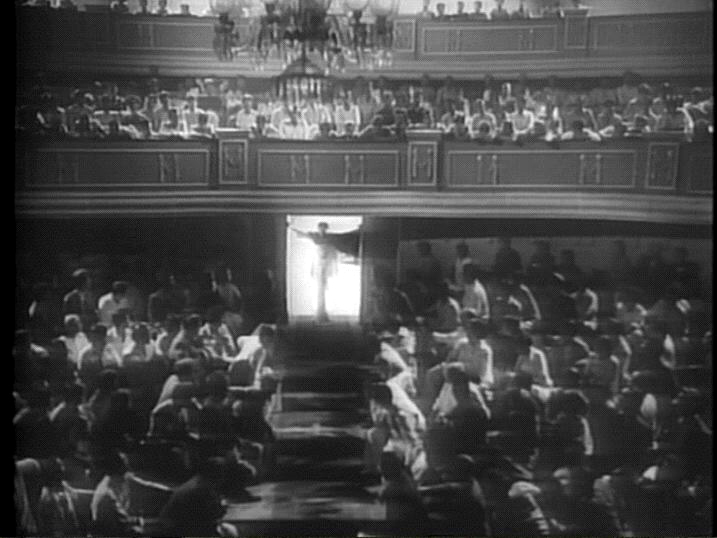
According to Raj Khosla, Guru Dutt believed the soul of Pyaasa was contained in the lines of hero Vijay’s song of lament: “Jinhe naaz hai Hind par, woh kahaan hain?” (“Where are those who are proud of this India?”), and Prime Minister Nehru himself is rumored to have been quite upset upon hearing this line, a direct invocation to the government for change.

Appalled and disillusioned, Guru Dutt’s hero stands Christ-like in the doorway of a ceremony to honor his own death.

But if that’s the case, what the heck is the chintzy “Hum aapki aankhon mein” dream sequence in which hero Vijay and Meena sing and dance in a heavenly courtyard of swirling mist and starry skies doing in the film? Perhaps it is not entirely surprising to learn that the song was not originally intended to be in the film–it was only added in later to appease the distributors who believed it to be unmarketable without at least one glitzy, expensive Bollywood song. The other songs in his film mesh seamlessly into the narrative, as if they are not songs at all, but mere continuations of dialogue–a novel technique pioneered by Dutt.

A greater travesty is, did you know the film was actually supposed to end with the high-angle crane shot of Meena all alone in the grand room with papers flying everywhere after Vijay leaves? To me, the scattered pages are a symbol of Vijay’s poetry whose role as a commodity in the film is in turn a symbolic attack of the loss of romanticism in the realities of the industrialization process. It’s as if to say, society must also honor the man who breathes life into the poems, not merely the price of the written words.

But as Dutt’s assistant recalls, Guru Dutt, “changed the ending because of how the distributors reacted. They felt the ending was too heavy. The financiers requested, ‘Why don’t you have a happy ending?’” Now Pyaasa finishes with Vijay finding spiritual fulfillment with the companionship of Gulabo and the two making their way into the hopeful sunset. I mean, isn’t this the kind of “all’s well that ends well” of conventional cinema he wanted to fight against?

So ultimately, the very focus on wealth and profitability that Guru Dutt chastises in his film is actually the force that proved overpowering in its production. Though Guru Dutt himself wanted otherwise, the distributors, believing to represent the mass market, were able to convince Dutt to change his plans and take fewer risks. He becomes just another flaw in his own criticism against Nehru’s India, greatly compromising the effectiveness of Pyaasa’s commentary. Essentially, the “solution” presented in a film like Shree 420 to try to work the system as best as possible, is all that Pyaasa shows is possible–try to be “purposeful” (as Guru Dutt wanted) within the limitations of the system. Recalling Vijay’s own lines, “Isko hi jeena kehte hain, to yuhiin jee lenge,” (“If this is life, then this is how we’ll live,”) Pyaasa often invites a sentiment to conform to the status quo rather than fight or question it.

Or am I reading too much into this?

–Mrs. 55

The Lost Art of the Raga-Mala

For musically-inclined fans of Hindi cinema, the Lata-Rafi duet “Kuhu Kuhu Bole Koyelia” from the film Suvarna Sundari (1957) stands out as one of the finest examples of how Hindustani classical music has been incorporated into the genre of Bollywood music. This song has always been a personal favorite of mine, and it happens to be one of the first pieces of Indian music I adapted for performance on the piano. This song takes on the structure of a ragamala (literally, a garland of ragas), a form derived from Hindustani classical music in which different musical modes are intertwined within a single composition. In “Kuhu Kuhu Bole Koyelia,” four ragas are used beautifully in combination: Sohini, Bahaar, Jaunpuri, and Yaman.

A.N.R and Anjali Devi star in Suvarna Sundari (1957)

Whenever I listen to a song like this, I feel compelled to draw comparisons between the music created during the Golden Age of Hindi cinema and the music produced by the Bollywood industry today. Aside from the occasional gem, the songs found in Hindi movies today fail to impress on all counts. The music produced today simply lacks the magic found in the songs from the yesteryears of Hindi cinema, which reflect the efforts of a host of talented music directors, lyricists, and vocalists.

Take, for example, the skillful manner in which Lata Mangeshkar and Mohammed Rafi render this composition. Their voices navigate through the intricacies of each raga with a level of musical precision and maturity that is sadly missing in the singers who rule the Bollywood industry today. In addition to nailing the technical sargam and harkats, they sing with a graceful ease and poise that allows this complex composition to appeal to a broad audience, regardless of musical background. Will we ever get to hear such a beautifully intricate raag-mala sung in a Bollywood film produced today? Based on current trends, I am skeptical about the prospects of such an opportunity – the industry needs to stop celebrating Sheila’s jawani and return to its roots in order to preserve the rich musical heritage of our culture.

–Mr. 55

P.S. Some of you may be interested to know that a Telegu version of this composition also exists, which was sung by Jikki and Ghantasala.