
The Meaning of Zuby Zuby Jalembu

Sharmila Tagore HOT An Evening in Paris

Sharmila Tagore burns up the screen in a quasi-French number from “An Evening in Paris” (1967).

I have breaking news. It’s a glimmer of light upon one of Bollywood’s great mysteries. The scene? Middle of the film An Evening in Paris. The year is 1967, and Shammi Kapoor is hot on the trail of a mystery. It’s one of those twin storylines–good twin is being held against her will by the bad guys (who look a whole lot like Pran in a blue pinstripe suit), and bad twin is a nightclub dancer who moonlights as a hit woman. By a stroke of brilliant luck, both twins are Sharmila Tagore.

So, anxious and slightly disheveled, Shammi Kapoor strolls into the Parisien nightclub, and his sense of Indian purity and uprighteousness takes a hit when the lights dim and a half-naked Sharmila Tagore struts onto the stage in a feathery swimsuit. Suddenly, she bursts into song:

Zuby zuby jalembu! Zuby zuby jalembu! Aa gaye. Shukriya. Ho mere meherabaan.”

I mean, what the heck? What do those cryptic words mean? For most of the general Indian population of the 60s watching this bizarre film, I’m guessing they

  1. Assumed it was something French and exotic (“is she really saying Suzy Suzy allez-vous?”)
  2. Didn’t care because the meaning of these Asha cabaret songs are rarely profound anyway
  3. Were too distracted by Sharmila’s dance moves and (lack of) costume to pay attention to the lyrics

Well, folks, I’m here to tell you it’s a mixture of choice 1 and 2! It’s actually slightly more meaningful than you probably thought (caveat: slightly). The tagline of the song has a legitimate basis in French music. Indian record companies probably got the spelling wrong–what we typically see as “Zuby Zuby Jalembu” should have been “Zou Bisou Bisou Bisou.” Asha’s awkward pronunciation, of course, did not help anyone.

Released as hit single in 1960 by Gillian Hills, “Zou Bisou Bisou” was a famous go-go style French song of seduction that was later redone by everyone from Sophia Loren to Megan Draper in Mad Men. Cover versions of it hit the French billboards in the 60s and, although its slow sensuality is a far cry from the high-pitched ecstatic Asha Bhonsle version, both certainly share something in common. “Bisou” (French slang for “kiss”) must have been heard somehow, somewhere by Shailendra who used it for authentic inspiration in writing this classy number that made it all the way back to Bombay.

So you see? It’s not entirely nonsense, nor is it entirely logical–the rest of the song’s lyrics don’t add up to anything profound in Hindi, but at least the effect is at very least “exotic.” And that’s all Indian audiences of the 60s could hope for in these kinds of tourist films, right? Sharmila Tagore had a special relationship with France, so much so that in 1999, the country awarded her the highest honor for artists: Insignes de Commandeur de l’Ordre des Arts et des Lettres I. Sure, it was probably more in honor of her earlier work with Satyajit Ray, but her tribute to French go-go music must’ve helped.
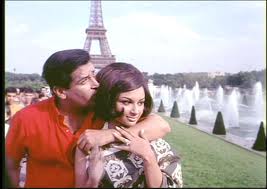
Look, it’s the Eiffel Tower in the background! WOW EXOTIC!

And there it is. One mystery closed. You can thank me later. This request was submitted by one of our favorite readers, Reena! Have an obscure Bollywood mystery you want solved? Send us a request and we’d love to investigate!

-Mrs. 55

P.S. OK, so I get it. The most interesting part of this post was the mention of Sharmila wearing a bikini on stage. The irony? After igniting a wave of change in film censorship and standards with her bold moves, when Sharmila herself joined the Central Board of Film Certification, she expressed concern with the idea of too many bikinis on screen. For more on cabaret songs in Bollywood, see our post on Lata gone wild!

Which Actor Did Hemant Kumar Sing For Best?

Hemant Kumar (1920-1989) was a legendary Hindi and Bengali film music composer and singer.

Hemant Kumar (1920-1989) was a legendary Hindi and Bengali film music composer and singer.

In classic Bollywood cinema, playback singers could make or break the career actor. Famous actor-singer pairings are legendary. The voice of the singer became the soul of the actor and once a perfect match was made, it was hard to separate them without upheaval. Who could imagine anything but the manly voice of Kishore Kumar with the face Rajesh Khanna? Or the playful sweetness of Mohammed Rafi with fun-loving Shammi Kapoor? When Mukesh passed away, Raj Kapoor (for whose career Mukesh lent his illustrious talent) famously burst into tears and announced, “I have lost my voice.”

But occasionally we find a rogue player in Hindi film music. Hemant Kumar stands out as a unique character, a difficult man to place in the rankings. For he was not merely a singer, but a legendary music director as well in both Hindi and Bengali cinema. Hemant Kumar was heavily influenced by Rabindrasangeet (like his contemporary S.D. Burman!), and first broke into the Bengali industry as a music director in 1947, the year of Indian independence. Hemant Kumar’s unmatched virtuosity led him to not only sing many of the hit songs of the 50s and 60s in Bombay himself, but he actually formed his own production company that made classics such as Bees Saal Baad (1962), Kohra (1964), and Khamoshi (1969). In the 70s he even dabbled as a film director with moderate success.

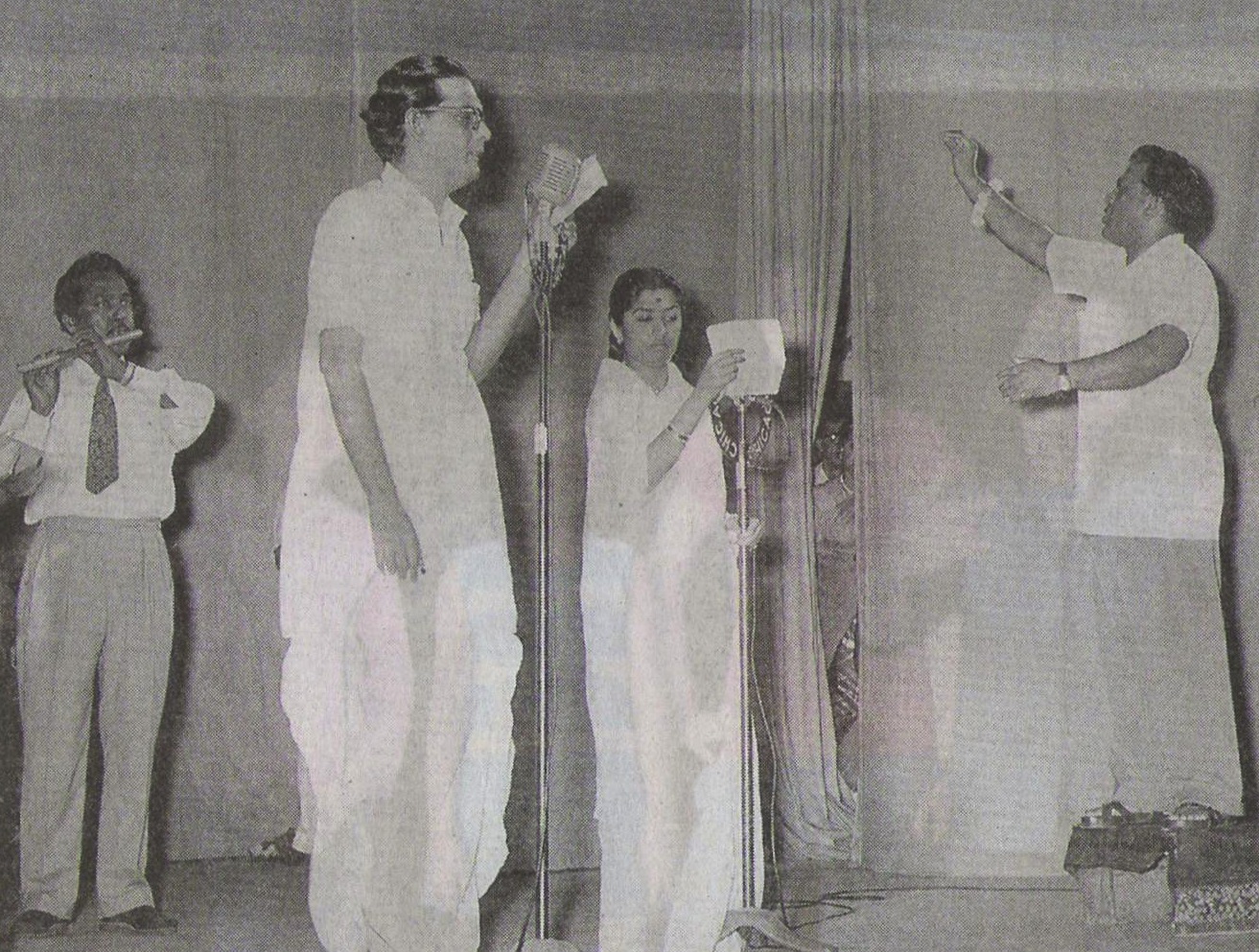
Hemant Kumar recording a song with Lata Mangeshkar

Hemant Kumar and Lata Mangeshkar during the studio recording of “Nain So Nain” from Janak Janak Paayal Baaje (1955).

But for me, it was as a singer that Hemant Kumar always shines and also the category in which history has given him the shaft. His voice was absolutely unlike any other in the industry–a deep and soulful richness that no one could touch. Interestingly, for a man whose talents were so diverse, Hemant Kumar never took to acting and singing his own songs on screen (à la Kishore Kumar). Instead, he sang for a myriad of rising and great actors across the decades–never branding himself with a single artist. Hemant Kumar remained a maverick, and for it, is often brushed aside.

So I now pose to you the question–which actor do YOU think Hemant Kumar sang for best? His voice graced the images of many men, but did it work for all of them? Your contestants are Guru Dutt, Dharmendra, Biswajeet, Dev Anand, and Shammi Kapoor. We present five songs below that illustrate some of Hemant Kumar’s finest collaborations with these actors and the cinematic chemistry that ensued.

1. Guru Dutt: Jaane Woh Kaise

The voice of tragedy, Hemant Kumar sings for Guru Dutt in this timeless lament from Pyaasa (1957). Guru Dutt, who often played the tragic poet, seems a natural choice for the resonant tones of Hemant Kumar in this song that has become iconic for all awkward dinner party songs.

2. Dharmendra: Tum Pukar Lo

Discussed in a previous post, Khamoshi (1968) is a heart-wrenching film about love, loss, and insanity. Although you don’t see much of Dharmendra’s face in this sequence, his subtle performance matches the song’s patient yearning with a hint of a Western flair. But to me, as an actor Dharmendra is somehow too shallow to be worthy of a Hemant Kumar solo. Maybe that’s just me?

3. Biswajeet: Yeh Nayan Dare Dare

A tender sequence from the film Kohra (1964), this song embodies the sweet side to Hemant’s voice that comes in the middle of a spooky film noir. I’m not going to pretend that Biswajeet is anything but a joke, but for me this pairing works–Hemant’s sweet vocals and Biswajeet’s confident, but appeasing motions to Waheeda are a pleasing combination.

4. Dev Anand: Yeh Raat Yeh Chaandni Phir Kahaan

God, I love it. I’ll be the first to tell you that no one sang better for Dev Anand than Mohammed Rafi, but this song is something else. I’ve discussed this sequence already in our earlier translation of the song, but let me just repeat that Hemant Kumar in a seductive mood blends beautifully with that longing gaze of Dev Anand’s. It’s just so exciting and rare, not to mention compliments Dev Anand’s semi-gravely voice in this film.

5. Shammi Kapoor: Aye Dil Ab Kahin Lejaa

This is another beautiful Hemant Kumar tragedy with a touch of mystery. Shammi is clearly giving it his all in this song, but somehow, I think it just doesn’t come together. Shammi Kapoor is too much of a hot mess for me to believe anything but Mohammed Rafi coming out of his mouth–the resonant voice of Hemant seems incongruous with those histrionics, despite its unarguable beauty.

And the winner is…?

I’m gonna have to say Guru Dutt–that song is just sublime on every level, but I’m open to discussion. Who do you think matched Hemant Kumar’s voice best? Let us know YOUR opinion in the comments!

-Mrs. 55

P.S. Wondering why we didn’t mention female playback singers here? It’s because the female side of things worked very differently, ie., it was Lata and Asha or bust. Every actress had them, and with the occasional Geeta Dutt or Shamshad interlude, there was no room for a “signature” playback artist per actress (although Lata will argue she “changed” her voice depending on the actress–more on this to come!)