Dekhi Zamane Ki Yaari Lyrics and Translation: Let’s Learn Urdu-Hindi

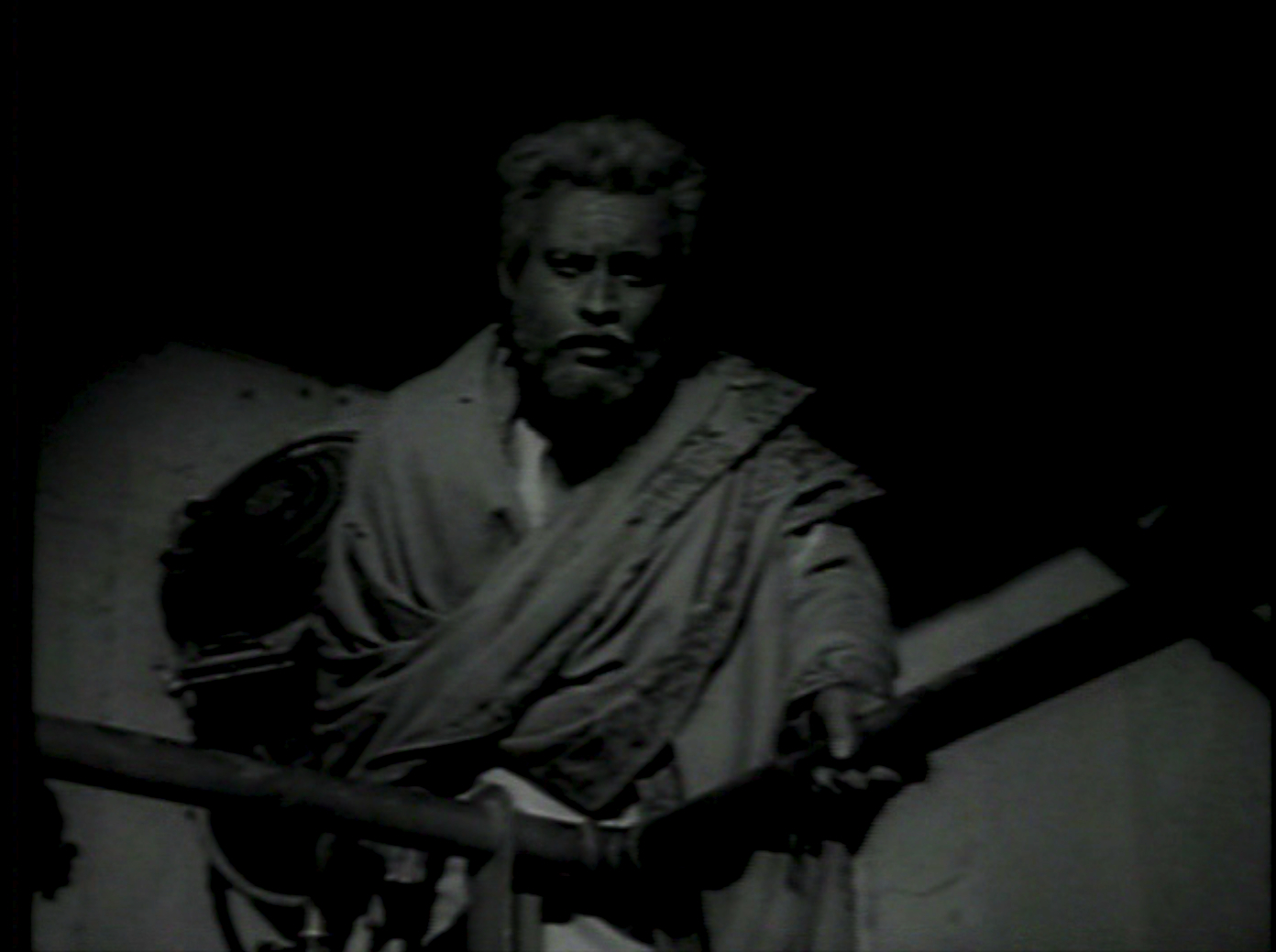
old man Guru Dutt Kaagaz Ke Phool 7

Guru Dutt reflects on his life as a once-great Bollywood director in the semi-autobiographical epic Kaagaz Ke Phool (1957).

The lyrics and English translation of Dekhi Zamane Ki Yaari are among the most beautiful you can find. The very soul of Guru Dutt can be found in the lyrics of Dekhi Zamaane Ki Yaari. The song is the heart of his masterpiece Kaagaz ke Phool (1957), and I contend contains the most passionate poetry you will ever find in a Bollywood song. Mohammed Rafi brings legendary Urdu poet Kaifi Azmi’s lyrics to an unheard of, feverish of climax that evokes a tragedy much deeper and more painful than any normal loss. Indeed, Kaagaz ke Phool tells a story of a different kind, and not one often explored: the slow destruction of an unfulfilled artist. I have already discussed some of the autobiographical parallels in this film in my translation of Waqt Ne Kiya, and will now present the actual story alongside the lyrics. It is one of the most haunting and powerful songs of that era.

Dekhi Zamaane ki Yaari reprises at different chapters in the film. The first starts in the opening as Guru Dutt plays an aged, dying film director who has returned to his old studio set before dawn. He sits up in the rafts and looks down on the empty world of show business below him. The song begins.

Dekhi Zamane Ki Yaari Lyrics and Translation:

Dekhi zamaane ki yaari
I have seen what goes for friendship in this world
Bichhade sabhee, bichhade sabhi baari baari
Everyone disperses,  one by one they all leave
Kya le ke mile.N ab duniya se? Aa.Nsuu ke siva kuch paas nahii.N
What will I take with me now to greet this world? Besides tears I have nothing
Ya phuul hi phuul the daaman mei.N, ya kaanto.N ki bhi aas nahii.N
I was either embraced by flowers, or other times did not even aspire to thorns
Matlab ki duniya hai saari
The whole world is selfish
Bichhade sabhee, bichhade sabhi baari baari
Everyone disperses,  one by one they all leave

The old man flashes back to younger days, when he was at the height of his career as a studio Bollywood director. The flashback transitions through a watery image of a lotus flower and a series of dutch-angled shots of eager fans. The high chorus interlude of the music inspires a sense of the divine, but when coupled with the teetering shots of the silent mob, also foreshadows something unnatural.

Guru Dutt smokes contemplatively on a balcony as fans await him below in Kaagaz Ke Phool (1957).

Waqt hai maherabaan, aarzuu hai javaan
During generous times, desires are young
Fikr kal ki karen, itni fursat kahaa.N
There is no leisure to worry about tomorrow
Daur yeh chaltaa rahe, rang uchaltaa rahe
Let this cycle continue, these colors keep splashing
Roop ko badalta rahe, jaam badalata rahe
Let the attractions keep changing, the intoxicants keep changing

Fans crowd Guru Dutt for signatures on empty pieces of paper that embody the theme of his film.

And here Guru Dutt masterfully transitions, for this is a story that is more than merely a tragic fall from societal grace. He shows us a character who has always felt alone–both when the world stood with him and when it abandoned him, searching for meaning in the dazzling lights of his own studio. It’s the kind of tragedy that doesn’t scream and doesn’t cause a colorful sensation. It’s one that softly and slowly erodes the soul–a desperate hunt for a human connection.

Guru Dutt comes home to a perpetually empty house in Kaagaz Ke Phool (1957)

Raat bhar mahamaan hai.N bahaare.N yahaa.N
Here, Spring is our guest the entire night
Raat gar dhal gayi, phir ye khushiyaa.N kahaa.N
But if the night ends, where do these joys go?
Pal bhar ki khushiyaa.N hai.N saari
All of these joys are only momentary
Badhane lagi beqaraari, badhane lagi beqaraari
And then restlessness begins to grow, restlessness begins to grow

Falling down a spiraling slope, he finds love at last and loses not only her, but his chance at happiness with his daughter, his friends, a wife, and his work. No producer will hire him, no actors will work with him. Everything these people once said and did for him was false. He returns years later to his old studio and sees Waheeda Rehman, the woman he loved and runs away in horror. Mohammed Rafi cries out with a violent passion in this segment–a ferocious plea to society and a desperate call to the suffering of his being. It is here that the meaning of “kaagaz ke phool” is explained–that dangerous unfeeling world of pretense. As the song comes to an end, Rafi gently sings the line, “Yeh khel hai kab se jaaari…” [“This game has been played so long…”] In his voice is the awful beauty of true resignation. You feel how tired this man is.

Utterly defeated, Guru Dutt looks back for a final time at the woman he loved and the world that once belonged to him in Kaagaz Ke Phool (1957).

Ud jaa! Ud jaa pyaase bha.Nvare! Ras na milega khaaro.N mei.N
Fly away thirsty bumblebee! You will not find nectar in these thorny shrubs
Kaaghaz ke phuul jahaa.N khilte hai.N, baiTh na un gulzaaro.N mei.N
Do not sit in those gardens where flowers of paper bloom
Naadan tamanna reti mei.N, ummiid ki kashti khaiti hai
In the sands of innocent desire, the boat of hope struggles to stay afloat
Ek haath se deti hai duniyaa, sau haatho.N se le leti hai
What the world gives with one hand, it takes away with one hundred
Yeh khel hai kab se jaari…
This game has been played for so long…
Bichhade sabhee, bichhade sabhi baari baari
Everyone disperses,  one by one they all pull away

Returning to the director’s chair, Guru Dutt bids farewell to society in Kaagaz Ke Phool (1957)

Then the flashback ends. He is an old man again hiding in the alcoves of his former studio. With careful decision, he sits down once more in the director’s chair in the center of the set.

Dekhi zamaane ki yaari
I have seen what goes for friendship in this world
Bichhade sabhee, bichhade sabhi baari baari
Everyone disperses,  one by one they all leave

Light floods the empty set. Dawn has broke and the crew enters to find an old unfamiliar man who has died sitting in the director’s seat.  The producer yells for his body to be removed so shooting can begin. And the cycle continues.

Kaagaz Ke Phool (1957) finishes over the blurred image of studio lights.

Glossary:

yaari: friendship; aa.Nsuu: tears; matlab: selfish (a homonym translates as “meaning”); duniyaa: society, world; waqt: time; aarzuu: desire; fikr: worry; fursat: leisure; daur: cycle, generation; rang: colour; uchalnaa: to splash, to scatter; jaam: intoxicant; mahamaan: guest; beqaraari: restlessness; bha.Nwara: bumblebee; ras: nectar; khaar: thorny shrub; kaaghaz: paper; gulzaar: garden; naadaan: innocent; reti: sand; ummiid: hope; kashti: boat; khel: game

-Mrs. 55
Two or Three Things I Know about Mira Nair: Thoughts from a Former Intern

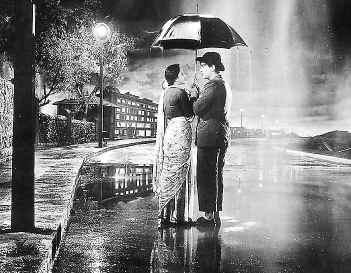
Nargis and Raj Kapoor in one of the most iconic shots of classic Indian cinema from Shree 420 (1955)

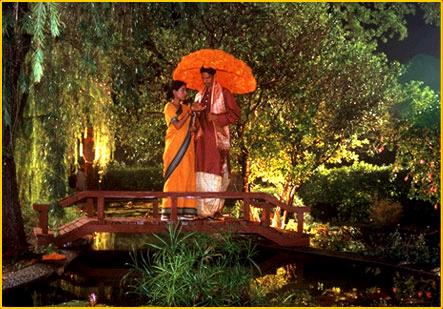
A scene from Mira Nair’s Monsoon Wedding (2001) inspired by Raj Kapoor’s classic

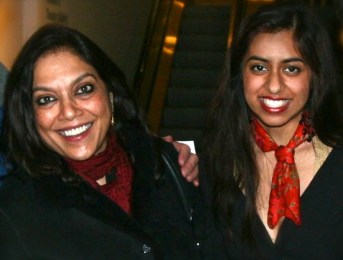
After the summer of my sophomore year, I was fortunate enough to intern with my favorite contemporary director Mira Nair. Both of us had studied film production at Harvard University and incidentally under the same professor! I first met Mira at his film screening at the Museum of Modern Art in New York City when I spotted her in the audience. My heart was beating so fast, I could hardly sit still through the screening. After the show, I gave her my impromptu elevator speech and joined the crew at Mirabai Films that summer!

Intern Mira Nair

Mira Nair and I at the MoMA my sophomore year. Note the glazed look in my eyes. Best day ever!

I was twelve years old when I saw Monsoon Wedding (2001) and have yet to find a movie from my generation that I love more. Mira’s other films include Vanity Fair, Salaam Bombay, The Namesake, Kama Sutra, and Amelia, but what does any of this have to do with old Hindi cinema? I want to talk about a side to her movies that you may not have been familiar with—that is, the impact of classic Bollywood on her work.

Perhaps you can recall that scene from Monsoon Wedding in which the wedding planner marries the housemaid beneath an umbrella. Look familiar? It should! Mira was directly inspired by Raj Kapoor’s famous song “Pyaar Hua Iqrar Hua” in directing this scene. Like Nargis and Raj Kapoor walking together on a rainy night, huddled together beneath an umbrella, Mira’s characters strike the same pose to celebrate their romance at the height of the Indian monsoons.

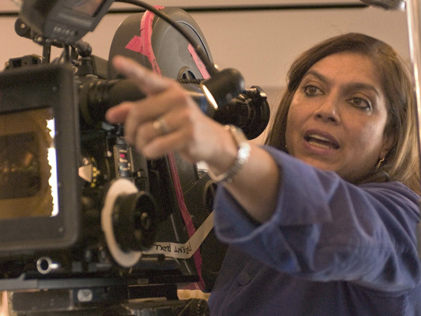
On-set and behind-the-camera with Hollywood director, Mira Nair.

In the front lobby of Mirabai Films hangs an original hand-painted movie poster of Aurat (1940), Mehboob Khan’s little-known precursor to the later smash-hit Mother India (1959). Its relative obscurity (and the eagerness to explain) brings a pride that can only be known to a fellow old Bollywood fanatic. By her desk is a beautiful and fascinating work of photography taken of the interior of R.K. Studios. Mira once explained how the studio in her photograph seems so unassuming and bland, but there, in an inconspicuous back wall besides an empty soda bottle hangs a small, telling picture of the greatest showman of India—Raj Kapoor himself. Despite his wealth and glamour, he and his colleagues maintained an inspiring sense of humility throughout his career that inspired hers.

If you’re looking for more celebrity interest, there is a great scene in her film, Vanity Fair (2004), in which the heroine (played fearlessly by Reese Witherspoon) makes an ill-received attempt to blend in among a high-class dinner party. Guess what? The scene was inspired by none other that the classic song Jaane Woh Kaise from Guru Dutt’s classic Pyaasa! In fact, Mira love it so much and wanted to make sure she captured Dutt’s spirit so precisely, that she got the whole cast together and watched Pyaasa for a movie night before the shoot. You heard me, people. If you have yet to watch Pyaasa yourself and are still looking for reasons to make the commitment, try this: Reese Witherspoon has seen it and you haven’t. Enough said.

Guru Dutt makes the room incredibly uncomfortable in Pyaasa (1957), an inspiration for Reese Witherspoon’s future character in Vanity Fair (2004).

And did you know Mira was very close friends with bold auteur Satyajit Ray? Mira’s favorite of his films include The Apu Trilogy and Days and Night in the Forest (1970), the latter of which was actually screened at the Harvard Film Archive last year with Sharmila Tagore in person! (I obviously had front row seats, almost underwent cardiac arrest upon seeing Sharmila in person, and begged for an autograph that is now framed on my desk. But that’s neither here nor there.) In fact, after growing up on these films, Mira came to respect Sharmila so much as an actress, and eagerly cast her in one of her first indie films called Mississippi Masala (1991)!

There are a million other ways old Bollywood films have influenced her work, and I have highlighted only a few that I know from working with her personally. Watch her films and let us know which others you can spot! Until then, put Pyaasa on your early Christmas list.

-Mrs. 55

Waqt Ne Kiya Lyrics and Translation: Let’s Learn Urdu-Hindi

For our next song, we discuss the lyrics and English translation of Waqt Ne Kiya, an evergreen song by Geeta Dutt from Kaaghaz Ke Phool (1957). Although nearly everyone has grown up watching movies, few people have an understanding of what the production of a film entails. I don’t mean just the technical aspects of constructing a shot—I refer to that way of life, to the tinsel-lined world of glamour and infamy, of triumph and ruin, and of the battle for self-respect that challenges a director. Guru Dutt’s final film, Kaaghaz Ke Phool (1957), is an intimate and haunting tragedy that shows the audience just that—a glimpse into the vanished studio era of 1950s Bollywood.

Waheeda Rehman pays a price for her fame in Kaaghaz Ke Phool (1957)

Following in the mesmerizing footsteps of Sunset Boulevard (1950) and The Blue Angel (Der blaue Engel, 1930), Kaaghaz Ke Phool reveals another side to the world of show business through the rise and spiraling downfall of a great director.  It examines the price of the soul of an artist, and is a harsh critique of contemporary values (even including the social condemnation of divorce!). In an ironic twist, the film was a flop at the box office when first released, leading to events in Guru Dutt’s personal life that mirrored the story of his own film. Eerily autobiographical, the film has now achieved a cult status in the history of Indian cinema.

The famous song “Waqt Ne Kiya” comes at a time in the film when the hero and the love of his life both come to an unspoken understanding that they must let each other go. As for the picturization, it is a cinematographer’s dream. Look at the lighting in these shots—at the rich blacks of the shadows, and how the dust from the overhead spotlights is captured floating ethereally in the air. The camera dollies in slowly to each character as they stare at one another and at their unfulfilled dreams enacting before them in the spotlight. There is actually very little movement by the actors—the real player is the camera itself, gracefully gliding through the empty set like a spectre of their own shattered hopes.

Enjoy the lyrics and full English translation of the masterpiece “Waqt Ne Kiya” below:

Waqt Ne Kiya Lyrics and Translation:

Waqt ne kiya kya hasee.N sitam
What a beautiful tragedy time has wrought
Tum rahe na tum
You are no longer you
Hum rahe na ham
I am no longer me
 
Beqaraar dil is tarha mile
Our restless hearts met in such a way
Jis tarha kabhi hum judaa na the
As though we were never apart
Tum bhi kho gaye
You became lost
Hum bhi kho gaye
I was lost too
Ek raah par chalke do qadam
As we walked a few footsteps on the same path
Waqt ne kiya…
 
Jaaye.Nge kahaa.N sujhta nahii.N
We cannot see where we are going
Chal paDe magar raastaa nahii.N
We set forward despite there being no path
Kya talaash hai
For what do we search?
Kuch pataa nahii.N
I do not know
Bun rahe hai.N dil khaab dam ba-dam
With every breath, my heart grows another dream
Waqt ne kiya…

Glossary:

Waqt= time, sitam= tragedy, torture; beqaraar= restless; tarha=manner judaa= apart; qadam= footsteps, talaash= search; dam ba-dam= with every breath

For anyone interested in gossip, the song is sung by Geeta Dutt—wife of none other than director and actor Guru Dutt himself. A major star on her own right, Geeta shot to fame at the age of sixteen when she wowed audiences with her uniquely rich and emotional voice (becoming S.D. Burman’s favorite!) But she too later suffered a personal tragedy from the well-known affair between her husband and his favorite actress, Waheeda Rehman—who actually lip-syncs “Waqt Ne Kiya” and plays the role of “the other woman” in the film! As I said, talk about life mimicking art. For more on Guru Dutt’s films, check out our earlier post on Pyaasa!

-Mrs. 55

Guru Dutt and the Struggle to Break Free of Convention

Guru Dutt’s poetic magnum opus, Pyaasa (1957), is often considered among the greatest cinematic achievements of all time, easily among the top 30 greatest Bollywood films ever made. You’re going to be hard-pressed to find someone more defensive of the genius that is Guru Dutt than yours truly. Pyaasa is an evocative film that explores one man’s search for humanism in the cold cynicism of post-independence Indian society. People often contrast Guru Dutt with his contemporary, famed actor and director Raj Kapoor, who shot hits like Shree 420 (1955)–a song-laden, fun rags-to-riches story with a clean happy ending. In contrast, the melancholic, disillusioned tone of Guru Dutt’s poetic films usually leave me feeling like my heart has been slowly torn out, but so beautifully done, I don’t even want it back anymore.

But I’m going to play devil’s advocate here and ask those who know and love both films, does it not seem that Pyaasa and Shree 420 both actually stemmed from the same reaction to the ideals of Nehru’s India under the “mandate of modernization?” Perhaps the creed of the heroic tramp of Shree 420 that spoke to the working masses is not so far from that of the starving poet of Pyaasa that stirred the minds of the intelligentsia. When Raj Kapoor and Guru Dutt, or any contemporary film-maker for that matter, sought to fill a void in their country’s cinema, despite such seemingly different approaches, they represented the emotions and wants of the same people. When you look closely, in fact, Pyaasa falls into many traps of the very conventions Guru Dutt wanted to break.

According to Raj Khosla, Guru Dutt believed the soul of Pyaasa was contained in the lines of hero Vijay’s song of lament: “Jinhe naaz hai Hind par, woh kahaan hain?” (“Where are those who are proud of this India?”), and Prime Minister Nehru himself is rumored to have been quite upset upon hearing this line, a direct invocation to the government for change.

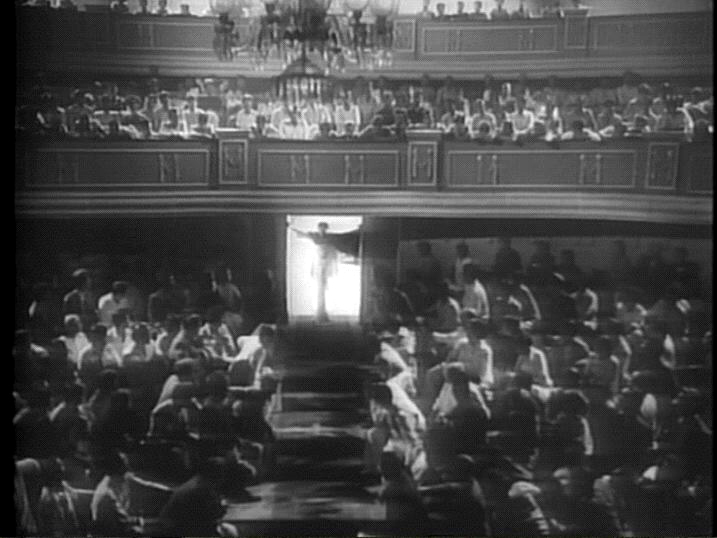
Appalled and disillusioned, Guru Dutt’s hero stands Christ-like in the doorway of a ceremony to honor his own death.

But if that’s the case, what the heck is the chintzy “Hum aapki aankhon mein” dream sequence in which hero Vijay and Meena sing and dance in a heavenly courtyard of swirling mist and starry skies doing in the film? Perhaps it is not entirely surprising to learn that the song was not originally intended to be in the film–it was only added in later to appease the distributors who believed it to be unmarketable without at least one glitzy, expensive Bollywood song. The other songs in his film mesh seamlessly into the narrative, as if they are not songs at all, but mere continuations of dialogue–a novel technique pioneered by Dutt.

A greater travesty is, did you know the film was actually supposed to end with the high-angle crane shot of Meena all alone in the grand room with papers flying everywhere after Vijay leaves? To me, the scattered pages are a symbol of Vijay’s poetry whose role as a commodity in the film is in turn a symbolic attack of the loss of romanticism in the realities of the industrialization process. It’s as if to say, society must also honor the man who breathes life into the poems, not merely the price of the written words.

But as Dutt’s assistant recalls, Guru Dutt, “changed the ending because of how the distributors reacted. They felt the ending was too heavy. The financiers requested, ‘Why don’t you have a happy ending?’” Now Pyaasa finishes with Vijay finding spiritual fulfillment with the companionship of Gulabo and the two making their way into the hopeful sunset. I mean, isn’t this the kind of “all’s well that ends well” of conventional cinema he wanted to fight against?

So ultimately, the very focus on wealth and profitability that Guru Dutt chastises in his film is actually the force that proved overpowering in its production. Though Guru Dutt himself wanted otherwise, the distributors, believing to represent the mass market, were able to convince Dutt to change his plans and take fewer risks. He becomes just another flaw in his own criticism against Nehru’s India, greatly compromising the effectiveness of Pyaasa’s commentary. Essentially, the “solution” presented in a film like Shree 420 to try to work the system as best as possible, is all that Pyaasa shows is possible–try to be “purposeful” (as Guru Dutt wanted) within the limitations of the system. Recalling Vijay’s own lines, “Isko hi jeena kehte hain, to yuhiin jee lenge,” (“If this is life, then this is how we’ll live,”) Pyaasa often invites a sentiment to conform to the status quo rather than fight or question it.

Or am I reading too much into this?

–Mrs. 55